
Learn / Finding your way
How it works
Cause and effect, with real numbers.
- First look
- How it works
- The physics, still to be written
- The frontier, still to be written
How it works
Cause and effect, with real numbers
Astronomers still talk about the sky as the ancients saw it: a great hollow ball with the stars fixed to the inside, turning round us once a day. Nobody believes in the ball any more, but it is a very handy way of saying where things are. It is called the celestial sphere.
| On the Earth | In the sky |
|---|---|
| North and south poles | The two celestial poles, straight above them |
| The equator | The celestial equator, a circle half way between the poles |
| Straight up, wherever you stand | The zenith |
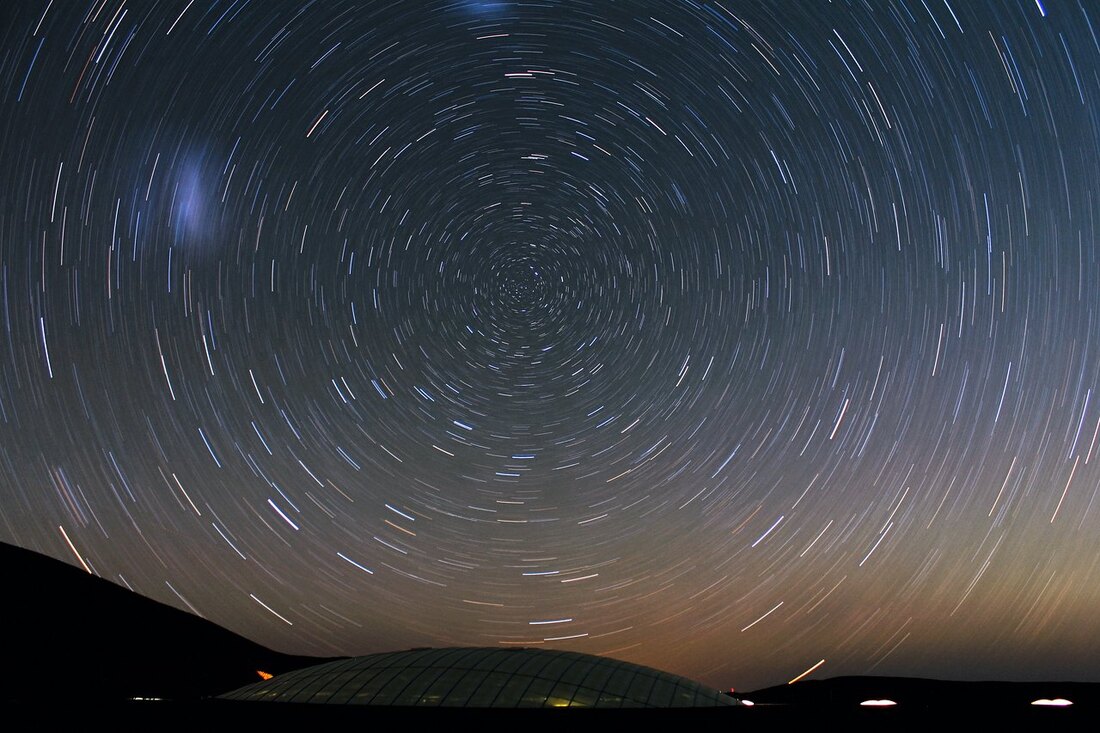
Reading the photograph. In half an hour the Earth makes one forty-eighth of a turn, which is seven and a half degrees (worked out here: 360 degrees divided by 48). So every streak in the picture is a seven and a half degree piece of a circle. The ones near the pole are short because their circles are small. The ones far from it are long.
How fast you are going. The Earth is 40,075 kilometres round at the equator, and it turns once in just under 24 hours. Someone standing on the equator is carried east at about 1,670 kilometres an hour. Further from the equator the circle you travel is smaller. At the latitude of Edinburgh, 56 degrees north, it comes to about 940 kilometres an hour. Both figures were worked out here. You feel nothing because the speed is steady and everything round you shares it.
The pole star. Polaris is not exactly at the pole. It is about two thirds of a degree away, a little more than the width of the full Moon, so it does go round in a very small circle of its own. That it is there at all is luck. The Earth’s axis slowly wobbles like a spinning top, taking about 26,000 years to go round once, and as it does the pole of the sky drifts among the stars. A few thousand years ago there was no bright star near it, and a few thousand years from now there will not be one again.
The southern pole has no bright star near it now, as the photograph shows.
What you see from where.
| Where you stand | Where the pole of the sky is | What the stars do |
|---|---|---|
| The North Pole | Straight overhead | They circle level with the horizon. None rises and none sets. |
| Edinburgh, 56 degrees north | 56 degrees up, in the north | Those within 56 degrees of the pole never set. The rest rise and set at a slant. |
| Cairo, 30 degrees north | 30 degrees up | Fewer never set, and more of the southern sky comes into view. |
| The equator | On the horizon | Every star rises straight up and sets straight down. You can see the whole sky over a year. |
The rule is simple. The height of the pole above your horizon, in degrees, equals your latitude. A navigator who measured the height of Polaris had the ship’s latitude to within a degree.
Two kinds of day. Measured against the stars, the Earth turns once in 23 hours, 56 minutes and 4 seconds. That is called the sidereal day. But in that time the Earth has also moved on round its orbit, by about one degree. The Sun is no longer in quite the same direction, and the Earth has to turn for nearly four minutes more to bring it back to the same place in the sky. That makes the 24 hours on the clock.
Four minutes a day is two hours a month and 24 hours a year. So after exactly one year the stars are back where they began.
Where this comes from
- NASA, From Stargazers to Starships: the celestial sphere
- ESO, Stars circle over the Residencia at Cerro Paranal
- Sky & Telescope, Meet Kochab, a guardian of the pole
- Polaris: the mathematics of navigation and the shape of the Earth (arXiv 2206.07491)
- NASA, Earth fact sheet
The words are written for this site. Sums in the text are worked from the figures in these sources.