
Learn / Stars
How it works
Cause and effect, with real numbers.
- First look
- How it works
- The physics, still to be written
- The frontier, still to be written
How it works
Cause and effect, with real numbers
An element is fixed by one number: how many protons are in the middle of its atoms. Hydrogen has 1, helium 2, carbon 6, oxygen 8, iron 26, gold 79. To make a new element you have to change that number, and that takes the heat and pressure of a star, or something more violent.
NASA publishes a chart, built on the work of the astronomer Jennifer Johnson, that sorts every element by where most of it was made. There are six places in nature.
| Where | What it made | Some of the elements |
|---|---|---|
| The first few minutes of the universe | The two lightest elements | Hydrogen, helium |
| Fast particles hitting atoms in space | Two rare, light elements | Beryllium, boron |
| Small stars at the end of their lives | Light elements, and some heavy ones built up slowly | Carbon, nitrogen, strontium, barium, lead |
| Heavy stars, and the supernovae that end them | Most of the elements from oxygen to rubidium | Oxygen, neon, sodium, magnesium, silicon |
| White dwarfs that blow up | The metals round iron | Titanium, chromium, manganese, iron, nickel |
| Neutron stars crashing together | Most of the heaviest elements | Silver, iodine, platinum, gold, uranium |
Many elements come from more than one of these. The chart shows sulphur and calcium as made partly by heavy stars and partly by exploding white dwarfs, and tin as made partly by small stars and partly by neutron stars. A few elements, such as radon and radium, are made when heavier atoms break down. Everything heavier than plutonium has only ever been made by people.
Inside a heavy star. A star more than about eight times as heavy as the Sun burns one fuel after another. Each needs a hotter core than the one before, and each runs out sooner.
| Fuel | What it mostly makes | Temperature of the core | How long it lasts |
|---|---|---|---|
| Hydrogen | Helium | 30 million kelvins | 10 million years |
| Helium | Carbon and oxygen | 200 million kelvins | 1 million years |
| Carbon | Neon and magnesium | 800 million kelvins | 100,000 years |
| Neon | Oxygen and magnesium | 1.5 billion kelvins | About a month |
| Oxygen | Silicon and sulphur | 2 billion kelvins | 2 years |
| Silicon | Iron | 3.3 billion kelvins | A few days |
These figures are NASA’s, for a heavy star. The Sun’s core is at about 15 million kelvins, so the last step happens at more than 200 times that temperature (worked out here: 3.3 billion divided by 15 million is 220).
Why it stops at iron. Joining small nuclei together gives out energy, and that energy is what holds a star up. Iron has the most tightly bound nucleus of all, so fusing iron gives nothing back. Once the core is iron the star has no fuel left there, and the collapse described in the lesson on supernovae follows.
Past iron. Heavier elements are built another way. A nucleus soaks up loose neutrons one at a time, and some of those neutrons then turn into protons, which moves the atom up to the next element. In ageing stars this happens slowly, over thousands of years. It builds elements such as strontium, barium and lead.
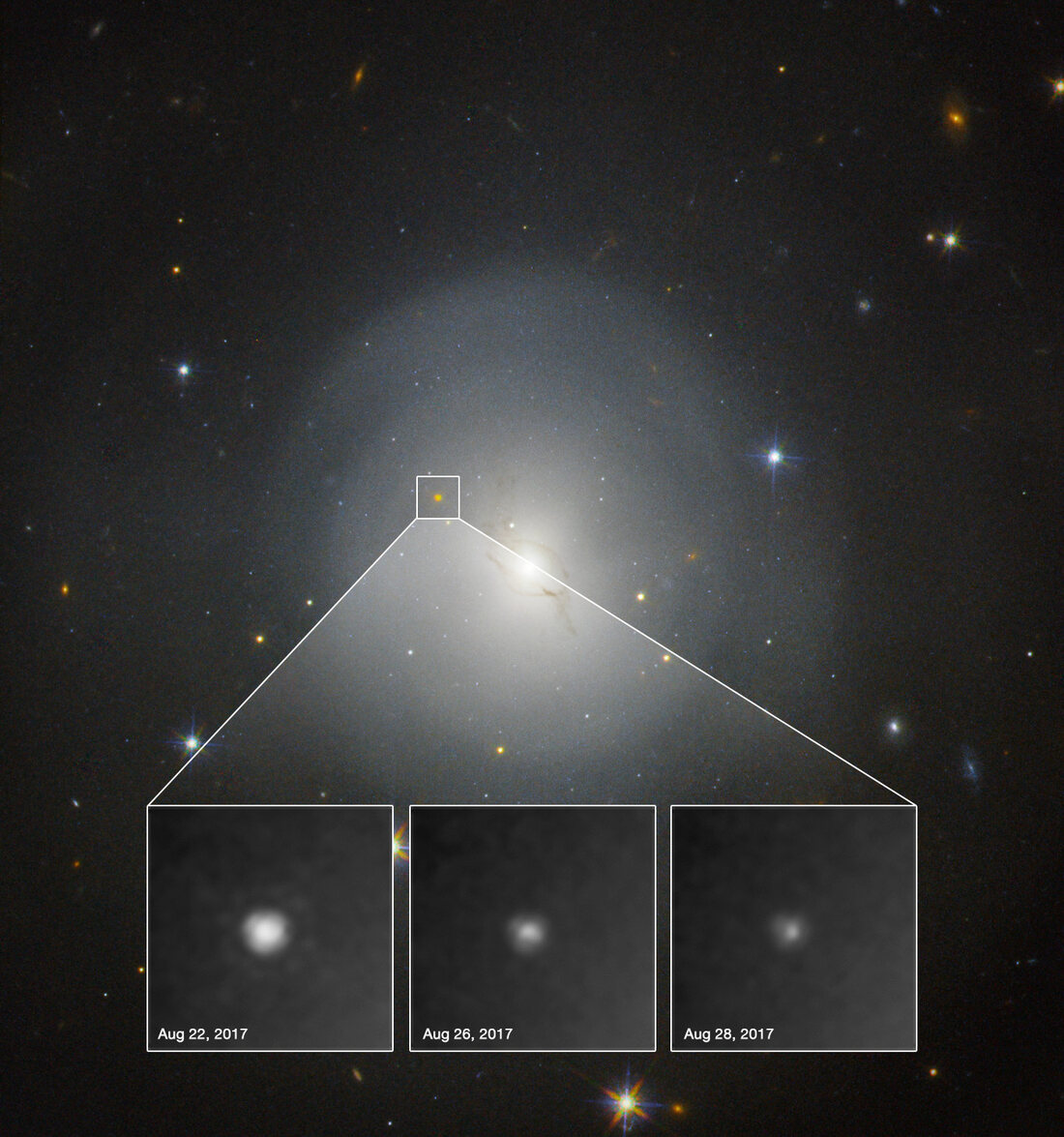
The crash of August 2017. When two neutron stars meet there are so many loose neutrons that a nucleus can soak up a great many in seconds. That fast route is the only way to make the heaviest elements. For decades nobody knew where it happened. On 17 August 2017 the LIGO and Virgo detectors felt the gravitational waves from two neutron stars spiralling together. About two seconds later, satellites caught a burst of gamma rays from the same part of the sky. Within 12 hours telescopes had found a new point of light in the galaxy NGC 4993, and about 70 observatories went on to watch it.
The wreckage was flying outwards at about a fifth of the speed of light. Over the next few days its colour went from very blue to very red, and its light carried signs of two heavy elements, caesium and tellurium. Both were close to what theory had predicted for a cloud of newly made heavy elements. That one event is the best evidence so far that crashes between neutron stars make much of the universe’s gold and platinum. It is still only one event, and astronomers are not yet sure whether such crashes can account for all of it.
What is not settled. The chart is a best estimate. The shares for many elements carry real doubt, and the heavy elements most of all. What is certain is the outline: hydrogen and helium from the beginning, and nearly everything else from stars.
Where this comes from
- NASA's Goddard Space Flight Center, Origins of the elements (chart, with data from Jennifer Johnson, Ohio State University)
- NASA Imagine the Universe, The life cycles of large stars
- Particle Data Group, review of Big Bang nucleosynthesis (2024)
- ESO, Telescopes observe first light from a gravitational wave source
- ESA/Hubble, Hubble observes first kilonova
The words are written for this site. Sums in the text are worked from the figures in these sources.