
Learn / The Sun
How it works
Cause and effect, with real numbers.
- First look
- How it works
- The physics, still to be written
- The frontier, still to be written
How it works
Cause and effect, with real numbers
By mass the Sun is about 73% hydrogen and 25% helium, with every other element making up under 2%. All of it is plasma: gas hot enough for its atoms to have lost electrons, so that it carries electric current and is pushed about by magnetism.
Working outward from the centre:
The core fills the inner quarter of the radius. At its centre the temperature is about 15.7 million K and the gas is squeezed to about 150 times the density of water. This is the only place where fusion happens. Every second about 600 million tonnes of hydrogen become helium, and about 4 million tonnes of mass leave as energy.
The radiative zone reaches out to about 70% of the radius. Energy crosses it as light, but the gas is so dense that the light is absorbed and sent off in a new direction almost at once, again and again. The trip takes many thousands of years.
The convective zone is the outer 30%. Here the gas carries the heat itself, rising hot, cooling at the top and sinking again, like a pan on the boil. The tops of the rising columns are the granules that pattern the surface, each about the size of France or larger.
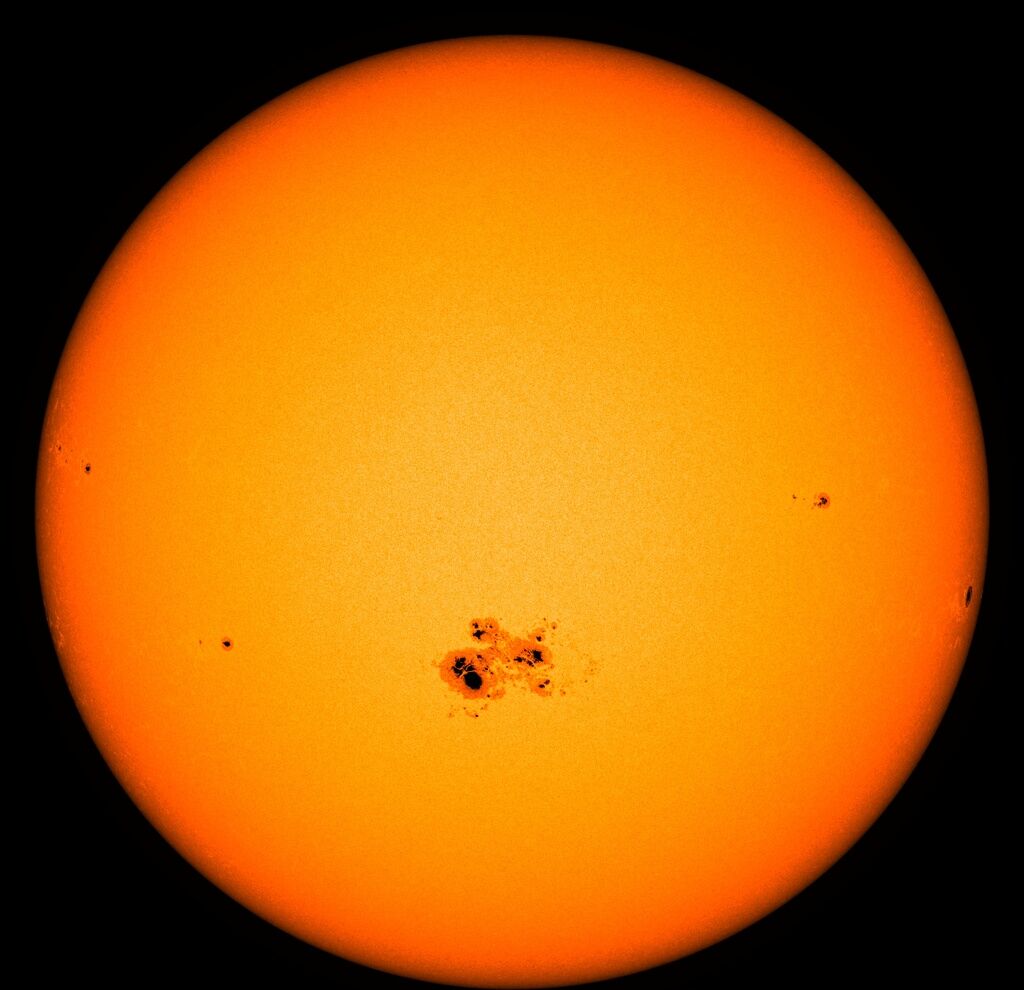
The photosphere is the layer we see. It is a few hundred kilometres deep and its temperature is 5,772 K. Sunspots are patches of it held about 1,700 degrees cooler by strong magnetism.
The chromosphere and corona lie above. The corona is extremely thin but has a temperature of more than a million kelvin, far hotter than the surface below it. Its outer edge has no end. It streams away past the planets as the solar wind.
The whole output is 3.83 × 10²⁶ watts. The Earth catches less than a billionth of it.
The Sun does not turn as a solid body. Its equator goes round in about 25 days and the regions near the poles take about 36.
It is about 4.6 billion years old and roughly halfway through its supply of hydrogen in the core.
Where this comes from
- NASA NSSDC Sun fact sheet
- NASA, Sun facts
- NOAA Space Weather Prediction Center, Sunspots and the solar cycle
- NASA/JPL astrodynamic parameters
The words are written for this site. Sums in the text are worked from the figures in these sources.