
Learn / Gravity and orbits
How it works
Cause and effect, with real numbers.
- First look
- How it works
- The physics
- The frontier, still to be written
How it works
Cause and effect, with real numbers
Newton’s rule. In 1687 Isaac Newton published one rule that covered falling apples and orbiting moons alike. Every pair of objects pulls on each other with a force that depends on two things.
- Mass. Double the mass of either object and the pull doubles.
- Distance. Move them twice as far apart and the pull falls to a quarter. Three times as far, a ninth. This is an inverse-square law, the same pattern by which light fades.
Distance is measured between centres. Standing on the ground you are about 6,400 km from the centre of the Earth, which is why going up a mountain, or even to a space station, changes the pull so little.
Mass and weight. Mass is how much matter you are made of, and it is the same everywhere. Weight is how hard gravity pulls on that mass where you happen to be.
| Standing on | Your weight compared with on Earth |
|---|---|
| The Moon | About a sixth |
| Mars | A little over a third |
| Jupiter’s cloud tops | About two and a half times |
| The Sun’s visible surface | About 28 times |
Everything falls together. Because a heavier object is pulled harder but is also harder to get moving, the two effects cancel, and all things fall at the same rate where there is no air. In 1971 the Apollo 15 astronaut David Scott dropped a hammer and a feather on the Moon. They landed at the same moment.
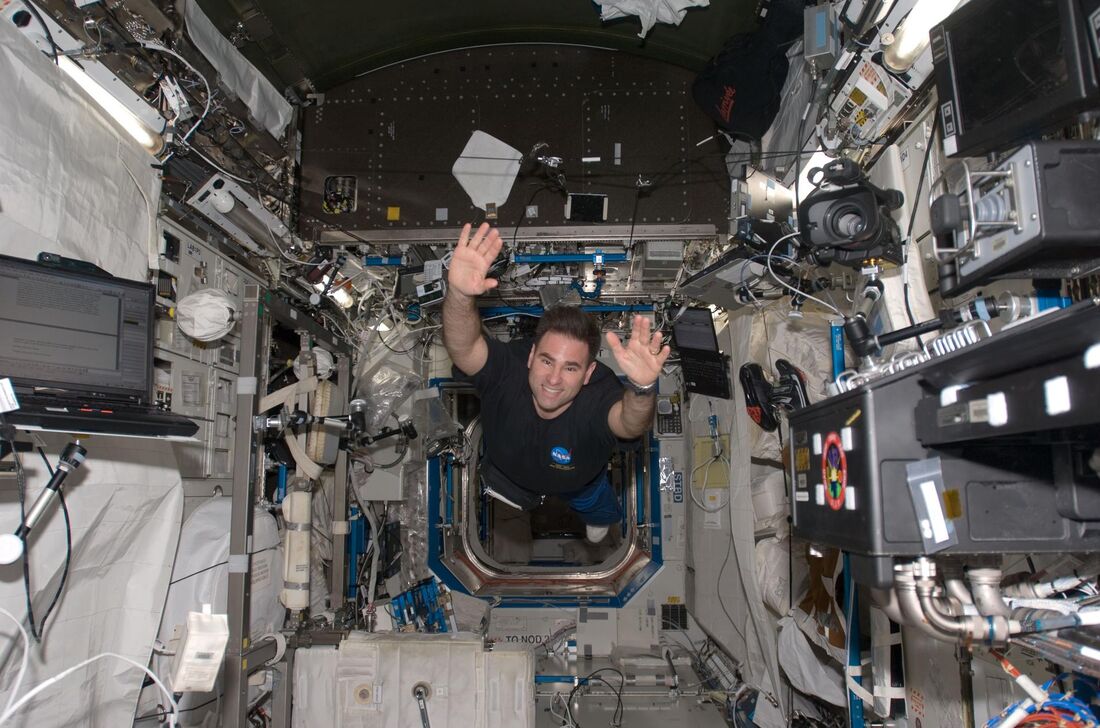
Why astronauts float. The International Space Station flies about 400 km up, where gravity is still about nine tenths as strong as on the ground. Nothing there is weightless in the sense of being beyond gravity. The station and everyone in it are in free fall: falling round the Earth, and missing it, all the time. With nothing pushing up on their feet, they feel no weight. The lesson on orbits explains the falling and missing.
Both bodies move. The Earth pulls on the Moon, and the Moon pulls back just as hard. So the Earth does not sit still while the Moon circles it. Both go round a balance point between them, like two skaters holding hands, with the heavier one making the smaller circle. For the Earth and Moon that point lies inside the Earth, about 4,700 km from its centre. For the Sun and Jupiter it lies just outside the Sun’s surface. That small wobble of a star is one of the ways planets round other stars are found.
Einstein’s deeper answer. Newton’s rule says how strong gravity is. It does not say what gravity is, and Newton admitted he did not know. In 1915 Albert Einstein gave a different picture: mass bends the space and time around it, and other things simply follow the straightest path they can through that bent space. For everyday purposes the two pictures give the same answers. They differ where gravity is strong or the measurement is very fine.
| Test | What was found |
|---|---|
| Mercury’s orbit | It turns slowly in a way Newton’s rule could not fully explain. Einstein’s accounts for it exactly |
| Starlight passing the Sun | Measured during the eclipse of 1919: the light bends by the amount Einstein predicted |
| Clocks | Clocks run slightly faster high up than on the ground. Satellite navigation has to correct for it or it would drift by kilometres a day |
| Gravitational waves | Ripples in space from two black holes colliding, first detected in 2015 |
Einstein’s picture has passed every test so far. It does not fit together with the physics of the very small, and nobody yet knows how to join the two.
Where this comes from
- NASA, Basics of Space Flight: gravity and mechanics
- NASA, Moon facts
- Nobel Prize in Physics 2017 (gravitational waves observed)
The words are written for this site. Sums in the text are worked from the figures in these sources.