
Learn / Stars
How it works
Cause and effect, with real numbers.
- First look
- How it works
- The physics, still to be written
- The frontier, still to be written
How it works
Cause and effect, with real numbers
A balance. A star is a contest between two things. Gravity pulls all of its gas towards the middle. The heat of the gas pushes back out. Where the two are equal the star holds its shape, and it can stay that way for billions of years.
The squeeze makes the centre hot and dense. In the Sun’s core it is nearly 16 million degrees. At that temperature the nuclei of hydrogen atoms hit each other hard enough to join into helium, and each joining lets out a little energy. This is nuclear fusion. The Sun turns about 600 million tonnes of hydrogen into helium every second, and has enough to go on for billions of years yet.
The lower limit. Fusion needs that heat, and the heat needs weight. A ball of gas with less than about 8 per cent of the Sun’s mass, roughly 80 times the mass of Jupiter, never gets hot enough in the middle to keep hydrogen burning. It glows dull red from the heat of its own shrinking and slowly cools. These are brown dwarfs: too heavy to be planets and too light to be stars.
The upper limit. The heaviest stars known have about 200 times the mass of the Sun. Much beyond that, a star shines so fiercely that its own light blows its outer layers away.
Mass decides. Once you know how much gas a star began with, you know most of the rest.
| Mass (Sun = 1) | What it is like | Light given out (Sun = 1) | Time spent burning hydrogen |
|---|---|---|---|
| 0.1 | A red dwarf, cool and faint | About a thousandth | Trillions of years |
| 1 | A star like the Sun | 1 | About 10 billion years |
| 10 | A blue-white giant | Several thousand | About 30 million years |
The last column is the surprise. A heavy star has more fuel, but it burns it far faster, so it dies young. A red dwarf sips its fuel so slowly that none has ever yet run out: the universe, at 13.8 billion years, is not old enough. The figures for red dwarfs come from computer models of stars, because nobody can watch one grow old.
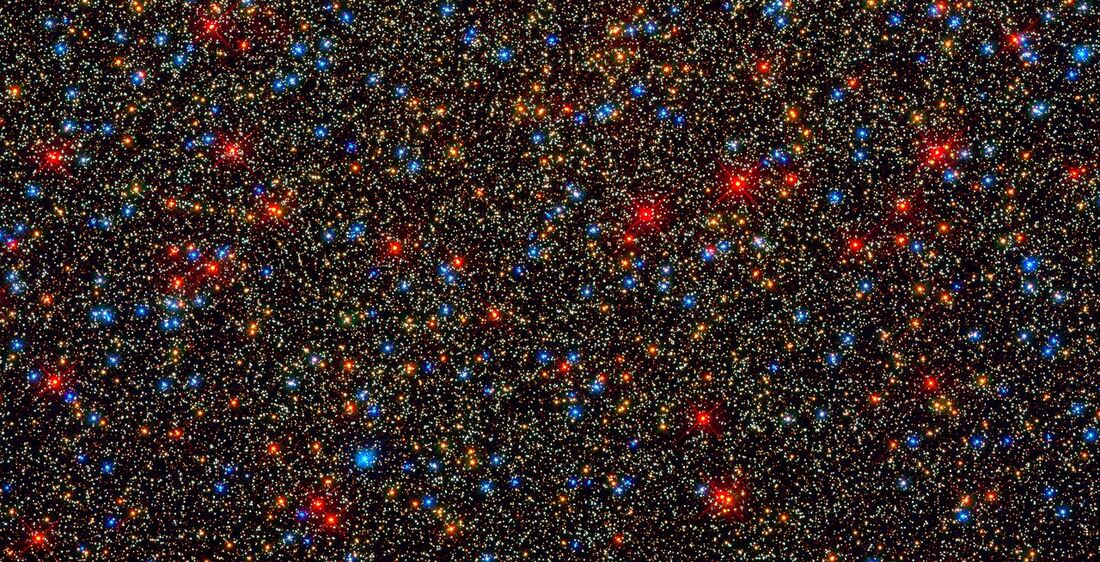
What is common. Small stars are common and large ones are rare. About three in every four stars near the Sun are red dwarfs, and not one of them can be seen without a telescope. The bright stars that make up the constellations are the unusual ones: they are either close or very powerful.
Where this comes from
The words are written for this site. Sums in the text are worked from the figures in these sources.