
Learn / White dwarfs, neutron stars and black holes
How it works
Cause and effect, with real numbers.
- First look
- How it works
- The physics
- The frontier, still to be written
Try it
Choose a mass and see how small it would have to be crushed.
How it works
Cause and effect, with real numbers
A black hole is not a thing made of some special material. It is a region of space where gravity has become so strong that every path leads inwards. All it takes is enough mass in a small enough space.
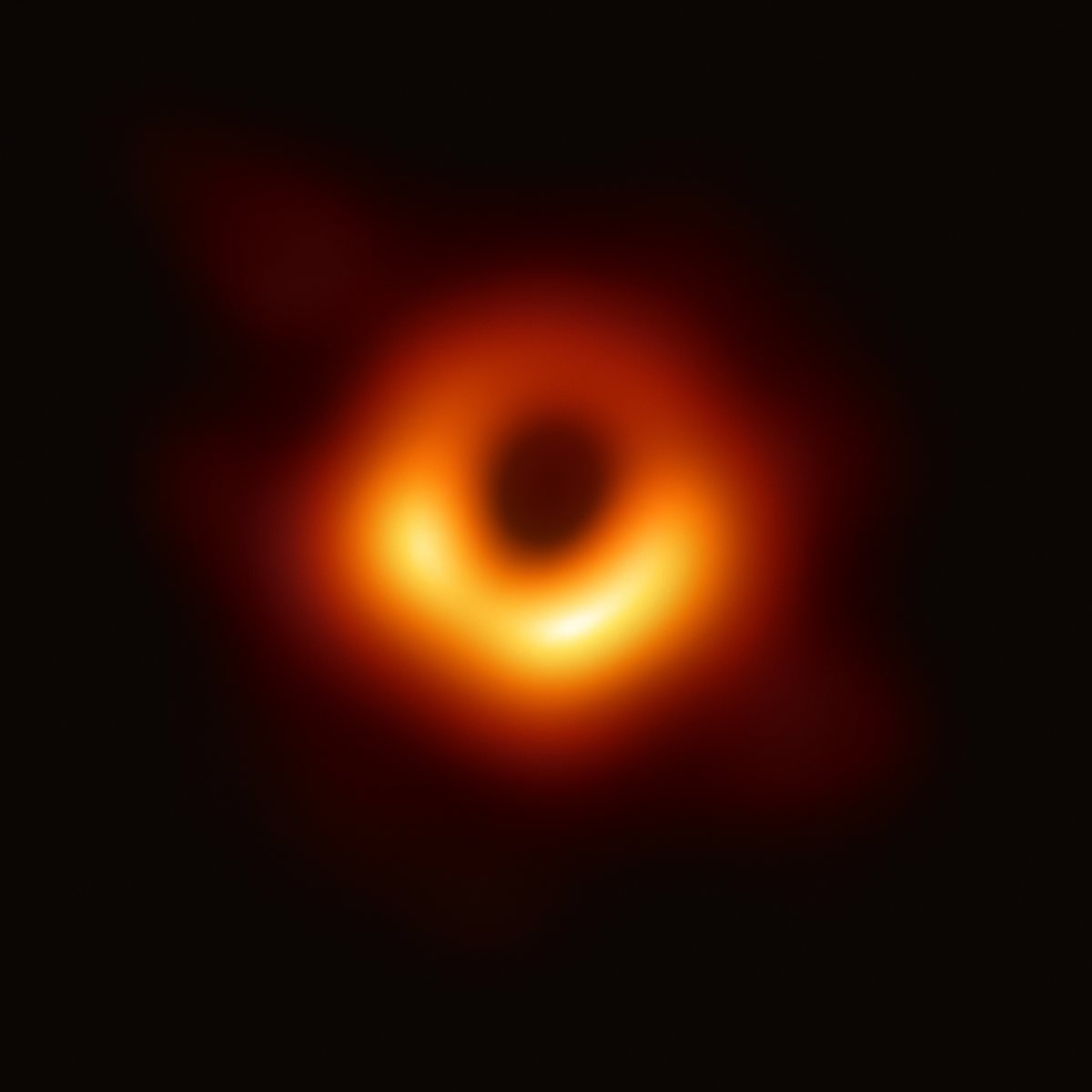
The first photograph. The picture above is real. It was taken by the Event Horizon Telescope, which is eight radio telescopes, from Hawaii to Spain to the South Pole, timed against atomic clocks and used together as one telescope the size of the Earth. It had to be that large. Seen from here the ring is so small that it is like measuring the length of a credit card lying on the Moon.
What it shows is M87*, a black hole of 6.5 billion Suns, 55 million light years away. The bright ring is very hot gas whirling round. The dark patch is the shadow: the region where light that should have reached us fell in. The shadow is about two and a half times wider than the black hole itself, because the black hole bends passing light towards it. One side of the ring is brighter because the gas on that side is rushing towards us.
How small is small enough. Every mass has a size it would have to be crushed inside to become a black hole. The size grows in step with the mass: about 3 km of radius for each mass of the Sun, so 6 km of width.
| If you crushed | It would become a black hole this wide | Which is about |
|---|---|---|
| The Earth | 18 mm | A small coin |
| The Sun | 6 km | Two thirds of the height of Mount Everest |
| A star of 10 Suns | 59 km | A marathon and a half |
| The black hole at the centre of our galaxy (4.3 million Suns) | 25 million km | 18 Suns side by side |
| M87*, the one in the photograph (6.5 billion Suns) | 38 billion km | Four times the width of Neptune’s orbit |
| One of the heaviest known (66 billion Suns) | 390 billion km | 43 times the width of Neptune’s orbit |
Nothing is going to crush the Earth or the Sun like this. Nature has only a few ways of doing it.
Getting a feel for the sizes. The small ones are tiny. A black hole made from a star ten times as heavy as the Sun would fit inside a large city.
The one at the centre of our galaxy, called Sagittarius A*, is 25 million km wide. That sounds vast, but it would fit inside the orbit of Mercury more than four times over, and light crosses it in 85 seconds.
M87* is in another class. Light takes a day and a half to cross it. Voyager 1, the farthest thing people have ever made, has been flying since 1977 and is now 26 billion km from home. In all that time it has not travelled as far as M87* is wide.
There is a surprise hidden in these numbers. Double the mass and the width doubles, so the space inside grows eight times. The heavier a black hole is, the more thinly its mass is spread, on average, over the space inside it. By our own sum from the widths above, Sagittarius A* comes out about a thousand times denser than water, while M87* comes out thinner than the air you are breathing. This is only an average. What is really inside is the subject of a later lesson.
From dying stars. When a heavy star runs out of fuel, its core collapses. If what is left of the core has less than about 2 to 3 times the Sun’s mass, it stops as a neutron star: a ball about 20 km across, held up by the pressure of particles packed as tightly as they can go. A teaspoonful would weigh more than a billion tonnes. If the core is heavier than that, no known force can hold it up, and it goes on falling in. The result is a black hole of a few Suns to a few tens of Suns in mass. Our galaxy probably holds tens of millions of them, perhaps many more. The nearest one known, found in 2022, is about 1,560 light years away.
At the centres of galaxies. Almost every large galaxy has a far heavier black hole at its centre, from hundreds of thousands to billions of times the mass of the Sun. The largest known reach tens of billions. How they grew so large, so early in the universe’s history, is not yet understood.
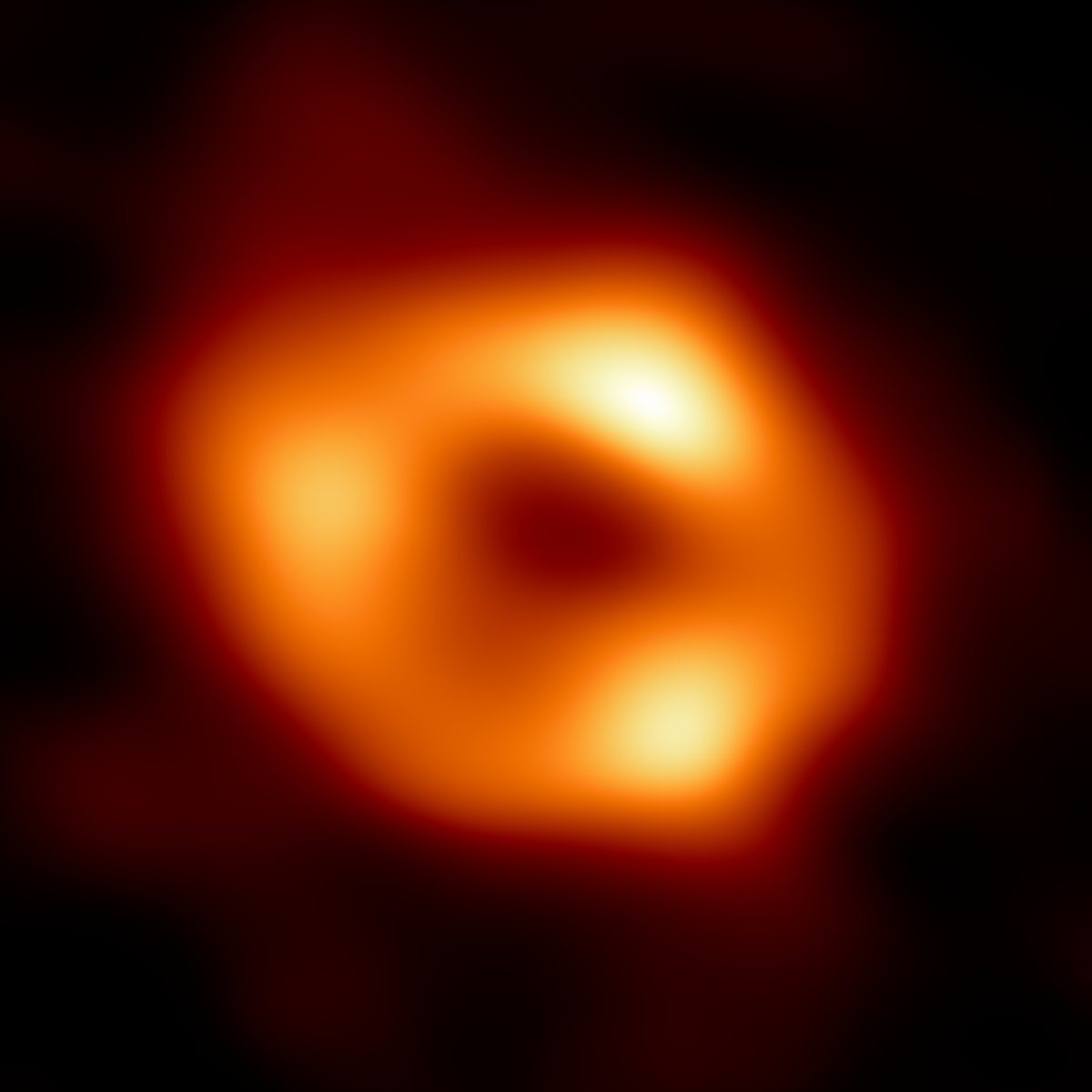
Ours was photographed too, three years after M87*. It is about 1,500 times lighter and much nearer, so the two rings look almost the same size in the sky. It was the harder one to catch. Gas takes days or weeks to circle M87*, but only minutes to circle Sagittarius A*, so the picture kept changing while it was being taken.
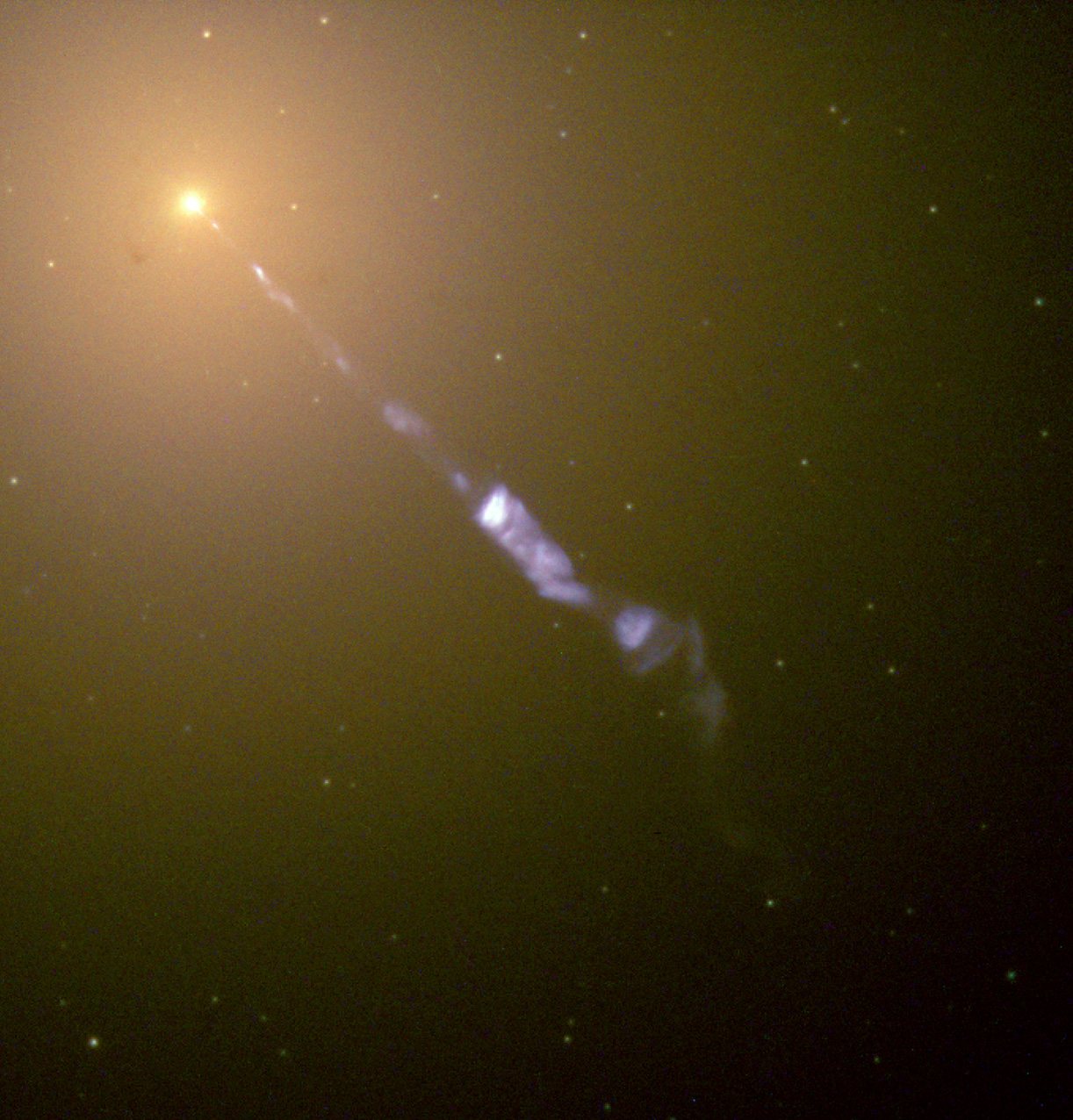
A black hole this heavy changes its whole galaxy. Not everything that comes close falls in. Some of the gas is flung outwards along two narrow jets, and M87’s is bright enough for Hubble to see.
How to find something invisible. Three ways, all of which have worked.
By its pull on a neighbour. Stars near the centre of our galaxy have been tracked for almost thirty years. One, called S2, goes round an empty-looking point every 16 years, reaching 7,650 km/s at its closest. Kepler’s laws give the mass of what it orbits: 4.3 million Suns, in a space smaller than our Solar System. Only a black hole fits.
By the glow of gas falling in. Gas pulled from a neighbouring star cannot fall straight in. It spirals inwards in a flat accretion disc, and friction heats it to millions of °C, hot enough to shine in X-rays. The first black hole found this way, in the 1960s and 70s, was Cygnus X-1: an unseen object of about 21 Suns circling a blue giant star every 5.6 days.
By the ripples when two collide. On 14 September 2015 two detectors in the United States, 3,000 km apart, each felt their 4 km arms change length by far less than the width of a proton. The cause was a gravitational wave from two black holes, of about 36 and 29 Suns, that had merged 1.3 billion light years away. The single hole they made had about 62 Suns of mass. The missing 3 Suns’ worth had been turned into energy and carried off as ripples in space, in a fifth of a second. Hundreds of mergers have been recorded since.
What they are not. A black hole’s gravity far away is no stronger than that of any other object with the same mass. Planets can orbit one safely. Only close in, within a few times its own width, does anything unusual happen. That is the subject of the next lesson.
Where this comes from
- NASA, Black holes
- NASA, Types of black hole
- ESO, First image of a black hole (2019). Photograph: EHT Collaboration, CC BY 4.0
- Event Horizon Telescope Collaboration, First M87 results, Paper I: the shadow of the supermassive black hole (2019)
- ESO, First image of the black hole at the heart of our galaxy (2022). Photograph: EHT Collaboration, CC BY 4.0
- ESA/Hubble, the jet of M87. Photograph: The Hubble Heritage Team (STScI/AURA) and NASA/ESA, CC BY 4.0
- NASA, Where are Voyager 1 and Voyager 2 now
- Nobel Prize in Physics 2020: black holes and the centre of our galaxy
- Nobel Prize in Physics 2017: the detection of gravitational waves
The words are written for this site. Sums in the text are worked from the figures in these sources.