
Learn / The Milky Way
How it works
Cause and effect, with real numbers.
- First look
- How it works
- The physics, still to be written
- The frontier, still to be written
How it works
Cause and effect, with real numbers
How much is there. Of the material between the stars, about 99 parts in 100 are gas and about 1 is dust. All of it together comes to roughly 15 per cent of the mass of the galaxy’s stars, about 10 billion times the mass of the Sun.
The gas comes in very different states.
| Kind of gas | Temperature | Where |
|---|---|---|
| Cold clouds of molecules | About 10 degrees above absolute zero, −263 °C | The thickest, darkest clouds, where stars form |
| Ordinary hydrogen gas | From about −170 °C to several thousand degrees | Spread through the disc of the galaxy |
| Glowing gas round hot stars | About 10,000 degrees | Bright nebulae such as the one in Orion |
| Very hot, very thin gas | A million degrees or more | Bubbles blown by exploding stars |
How little dust there is. A cubic kilometre of space holds only a few hundred to a few thousand grains of dust, and each grain is less than a ten-thousandth of a millimetre across. Each has a core of rock or soot with a coat of ice. It blocks the view only because the distances are so long: a line of sight thousands of light years deep passes enough grains to hide what lies behind.
Why dust reddens. The grains are about the size of the waves of visible light, and they scatter blue light more than red. A star seen through dust looks both fainter and redder than it is. Infrared waves are longer than the grains are wide and mostly pass by. That is why infrared telescopes can see into dark clouds and through to the centre of the galaxy.
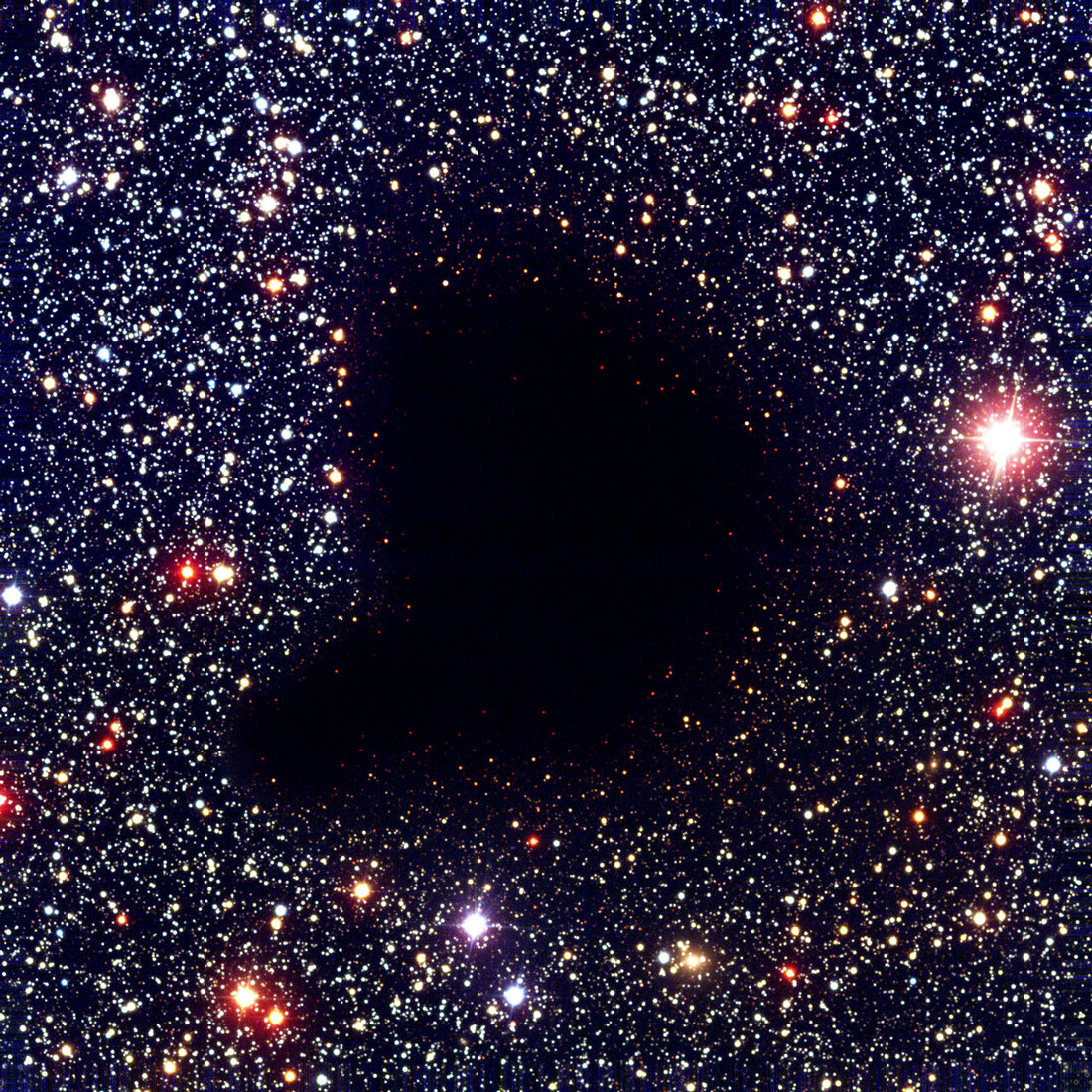
Barnard 68 in numbers. The cloud is about 12,500 times as wide as the distance from the Earth to the Sun, and its temperature is 16 degrees above absolute zero, −257 °C. It is the kind of cloud that may one day fall in on itself and make a star.
The 21 centimetre signal. A hydrogen atom is one proton with one electron. Each behaves like a tiny magnet, and the two can point the same way or opposite ways. Opposite has slightly less energy. When an atom drops from one to the other it gives out a radio wave 21 centimetres long. A Dutch student, Hendrik van de Hulst, worked out in 1944 that this should happen, and it was first picked up in 1951. Radio waves pass through dust, so this one signal lets astronomers map the gas right across the Milky Way.
Molecules. In the coldest clouds, atoms join into molecules. Hundreds of different kinds have been found in space by the radio waves they give out, the largest of them built of 60 or 70 carbon atoms.
Where this comes from
- OpenStax Astronomy 2e, 20.1 The interstellar medium
- OpenStax Astronomy 2e, 20.2 Interstellar gas
- ESO, How to become a star: the dark cloud Barnard 68 (2001)
The words are written for this site. Sums in the text are worked from the figures in these sources.