
Learn / The universe
How it works
Cause and effect, with real numbers.
- First look
- How it works
- The physics, still to be written
- The frontier, still to be written
How it works
Cause and effect, with real numbers
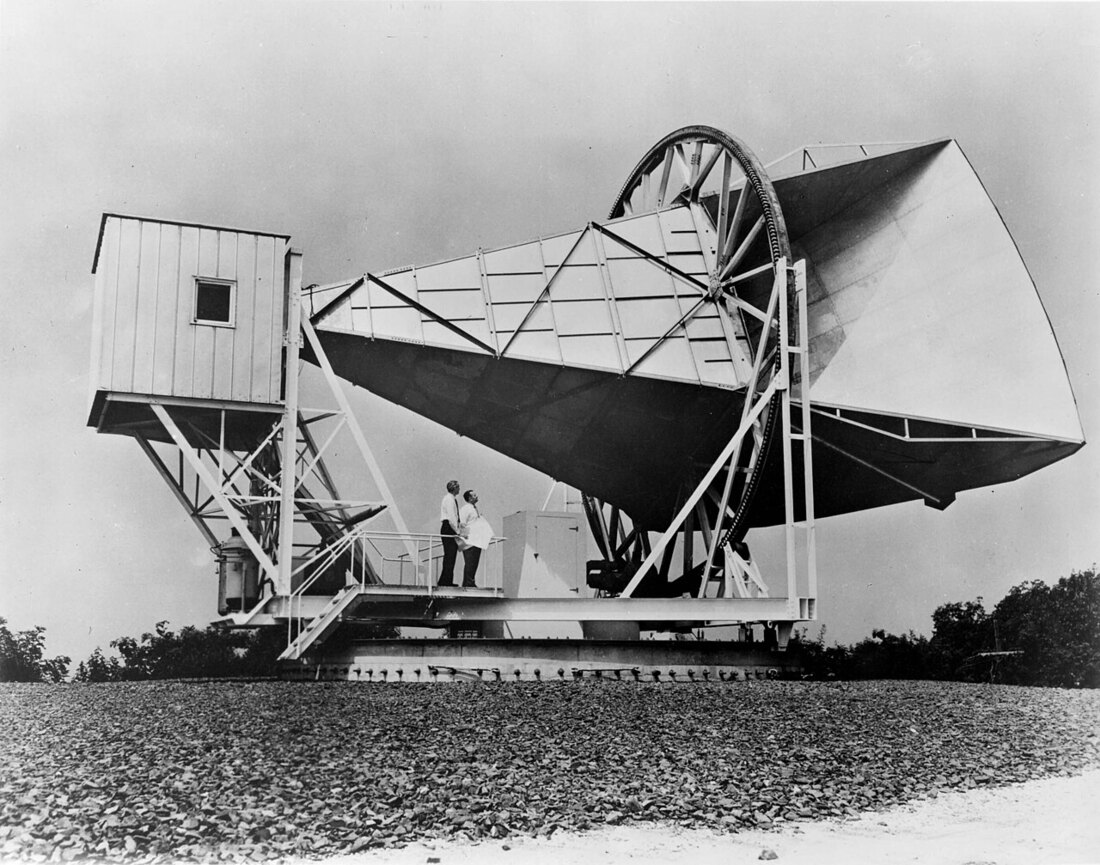
Predicted, then forgotten. In the late 1940s George Gamow, Ralph Alpher and Robert Herman worked out that if the universe began hot, a glow should be left over, and they put its temperature today at no more than 5 degrees above absolute zero. Nobody went looking. Penzias and Wilson found it by accident, and shared the Nobel Prize in 1978.
Three spacecraft.
| Spacecraft | Launched | What it showed |
|---|---|---|
| COBE (NASA) | 1989 | The glow is at 2.73 degrees, and it has patches that differ by about 1 part in 100,000 |
| WMAP (NASA) | 2001 | A sharp map of the patches over the whole sky, and from it the age of the universe |
| Planck (ESA) | 2009 | A sharper map still, able to tell apart differences of a few millionths of a degree |
What the map gives. From nine years of WMAP’s measurements:
| Age of the universe | 13.77 billion years, to within half a per cent |
| Ordinary atoms | About 5 per cent |
| Dark matter | About 25 per cent |
| Dark energy | About 70 per cent |
The later Planck spacecraft, with a sharper map, gave 13.8 billion years, which is the figure used elsewhere in these lessons. The two agree to within their margins.
How a pattern of spots can give an age. Before the fog cleared, the hot gas rang like a bell. Gravity pulled it into the denser patches and the pressure of the light pushed it back out, over and over. When the fog cleared, the ringing stopped where it was and left spots of a favourite size. How big that size looks on the sky depends on how far the light has come and on what the universe is made of. Measure the spots, and those numbers follow.
Why it marks the edge. The fog was opaque. No light from before it cleared can reach us, however good the telescope. To see further back takes a different messenger. See Messengers other than light.
The map’s colours. The map shows microwaves, which have no colour. Red was chosen for the slightly warmer patches and blue for the slightly cooler. The glow of our own galaxy, which lies across the middle of the sky, has been taken out.
Where this comes from
- ESA, Planck and the cosmic microwave background
- NASA, WMAP overview
- Nobel Prize in Physics 1978: discovery of the cosmic microwave background
The words are written for this site. Sums in the text are worked from the figures in these sources.