
Learn / Exploring space
The first journeys: Sputnik, Gagarin and the Moon
How it works
Cause and effect, with real numbers.
- First look
- How it works
- The physics, still to be written
- The frontier, still to be written
How it works
Cause and effect, with real numbers
Sputnik. The ball itself held little more than batteries and a radio. Four aerials trailed behind it, each in two parts 2.4 and 2.9 metres long. Its path took it from 215 km above the ground at the lowest to 939 km at the highest. The batteries ran out on 26 October 1957. The thin air at that height slowly dragged it down, and it burned up on 4 January 1958 after 1,440 trips round the Earth. Sputnik is simply the Russian word for a satellite.
Gagarin’s flight. His spacecraft, Vostok 1, was a ball 2.3 metres across. It weighed 4,725 kg at launch. It went no lower than 181 km and no higher than 327 km. It was not built to land gently with a person inside, so at a height of 7 km Gagarin was thrown clear in his seat and came down under his own parachute, in farmland near the Russian town of Engels. Some sources give the length of the flight as 106 minutes.
More firsts. Valentina Tereshkova became the first woman in space in June 1963. In March 1965 Alexei Leonov became the first person to leave a spacecraft and float outside it.
Robots went to the Moon first. The Soviet probe Luna 2 hit the Moon in September 1959, the first thing made by people to touch another world. A month later Luna 3 sent back the first pictures of the far side, which can never be seen from the Earth. In February 1966 Luna 9 made the first gentle landing, which showed that the surface was firm enough to stand on.
The six landings.
| Flight | Launched | Where it landed |
|---|---|---|
| Apollo 11 | 16 July 1969 | The Sea of Tranquility |
| Apollo 12 | 14 November 1969 | The Ocean of Storms, beside an old robot lander |
| Apollo 14 | 31 January 1971 | Fra Mauro |
| Apollo 15 | 26 July 1971 | Beside the Apennine mountains. The first to take a car |
| Apollo 16 | 16 April 1972 | The Descartes highlands |
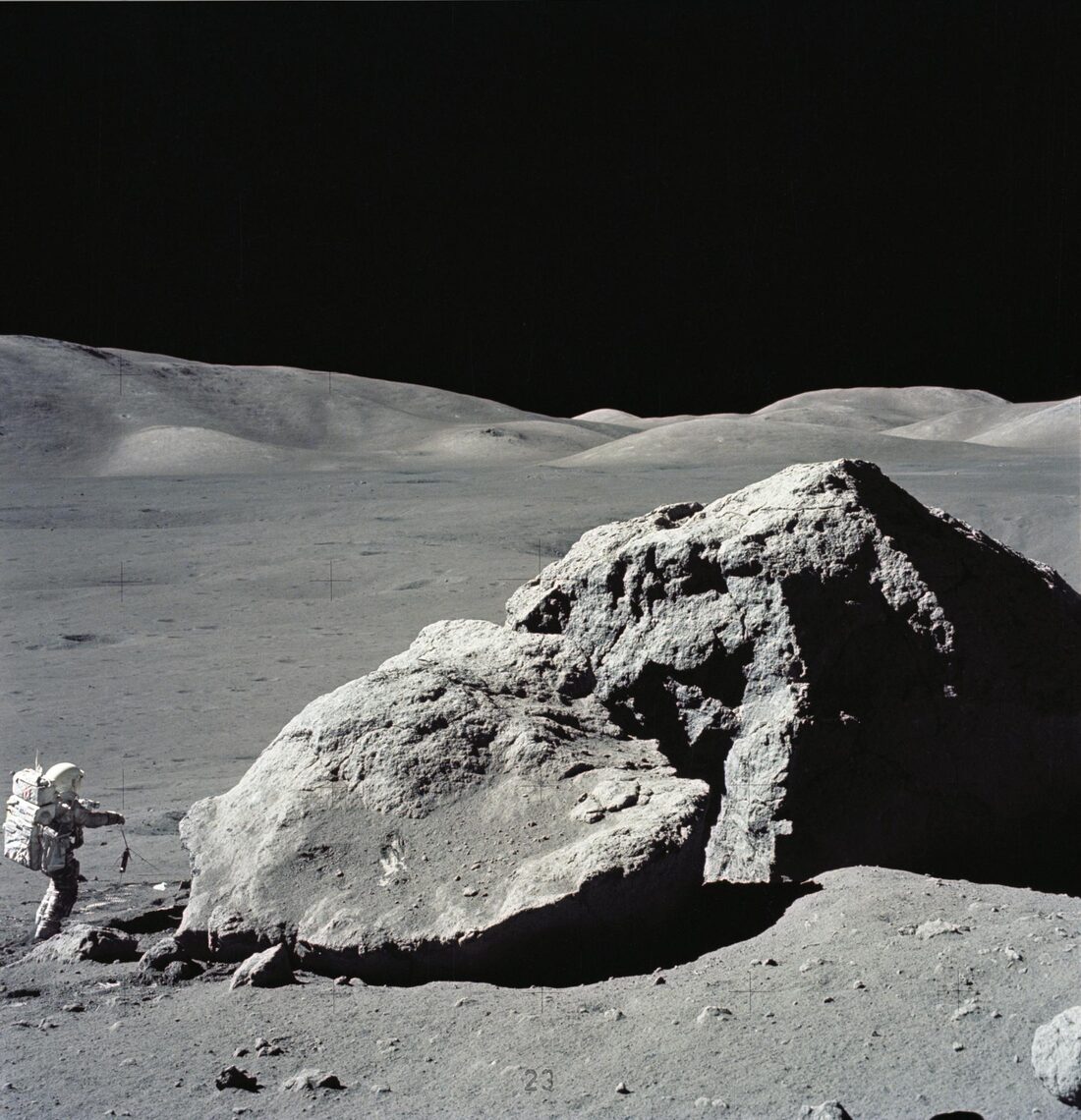
| Apollo 17 | 7 December 1972 | The Taurus-Littrow valley |
In all, 24 people flew to the Moon between December 1968 and December 1972, three of them twice. Twelve of them walked on it.
Apollo 11 in numbers. The landing was at 20:17 by Greenwich time on 20 July 1969. Armstrong and Aldrin were outside for 2 hours, 31 minutes and 40 seconds, and on the Moon for more than 21 hours altogether. They brought back 21.55 kg of rock and soil. All three men landed in the Pacific on 24 July.
After Apollo. Robots carried on. China’s Chang’e 3 landed in 2013, and in 2019 Chang’e 4 made the first landing on the far side. India’s Chandrayaan-3 landed near the south pole on 23 August 2023, and Japan’s SLIM on 19 January 2024. On 22 February 2024 a lander called Odysseus became the first built by a private company to reach the surface in working order.
Artemis II. The crew left the Kennedy Space Center on 1 April 2026 and came down in the Pacific on 10 April by local time, after 9 days and 1 hour. They did not land or go into orbit round the Moon. They swung round its far side, coming within 6,545 km of the surface on 6 April. The old record for distance from the Earth, 400,171 km, had been set by Apollo 13 in 1970.
Where this comes from
- Wikipedia, Sputnik 1
- Wikipedia, Vostok 1
- Wikipedia, Apollo program
- Wikipedia, Apollo 11
- Wikipedia, List of Apollo missions
- NASA, Apollo landing site coordinates
- Wikipedia, Moon landing
- Wikipedia, Artemis II
- NASA image library, Earthset from Artemis II (art002e021278)
- NASA image library, Harrison Schmitt beside a boulder (AS17-140-21496)
The words are written for this site. Sums in the text are worked from the figures in these sources.