
Learn / White dwarfs, neutron stars and black holes
How it works
Cause and effect, with real numbers.
- First look
- How it works
- The physics, still to be written
- The frontier, still to be written
How it works
Cause and effect, with real numbers
Nobody has been near a black hole, and no probe could report back from inside one. What follows comes from Einstein’s theory of gravity, general relativity. That theory has passed every test made of it so far, including the tests made close to black holes. Where it is known to run out, this lesson says so.
The horizon. The event horizon is a sphere round the black hole. Its size depends only on the mass: about 3 km of radius for each Sun. Inside it, all directions lead inwards, in the same way that on Earth all moments lead to tomorrow. Getting out is not difficult. It is not on the map.
Two views of one fall. Drop a probe that flashes a light once a second, and watch from a safe distance.
What you see. Gravity slows time. Clocks lower down run slow compared with clocks higher up. This is measured on Earth, where it is tiny, and satellite navigation has to correct for it. Near a horizon it becomes extreme. The probe’s flashes arrive further and further apart. Each is redder than the last, because the light is stretched as it climbs out. The probe seems to slow, dim and redden, and it fades from view just outside the horizon. You never see it cross.
What the probe sees. For the probe, nothing slows down. Its own clock ticks normally, and it crosses the horizon in a short time. Nothing marks the place. Both accounts are correct. They do not contradict each other, because no message can pass from the probe to you once it is inside.
Stretching. Gravity is stronger at your feet than at your head if you fall feet first. This difference is a tide, the same effect that raises the Earth’s seas, and near a black hole it can pull things apart. Oddly, small black holes are the fierce ones. At the horizon of a black hole of 10 Suns, 30 km from the centre, the stretching would destroy anything long before it arrived. At the horizon of the black hole in the middle of our galaxy, 12.7 million km from its centre, a falling astronaut would feel nothing unusual. The stretching comes later, further in.
Just outside. At one and a half times the radius of the horizon, gravity bends light so strongly that it can travel in a circle. Gas can orbit steadily only further out again, beyond about three times the horizon’s radius if the black hole is not spinning. Inside that, gas drops in.
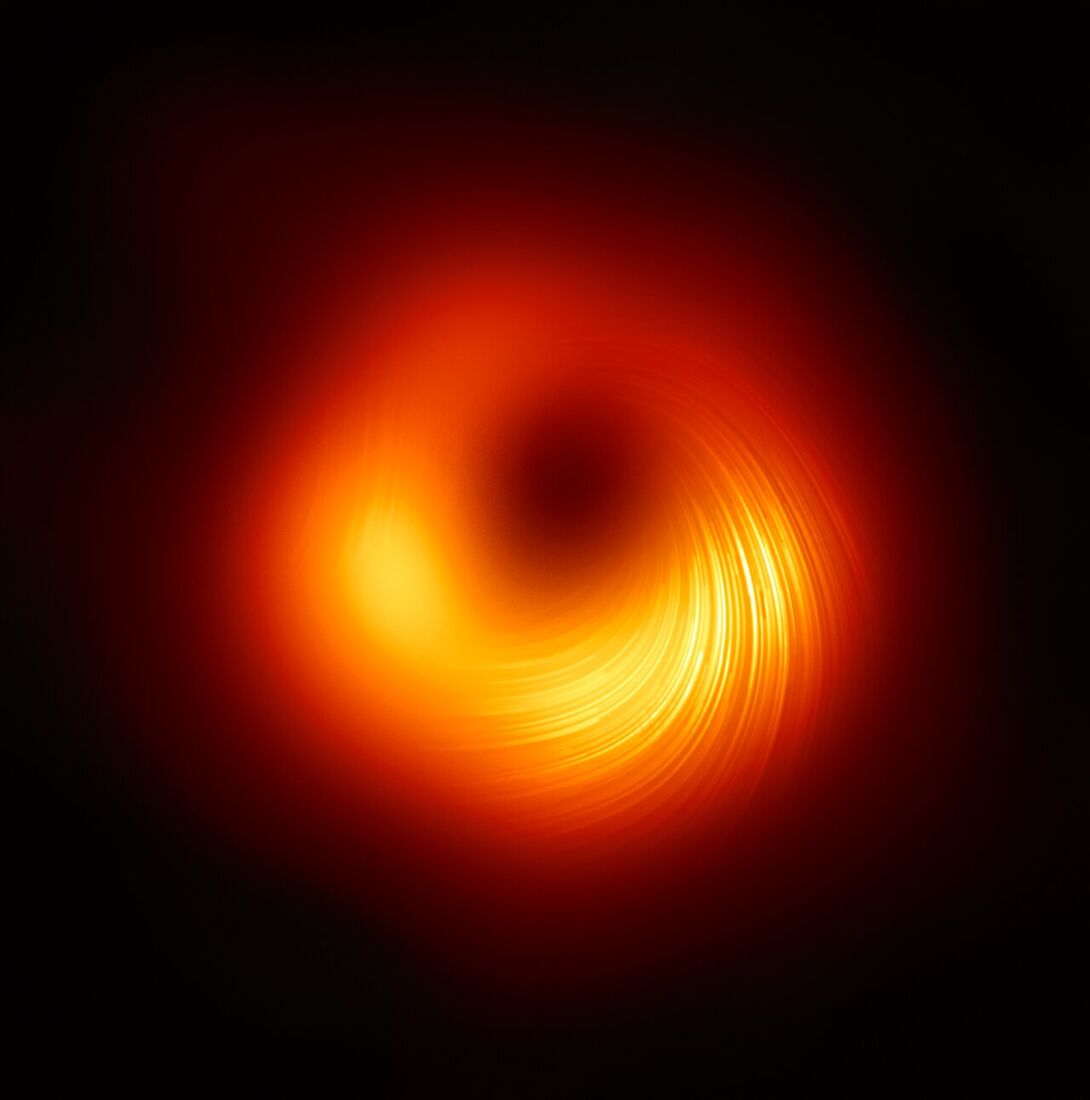
The pictures. A network of radio telescopes spread across the Earth, working as one dish the size of the planet, has made images of two black holes: the one in the galaxy M87, published in 2019, and the one at the centre of our own galaxy, published in 2022. Each shows a bright ring with a dark centre. The ring is light from hot gas, bent round the black hole on its way to us. The dark centre is the black hole’s shadow. Bending makes the shadow look about two and a half times wider than the horizon itself. The size of both rings matched what general relativity had predicted from the masses.
The middle. The theory says that everything which falls in ends at a single point of endless density, the singularity. Few physicists believe that as it stands. It is more likely a sign that general relativity stops working there, and that a theory joining gravity to the physics of the very small, which nobody yet has, is needed.
Do black holes last for ever? In 1974 Stephen Hawking worked out that a black hole should glow very faintly and slowly lose mass. This is theory, and it has never been observed. For a black hole with the mass of the Sun the glow would have a temperature of about 60 billionths of a kelvin, far colder than space itself at 2.7 K, so every black hole of that size today takes in more than it gives out.
Where this comes from
- NASA, Black holes
- ESO, first image of the black hole at the heart of our galaxy (2022)
- Nobel Prize in Physics 2020: black holes and the centre of our galaxy
The words are written for this site. Sums in the text are worked from the figures in these sources.