
Learn / Light, and how we know anything
How it works
Cause and effect, with real numbers.
- First look
- How it works
- The physics, still to be written
- The frontier, still to be written
How it works
Cause and effect, with real numbers
What the air does. The air treats each kind of light differently. Ozone high up absorbs most ultraviolet, which is why sunburn is not far worse. Water vapour and carbon dioxide absorb most infrared. Gamma rays and X-rays are stopped by the upper air itself, long before they reach the ground. Only two clear “windows” are left: one for visible light, with a little ultraviolet and infrared on either side, and one for radio waves. Astronomy was done through the first window alone until the 1930s. Even there, pockets of warm and cool air bend the light this way and that many times a second, and smear a star into a small dancing blob.
The idea. In 1946, eleven years before anything had been put into orbit, the American astronomer Lyman Spitzer wrote a paper setting out what a large telescope in space could do. He spent much of the next thirty years persuading people to build one. The first space telescope to work was an American satellite called OAO-2 in 1968, which looked at the sky in ultraviolet. Hubble was approved in the 1970s and named after Edwin Hubble, who showed that there are other galaxies and that they are moving apart.
The flaw, and the repair. Hubble’s mirror is one of the most exactly made objects there is. It was made exactly wrong. A measuring device used to check its shape had been put together with one lens 1.3 mm out of place, so the mirror was polished with great care to the wrong curve. The error at the edge, 2.2 thousandths of a millimetre, is about a fiftieth of the width of a hair, taking a hair as a tenth of a millimetre. Worked out here. Because the error was known so exactly, it could be cancelled. In December 1993 the shuttle Endeavour carried up a new camera with the opposite error built in, and a set of small mirrors on arms to correct the light for the other instruments. Astronauts visited Hubble five times in all, the last time in May 2009, replacing cameras, batteries and the spinning wheels that keep it pointed. It can hold its aim to within 0.007 of a second of arc. That is the width of a human hair seen from about 3 km away. Worked out here, taking a hair as a tenth of a millimetre.
What Hubble has done. By March 2024 Hubble had made more than 1.7 million observations, and astronomers had written more than 23,000 papers from them, according to NASA. It fixed the rate at which the universe is expanding, helped to show that the expansion is speeding up, showed that nearly every large galaxy has a giant black hole in the middle, and took the long “deep field” pictures that showed thousands of galaxies in patches of sky that had looked empty.
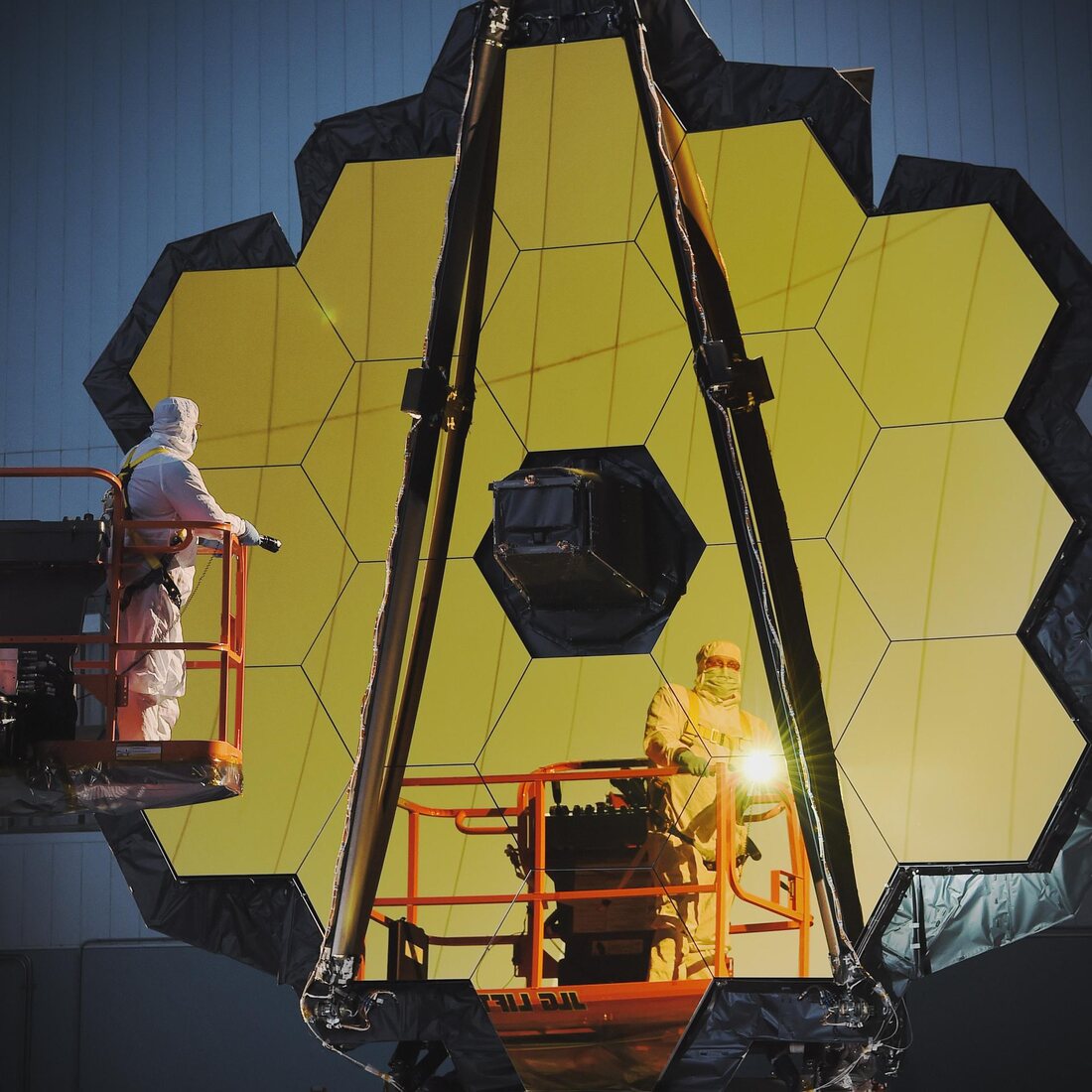
Webb. The James Webb Space Telescope was built by NASA with the European and Canadian space agencies, and cost about 10 billion US dollars. Its mirror collects 25.4 square metres of light against Hubble’s 4.0, more than six times as much. It sees light with wavelengths from 0.6 to 28.5 thousandths of a millimetre, from orange light far out into the infrared. Its five-layer sunshield measures 14.2 by 21.2 metres. Nobody can visit it: it circles a balance point called L2, four times as far away as the Moon, where the Sun, the Earth and the Moon all stay on the same side and one shield can block all three. It took a month to get there, and the unfolding had hundreds of steps that each had to work first time. All of them did.
The rest of the fleet. These are some of the best known. The dates are of launch and, where it has happened, of the end of work.
| Telescope | Years | What it looked at |
|---|---|---|
| Compton | 1991 to 2000 | Gamma rays, from the most violent events there are |
| Chandra | 1999 to now | X-rays, from gas at millions of degrees round black holes and in clusters of galaxies |
| Spitzer | 2003 to 2020 | Infrared, before Webb |
| Fermi | 2008 to now | Gamma rays |
| Kepler | 2009 to 2018 | The tiny dips in a star’s light as a planet crosses it |
| Planck | 2009 to 2013 | The oldest light in the universe |
| Gaia | 2013 to 2025 | The places and movements of more than a billion stars |
| TESS | 2018 to now | Planets crossing the nearer, brighter stars |
| Euclid | 2023 to now | The shapes of galaxies, to map dark matter |
The newest. NASA’s Nancy Grace Roman Space Telescope was launched on 30 August 2026 and is on its way to the same balance point as Webb. Its mirror is the same size as Hubble’s, but each picture takes in about 100 times as much sky. It is named after the NASA astronomer who did most to get Hubble built. Its first science pictures are expected early in 2027.
Is the ground finished, then? No. A mirror on the ground can be far bigger and far cheaper, and can be mended on a Tuesday afternoon. Modern telescopes on mountains measure the shaking of the air and bend a small mirror hundreds of times a second to undo it. The largest now being built has a mirror 39 metres across. The two kinds work together: the ground for size, and space for the kinds of light that never arrive.
Where this comes from
- NASA, Hubble Space Telescope: about and mission facts
- Wikipedia, Hubble Space Telescope
- NASA, James Webb Space Telescope
- Wikipedia, James Webb Space Telescope
- Wikipedia, Space telescope
- Wikipedia, Nancy Grace Roman Space Telescope
- ESA/Hubble, M100 before and after the first servicing mission
- ESA/Webb, Webb's first deep field
The words are written for this site. Sums in the text are worked from the figures in these sources.