
Learn / Stars
How it works
Cause and effect, with real numbers.
- First look
- How it works
- The physics, still to be written
- The frontier, still to be written
How it works
Cause and effect, with real numbers
A supernova is not one thing. Two quite different stars can end this way, and astronomers tell them apart by spreading the light into a spectrum and looking for hydrogen.
| A heavy star’s core gives way | A white dwarf is overfed | |
|---|---|---|
| The star | More than about 8 times the Sun’s mass | A white dwarf with a close partner |
| The trigger | The iron core can no longer hold itself up | Its mass nears 1.4 Suns |
| What happens | The core falls in, and the rest is blown off | The whole star burns at once |
| What is left | A neutron star or a black hole, in a spreading cloud | A spreading cloud and nothing else |
| Astronomers’ name | Type II (and Type Ib) | Type Ia |
| Hydrogen in its light | Usually | None |
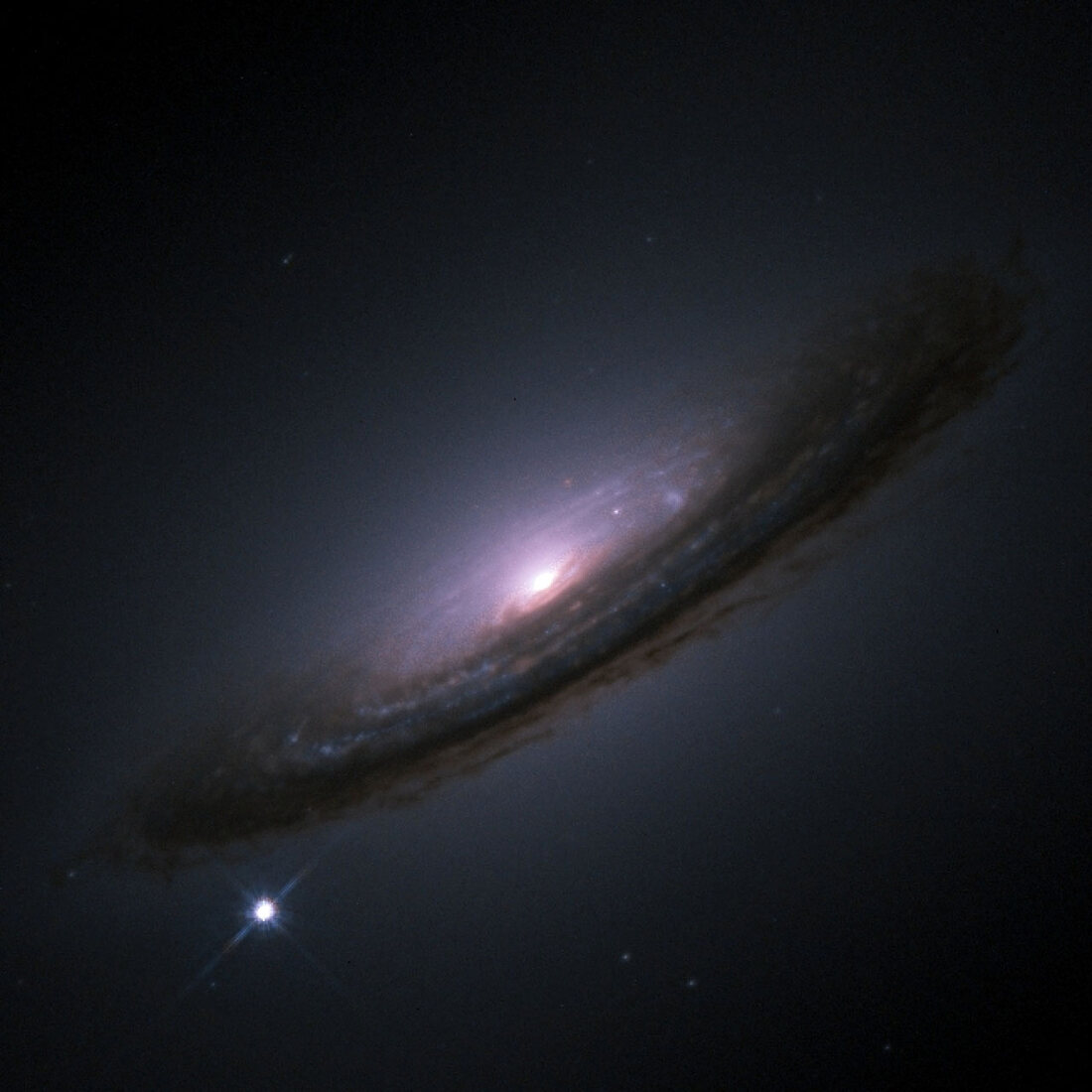
A core gives way. A heavy star burns one fuel after another, each faster than the last. By the time it is making iron out of silicon, it has days left. Iron is the end of the line, because fusing iron gives no energy back. The core is left with nothing to hold it up, and it falls in on itself in under a second. It is squeezed until the particles in it are pressed together as tightly as they can go. Then it stiffens and bounces back, and that rebound turns the fall into an explosion. The layers above are thrown off into space, and the crushed core stays behind as a neutron star or, if it is heavy enough, a black hole.
A white dwarf is overfed. A white dwarf on its own is finished. One with a close partner can pull gas across from it and gain weight. As its mass comes near 1.4 Suns, the limit that Subrahmanyan Chandrasekhar worked out, the carbon and oxygen it is made of begin to fuse all through the star at once. There is no slow burn and no core left over. The whole star is blown apart. Astronomers still argue about what kind of partner does the feeding.
Why the second kind is so useful. Because these white dwarfs all blow up at nearly the same mass, they all reach nearly the same brightness. So if one looks faint, it must be far away, and how faint tells you how far. That makes them one of the best rulers there is for measuring the distances to other galaxies.
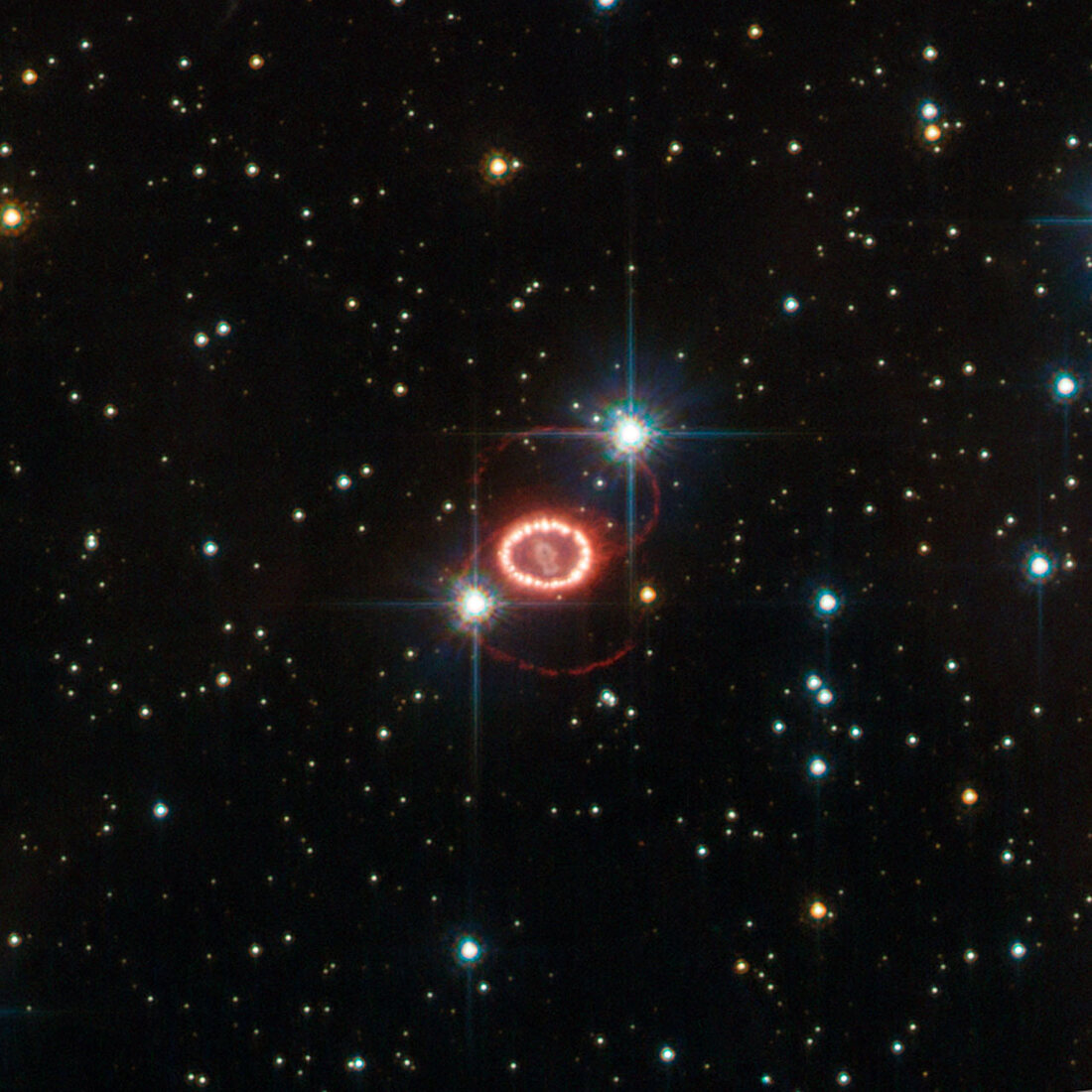
The one in 1987. On 24 February 1987, Ian Shelton noticed a new star in the Large Magellanic Cloud, a small galaxy 168,000 light years away. It was the first supernova bright enough to see without a telescope since 1604. At its brightest it shone with the power of 100 million Suns, and it stayed bright for months.
The star that blew up was already in the catalogues. It was a blue supergiant about 20 times as heavy as the Sun. That was a surprise, because theory had expected a red supergiant.
The day before anyone saw the light, three detectors deep underground, in Japan, the United States and what was then the Soviet Union, had each recorded a burst of neutrinos within a few seconds of one another: 12, 8 and 5 of them, 25 in all. Neutrinos are particles that pass through almost anything, so they came straight out of the collapsing core. Theory had said that a collapsing core should give off a flood of them. Those 25 were the proof.
How often. In a galaxy like ours a supernova goes off about once a century. The last ones seen in our own galaxy were in 1572, studied by Tycho Brahe, and in 1604, studied by Johannes Kepler. Every one studied since has been in another galaxy.
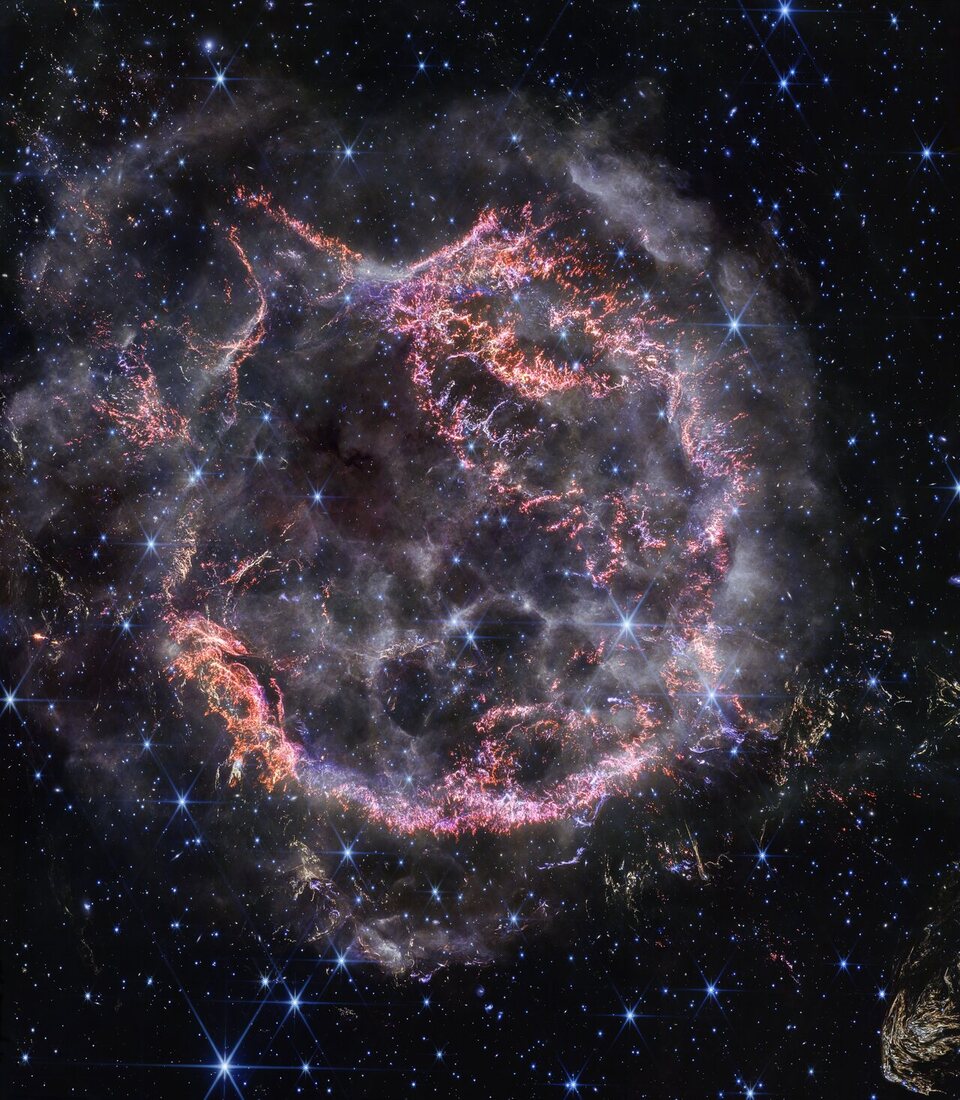
What is left. The gas thrown out goes on spreading for thousands of years, ploughing into whatever lies round it and glowing as it goes. The Crab Nebula is the wreck of the supernova of 1054. Cassiopeia A, above, is younger still.
Why it matters to us. The universe began with hydrogen, helium and very little else. Carbon, oxygen, silicon and iron were made later, inside stars. A supernova does two jobs. It scatters what the star has made, and in the heat of the blast it makes elements heavier than iron, which a star cannot make while it is shining steadily. All of it drifts into the clouds from which the next stars form. The Sun, the Earth and everything on it were made from gas that earlier stars had already enriched.
Where this comes from
- NASA Imagine the Universe, Supernovae
- NASA, Stars
- NASA, The dawn of a new era for Supernova 1987A
- ESA/Hubble, Hubble revisits an old friend (SN 1987A)
- Panagia 2004, SN 1987A: the unusual explosion of a normal Type II supernova
- NASA, Webb's new look at the exploded star Cassiopeia A
- ESA/Hubble, Cassiopeia A
The words are written for this site. Sums in the text are worked from the figures in these sources.