
Learn / Stars
How it works
Cause and effect, with real numbers.
- First look
- How it works
- The physics, still to be written
- The frontier, still to be written
How it works
Cause and effect, with real numbers
There are two quite different reasons why a star’s light can change. Either the star itself is changing, or something is getting in the way.
| The star itself changes | Something gets in the way | |
|---|---|---|
| What happens | The star swells and shrinks, or throws off gas and dust | A partner star passes in front of it |
| The pattern | A smooth rise and fall | Steady light, with sharp dips |
| How regular | From clockwork to quite unpredictable | Clockwork |
| An example to look for | Delta Cephei, Mira, Betelgeuse | Algol |
Four stars you can follow by eye.
| Star | Kind | How long one cycle takes | How much it changes |
|---|---|---|---|
| Delta Cephei | Pulsing supergiant (a Cepheid) | 5.366 days | About 2 times |
| Mira | Pulsing red giant | About 332 days | About 600 times |
| Algol | Two stars that eclipse | 2.867 days | About 3 times, for a few hours |
| Betelgeuse | Red supergiant | Not regular | Usually a little; to about a third in early 2020 |
The figures for how much each changes are in light the eye can see. Those for Mira and Algol were worked out here from the published magnitudes. Each step of one magnitude is a change of about 2.5 times. Mira usually goes from about magnitude 3 to about magnitude 10, which is seven steps, or about 600 times. Algol goes from 2.1 to 3.4, which comes to a little over 3 times.
Why a star pulses. The fusion in the star’s core stays steady all the while. What changes is how easily the heat can get out through the outer layers. When those layers hold heat in, pressure builds beneath them and pushes them outwards. They swell past the point of balance, the heat escapes, the push dies away, and gravity pulls them back in. They fall past the point of balance too, and it all starts again. The star behaves like a weight bouncing on a spring.
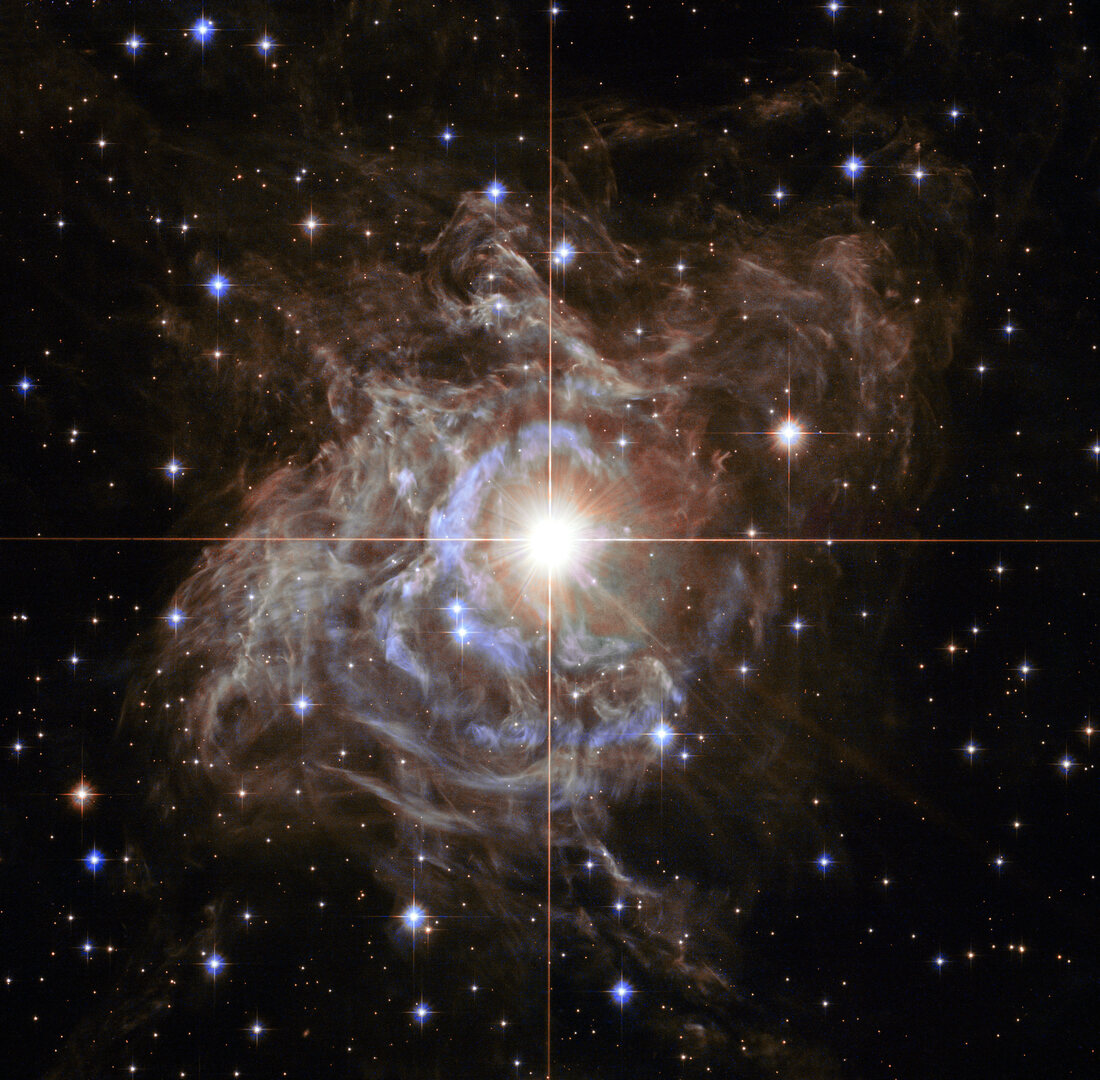
Mira. Mira is a red giant about 400 light years away and roughly 700 times as wide as the Sun. Its swings are much bigger than a Cepheid’s and not so regular. Some peaks are a good deal brighter than others. Its surface is cool even for a red giant, between about 1,900 and 2,600 kelvins as it swells and shrinks.
Algol. The two stars of Algol are far too close together to be told apart in a telescope. We happen to see their orbit almost edge on, so each passes in front of the other once in every circuit. When the fainter star covers the brighter one, the light drops for just over 9 hours from start to finish. When the brighter one covers the fainter, the dip is too small to notice by eye. Its fading had been noticed long before anyone understood it. In the 1780s the astronomer John Goodricke gave the right explanation. He was also the one who found the changes in Delta Cephei, in 1784.
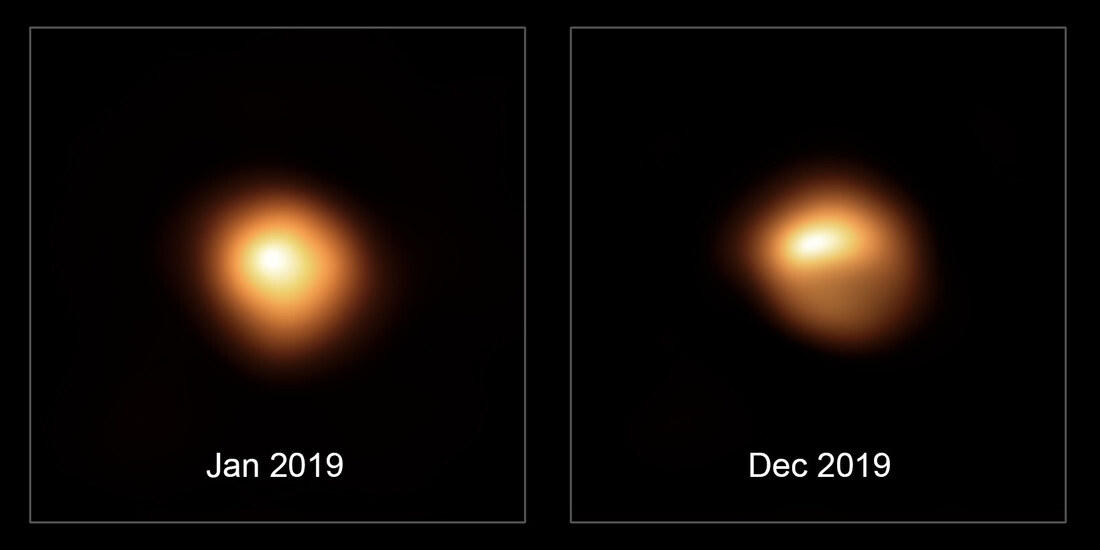
The Great Dimming. Betelgeuse always varies a little. What happened in the winter of 2019 to 2020 was far more than usual, and for a while there was talk that the star might be about to explode. The pictures above settled it. The team that took them found that the star had pushed out a large bubble of gas. Soon afterwards a patch of its surface cooled, and that let the gas turn into solid dust. The dust hid the southern part of the star from us. It was not an early sign of a supernova.
New stars that are not new. Now and then a star flares up where none could be seen before. It used to be called a nova, the Latin for new, and the name has stuck. It is in fact an old pair of stars. One is a white dwarf, and it pulls hydrogen across from its partner. The gas piles up on its surface, growing hotter and denser, until it goes off like a bomb. Only the surface layer is blown away. The white dwarf survives, so the same thing can happen again. Most take between 10,000 and 100,000 years to gather enough gas. A few, such as RS Ophiuchi, manage it every 20 years or so.
Why they matter. For a Cepheid, the time taken over one pulse tells you how luminous the star really is. Compare that with how bright it looks and you have its distance. The lesson on the distance ladder shows how this gave the first distance to another galaxy.
The Sun. The Sun’s output rises and falls by about 0.1 per cent over its 11-year cycle of activity. Against the stars above, that is very steady indeed.
Where this comes from
- ESA/Hubble, Hubble image of variable star RS Puppis
- SEDS, Mira (Omicron Ceti)
- Society for Popular Astronomy, Guide to Algol (Beta Persei)
- ESO, Telescope sees surface of dim Betelgeuse
- ESO, Mystery of Betelgeuse’s dip in brightness solved
- CSIRO Australia Telescope National Facility, Pulsating variable stars
- Astronomy magazine, the original Cepheid variable
- CSIRO Australia Telescope National Facility, Cepheids and distance
- NASA, Blobs in space: the legacy of a nova
- NASA Astronomy Picture of the Day, Explosions from white dwarf star RS Oph
- NASA, TSIS-1 (the Sun’s total output and how it varies)
The words are written for this site. Sums in the text are worked from the figures in these sources.