
Learn / The Milky Way
How it works
Cause and effect, with real numbers.
- First look
- How it works
- The physics, still to be written
- The frontier, still to be written
How it works
Cause and effect, with real numbers
The winding problem. The Sun takes about 230 million years to go once round the centre of the galaxy. A star half as far out takes about half as long, because stars across most of the disc move at much the same speed and the inner ones have a shorter road. After a single turn of the outer star, the inner one is a whole lap ahead. The galaxy is about 13 billion years old, time enough for the Sun’s part of it to have gone round more than fifty times (worked out here from those two figures). Arms made of fixed stars would have been wound into a smooth blur long ago.
What keeps them, and what astronomers argue about. One long-standing idea is a single long-lived wave of crowding that sweeps steadily round the disc. Computer models suggest something less tidy. A review of the evidence in 2014 concluded that most arms are not permanent at all. They form, stretch, break up and form again, set off by clumps in the disc pulling on the stars round them. On that view a galaxy always has arms, but never the same arms for long. Either way, the arms are patterns and the stars pass through.
| What sets the arms going | What it tends to make | Example |
|---|---|---|
| Clumps in the disc itself | Many short, ragged arms that come and go | Most spirals |
| A companion galaxy passing by | Two long, sweeping arms | The Whirlpool, M51 |
| A bar across the middle | An arm from each end of the bar | NGC 1300 |
Reading the Whirlpool. The dark threads along the inner edge of each arm are lanes of dust, where the gas is being squeezed. Just outside them come the pink clouds where stars are being born, and then the blue clusters of new stars. Dust, pink, blue: the order shows the gas moving through the arm and what happens to it on the way.
Our own arms. Dust hides most of the disc from us, so the map is made with radio waves from hydrogen gas and with infrared light, both of which pass through dust. They show a modest bar, two main arms called Scutum-Centaurus and Perseus, and fainter ones including Sagittarius. The Sun is near the inner edge of the Orion spur, a short piece of arm about 10,000 light years long.
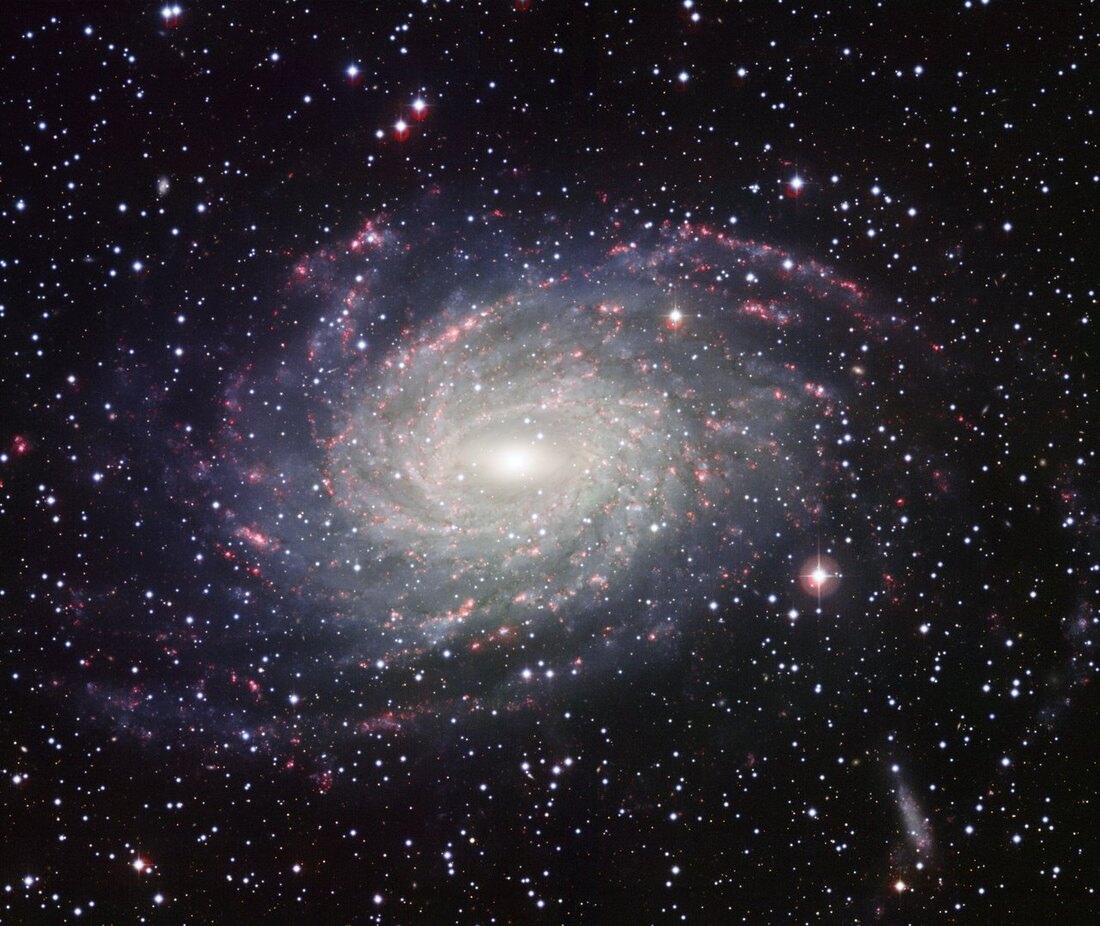
NGC 6744. It lies about 30 million light years away and is almost twice as wide as the Milky Way. It even has a small ragged companion, as our galaxy has the Magellanic Clouds.
Where this comes from
- OpenStax Astronomy 2e, 25.2 Spiral structure
- Dobbs and Baba 2014, Dawes Review 4: Spiral structures in disc galaxies
- ESA/Hubble, Out of this whirl: the Whirlpool Galaxy (M51) and companion galaxy (2005)
- ESO, A postcard from extragalactic space? NGC 6744 (2011)
- Reid and others 2019, Astrophysical Journal 885, 131
The words are written for this site. Sums in the text are worked from the figures in these sources.