
Learn / Exploring space
How it works
Cause and effect, with real numbers.
- First look
- How it works
- The physics, still to be written
- The frontier, still to be written
How it works
Cause and effect, with real numbers
Four ways to visit a world. Each is harder than the one before, and each tells you more.
| Way | What happens | An example |
|---|---|---|
| Fly past | A few hours close up, at full speed, then gone | New Horizons passed 12,500 km above Pluto on 14 July 2015 after a journey of nine and a half years |
| Go into orbit | Stay for years and watch the seasons change | Cassini at Saturn, 2004 to 2017 |
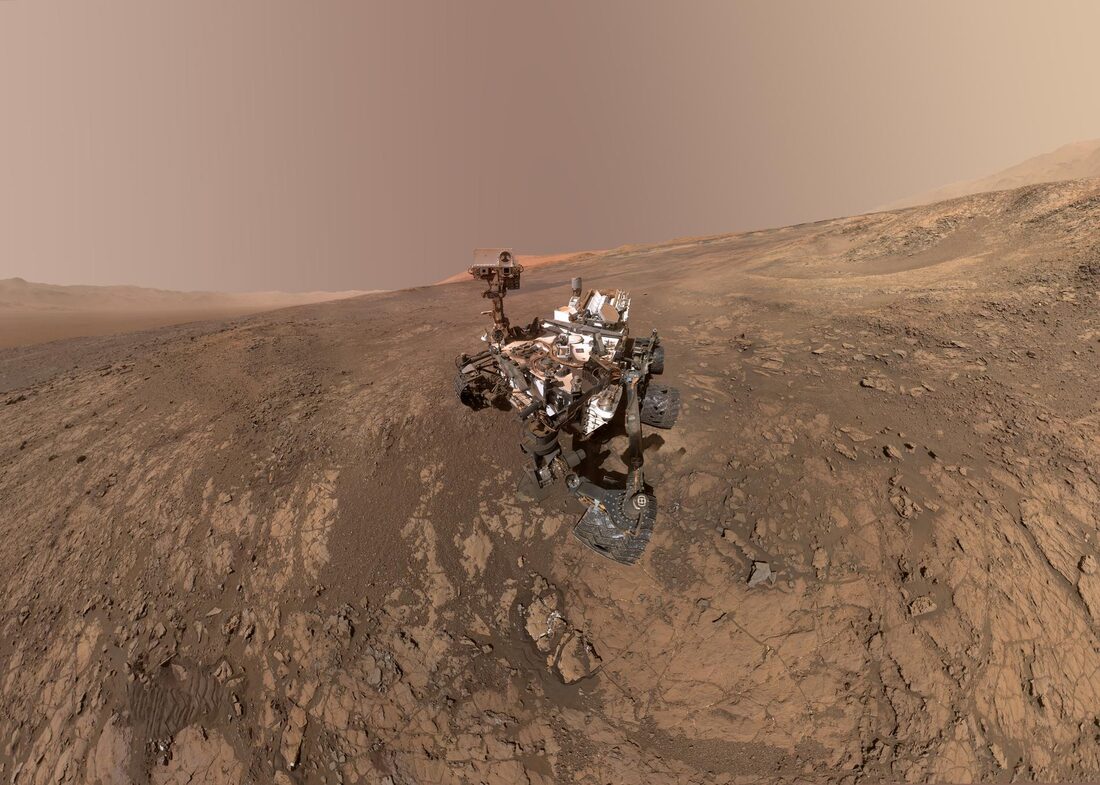
| Land, or land and drive | Touch the ground and test what it is made of | Curiosity and Perseverance on Mars |
| Bring a piece back | Study it in the best laboratories on the Earth | OSIRIS-REx and the asteroid Bennu |
The Voyagers. Voyager 2 was launched on 20 August 1977 and Voyager 1 on 5 September 1977. Between them they explored Jupiter, Saturn, Uranus and Neptune and 48 of their moons. Voyager 1 crossed out of the Sun’s bubble of wind into the space between the stars in August 2012, and Voyager 2 followed on 5 November 2018. They are the only spacecraft to have worked out there.
A light-day away. NASA expects Voyager 1 to pass 25.9 billion km from the Earth on 18 November 2026. Light and radio take 24 hours to cross that distance. A question sent to the spacecraft that day gets its answer two days later. The furthest any person has been from the Earth is 406,771 km, on the Artemis II flight of April 2026. Divide one distance by the other and you get about 64,000. Worked out here.
How long the signal takes. Radio travels at the speed of light, and nothing can be sent faster.
| From | One way |
|---|---|
| Mars, on the day Perseverance landed | 11 minutes |
| Pluto, on the day New Horizons flew past | 4 hours 25 minutes |
| Voyager 1, in November 2026 | 24 hours |
New Horizons could send its pictures home only slowly from so far away. The last of what it recorded at Pluto arrived on 25 October 2016, fifteen months after the fly-past.
Landing on Mars. Perseverance weighs 1,025 kg. It met the air of Mars behind a heat shield, opened a parachute 21 metres wide, and then let go of that too. For the last stretch it hung beneath a frame held up by rocket engines, which lowered it to the ground on ropes and then flew off to crash at a safe distance. On the way down it compared what its cameras saw with a map it carried, and steered clear of danger. It landed within about five metres of where it was aimed. It carries 19 cameras, and several of them filmed the landing.
What the rovers have done. Curiosity weighs 899 kg and is about three metres long. By 26 August 2026 it had climbed a full kilometre up the mountain in the middle of its crater. Perseverance had driven 45.25 km by 30 October 2026. It also carried a small helicopter, Ingenuity, which on 19 April 2021 made the first powered flight on another planet. It was meant to fly five times. It flew 72 times before a broken blade grounded it in January 2024.
How Cassini ended. By 2017 Cassini was almost out of fuel. So that it could never crash into Enceladus or Titan and carry germs from the Earth to moons that might have life of their own, its controllers steered it into Saturn itself on 15 September 2017, where it burned up.
What was in the dust from Bennu. Bennu is about half a kilometre across. In January 2025 the teams studying the sample reported 14 of the 20 amino acids that living things on the Earth use to build proteins. They found no sign of life itself. What the dust shows is that such ingredients can be made in space, with no life to make them.
The fastest thing ever built. The Parker Solar Probe was launched on 12 August 2018 to fly through the outer air of the Sun. On 24 December 2024 it passed 6.16 million km above the Sun’s surface at 690,000 km an hour, which is 191 km every second. It hides behind a shield 11.4 cm thick, made to stand about 1,370 °C.
Where this comes from
- NASA, Voyager mission overview
- NASA, Where are Voyager 1 and Voyager 2 now?
- NASA Photojournal, Neptune full disk (PIA01492)
- Wikipedia, Perseverance (rover)
- NASA, Curiosity (Mars Science Laboratory)
- NASA, Cassini-Huygens
- NASA image library, The Day the Earth Smiled (PIA17172)
- Wikipedia, OSIRIS-REx
- Wikipedia, New Horizons
- Wikipedia, Parker Solar Probe
- Wikipedia, Artemis II (furthest distance of people from the Earth)
The words are written for this site. Sums in the text are worked from the figures in these sources.