
Learn / Light, and how we know anything
Redshift and the Doppler effect
How it works
Cause and effect, with real numbers.
- First look
- How it works
- The physics, still to be written
- The frontier, still to be written
How it works
Cause and effect, with real numbers
Trumpets on a train. Doppler was a mathematician working in Prague, and he had no proof. It came from the Netherlands in 1845, from a young scientist called Christophorus Buys Ballot. He put trumpeters on an open railway wagon on the line out of Utrecht and had them hold one steady note while the engine pulled them past listeners standing by the track. A first try in February was ruined by hail and snow. In June it worked: the note was heard about half a tone higher as the train came on and about half a tone lower as it went away, according to an account in Physics Today.
How big is the change? For sound it depends on how fast the thing is moving compared with sound itself, about 343 metres a second in air. An ambulance passing at 50 km an hour drops in pitch by about 8 per cent as it goes by, a little more than the step between two neighbouring keys on a piano. Worked out here. For light the comparison is with the speed of light, 299,792 km a second, so the shifts from everyday speeds are tiny.
Doppler’s mistake. Doppler put the idea forward to explain the colours of stars. He thought that stars looked red or blue because of how they were moving. That was wrong: stars move far too slowly, and their colours come from their temperatures. In 1848 the French physicist Hippolyte Fizeau saw what would really show the effect, which was the dark lines. In 1868 the English astronomer William Huggins found a shift in the lines of Sirius, the first for any star.
The number z. Astronomers write the size of a redshift as a number called z. It is the fraction by which each wave has grown. If z is 1, every wave is twice as long as it was. Add 1 to z and you have the stretch.
| What | z | Stretch |
|---|---|---|
| The Andromeda galaxy | −0.001 | Squeezed by a thousandth |
| A galaxy a billion light years away | about 0.07, worked out here | 1.07 times |
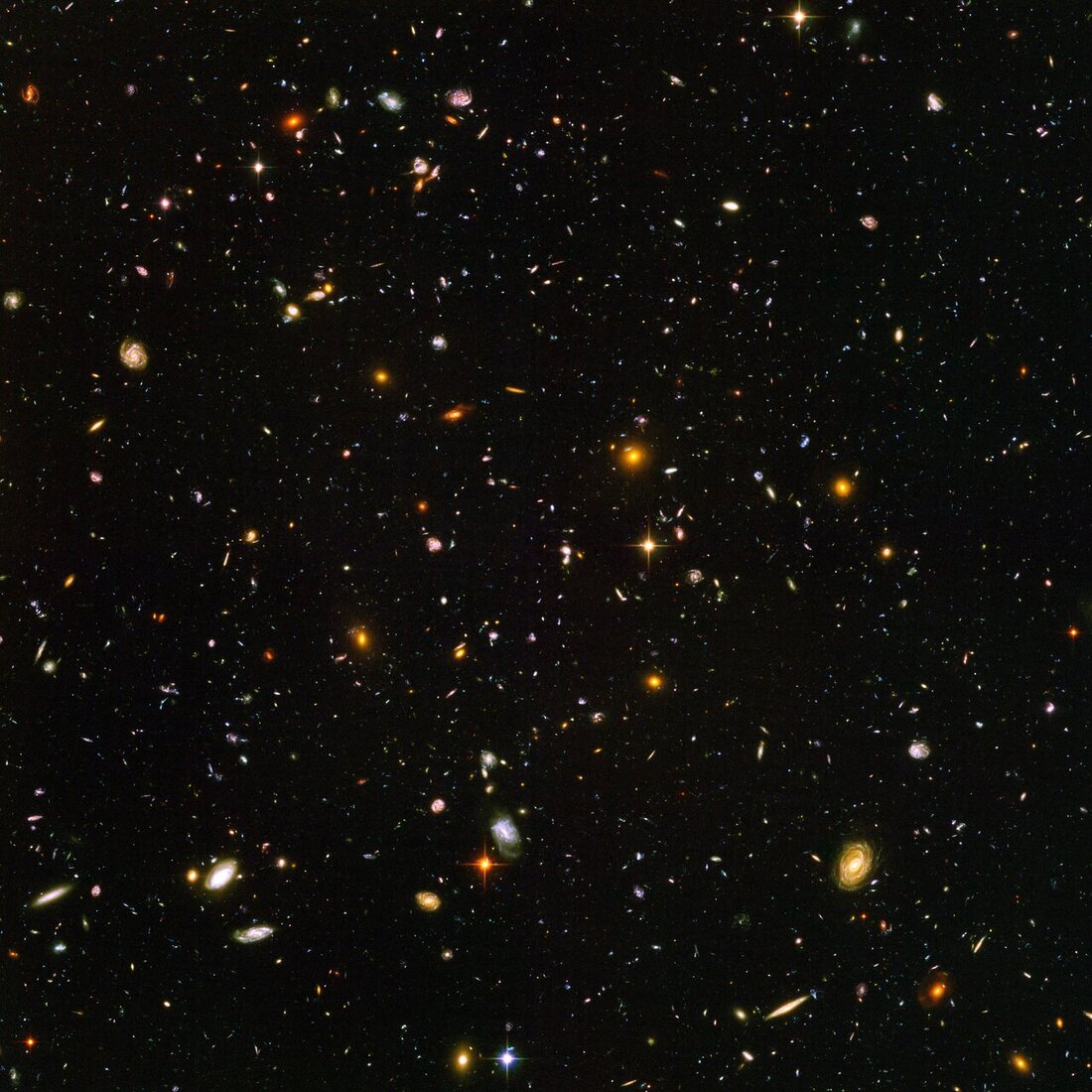
| JADES-GS-z14-0 | 14.18 | 15.2 times |
| MoM-z14, the most distant galaxy confirmed by 2025 | 14.44 | 15.4 times |
| The oldest light in the universe | 1,089 | 1,090 times |
The oldest light of all was given off by glowing gas at about 3,000 degrees, when the universe was about 379,000 years old. It has been stretched so far that it now arrives as microwaves, as if from something only 2.7 degrees above the coldest possible temperature.
Three kinds of redshift. The first is the Doppler kind, from movement through space. The second is the stretching of space, which is the one that matters for far galaxies. It is not really a speed at all, and it is a mistake to read a large z as “faster than light”. The third comes from gravity: light climbing away from a heavy object loses a little energy and is reddened. In 1960 Robert Pound and Glen Rebka measured this at Harvard University by sending gamma rays 22.5 metres up a tower. The shift was 2.5 parts in a thousand million million, as Einstein’s theory said it should be.
Slipher’s work. Slipher worked at the Lowell Observatory in Flagstaff, Arizona, from 1901 to 1954. He reported the speed of Andromeda on 17 September 1912. Nobody then knew what the “spiral nebulae” were. That they were other galaxies was shown by Hubble in the 1920s, and Hubble’s rule of 1929 rested on Slipher’s shifts and on new ones measured by Milton Humason. Andromeda is one of the few exceptions to the rule. It is close enough for the pull between it and the Milky Way to beat the growth of space.
The same trick on the Earth. A police speed gun sends out radio waves and measures the shift in the echo from a car. For a car at 108 km an hour the echo is shifted by about one part in five million. Hospitals use the echo of sound waves in the same way to measure how fast blood is flowing. The planet found in 1995 goes round a star called 51 Pegasi, and swings it to and fro at about 56 metres a second. That is a shift of about one part in five million as well. The sums of the two fractions were worked out here.
Where this comes from
- Wikipedia, Redshift
- Wikipedia, Doppler effect
- Physics Today, The fall and rise of the Doppler effect
- Wikipedia, Vesto Slipher
- Wikipedia, JADES-GS-z14-0
- Wikipedia, Pound-Rebka experiment
The words are written for this site. Sums in the text are worked from the figures in these sources.