
Learn / Stars
Red dwarfs, the commonest stars
How it works
Cause and effect, with real numbers.
- First look
- How it works
- The physics, still to be written
- The frontier, still to be written
How it works
Cause and effect, with real numbers
The numbers. Red dwarfs run from about 0.08 to about 0.6 of the Sun’s mass. Their surfaces are at roughly 2,400 to 3,900 degrees on the kelvin scale, against 5,800 for the Sun. They give out between about a 14th and about a 3,000th of the Sun’s power, and most of it is infrared, which the eye cannot see. Below 0.08 of the Sun’s mass the centre never gets hot enough to burn ordinary hydrogen steadily, and the object is a brown dwarf, not a star.
How common? The figure of three-quarters comes from counting the stars near the Sun, where even the faintest can be found, and assuming the rest of the galaxy is similar. It is an estimate. The count of 50 out of the 60 nearest stars is given by Wikipedia’s article on red dwarfs.
| Star | Distance | Mass, Sun = 1 | Notes |
|---|---|---|---|
| Proxima Centauri | 4.25 light years | 0.12 | The nearest star. It circles the pair of stars called Alpha Centauri about once in 547,000 years |
| Barnard’s Star | 5.96 light years | 0.16 | About 10 billion years old. Four small planets, all confirmed by 2025 |
| TRAPPIST-1 | about 40 light years | 0.09 | Seven planets about the size of the Earth |
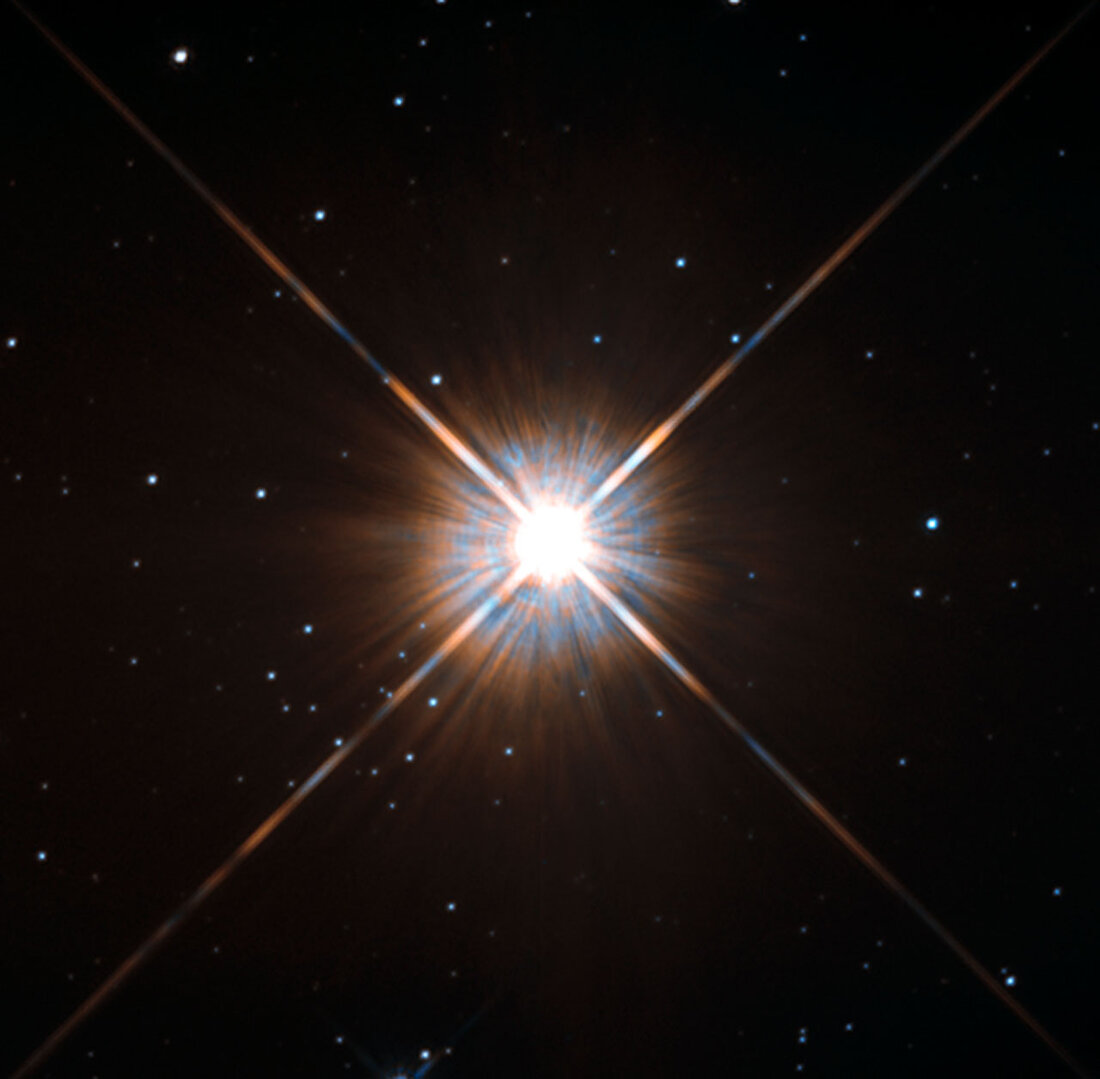
Proxima. It was found in 1915 by Robert Innes at the Union Observatory in Johannesburg. Its surface is at about 2,830 kelvin and it turns once in about 85 days. Taking all its light and heat together it gives out about 0.16 per cent of the Sun’s power, which is one part in about 640. In visible light alone it gives out far less, about one part in 18,000. Both fractions were worked out here from the percentages given by Wikipedia. Full daylight cut by 18,000 times is about the light of late dusk.
Barnard’s Star. The second nearest red dwarf moves across the sky faster than any other star, 10.3 seconds of arc a year. That is the width of the full Moon in about 175 years. Worked out here. The American astronomer Edward Barnard measured the movement in 1916. The star is coming closer, and in about 10,000 years it will pass 3.75 light years from the Sun.
Stirred, not layered. In the Sun, the helium made at the centre stays at the centre. The fuel there runs out while most of the Sun’s hydrogen, further out, is never used. A red dwarf below about a third of the Sun’s mass is different. It boils from the centre to the surface, so the helium is carried away and fresh hydrogen is carried in. Small fuel tank, tiny flame, and nearly every drop used: that is why they last so long. A star like Barnard’s should shine for about 2,500 billion years.
What happens in the end? Nobody has seen it, because it has not happened yet. The theory is that the smaller red dwarfs never swell into red giants as the Sun will. They slowly grow hotter and bluer for a few billion years and then fade into white dwarfs made of helium.
Flares and life. The flare of March 2016 on Proxima is thought to be one of about five as large each year. On 6 May 2019 another was, for a moment, the brightest ever recorded from the star in ultraviolet light. A planet close in would need a thick atmosphere or a strong magnetic shield to keep its air. There is another side to it: red dwarfs calm down as they age, and they offer a steady home for a thousand times longer than the Sun can.
Proxima’s planets. Proxima b was announced on 24 August 2016. It is at least 1.06 times as heavy as the Earth and lies 0.048 of the Earth’s distance from its star, eight times closer than Mercury is to the Sun. Worked out here. A second, smaller planet, Proxima d, goes round in 5.1 days and was confirmed in 2025. A third has been claimed and is disputed.
Where this comes from
- Wikipedia, Red dwarf
- Wikipedia, Proxima Centauri
- Wikipedia, Barnard's Star
- ESA/Hubble, Hubble's view of Proxima Centauri
The words are written for this site. Sums in the text are worked from the figures in these sources.