
Learn / Lesson packs
Everything about the Solar System
The Sun and all that goes round it: planets, moons, rings, comets and the cold edge, and the rules that keep them moving.
26 lessons in 5 parts. Every one can be read again at a deeper level.
Part 1
The Sun
The star in the middle, which holds almost all of the mass.
- 1What the Sun is
The Sun is a star seen close up: a ball of glowing gas, layered like an onion, with a furnace in the middle.
With moving pictures and photographs
- 2How the Sun shines
The Sun turns matter into light in its core. The light then takes many thousands of years to find its way out.
- 3The active Sun
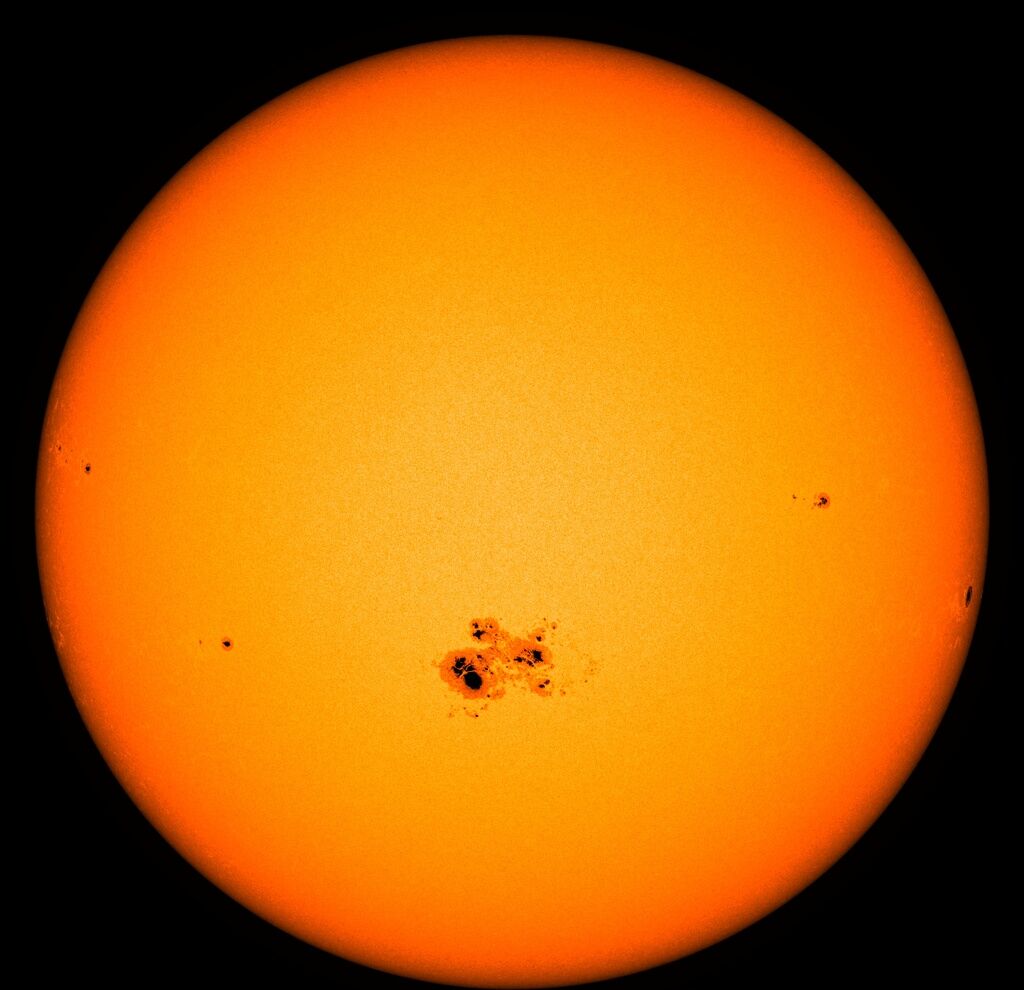
The Sun has weather: dark spots, sudden flares and vast eruptions that follow an eleven-year rhythm and can reach the Earth.
- 4The Sun's reach: the solar wind and the edge
The Sun blows a thin wind past every planet. Far beyond Neptune the wind stops, and two spacecraft have crossed the place where it does.
Part 2
The planets
Three kinds of world, how they formed, and why their skies differ.
- 5Rock, gas, ice: three kinds of planet
The eight planets come in three sorts, and where each one formed explains which sort it is.
- 6What counts as a planet
For 76 years the Solar System had nine planets. In 2006 astronomers agreed on what the word means, and Pluto no longer fitted.
With moving pictures and photographs
- 7The Earth as a planet
Seen from outside, the Earth is one rocky planet among four. It is also the only one with seas on its surface, and the only place known to have life.
With moving pictures and photographs
- 8How the planets formed
The planets grew from a disc of gas and dust around the young Sun, from specks to boulders to worlds, in a few tens of millions of years.
- 9Inside planets and their magnetic shields
Nobody has been more than a scratch below the ground, yet earthquakes show what is inside the Earth. The moving metal at its centre makes a shield round the planet.
With moving pictures and photographs
- 10Air and the greenhouse: Venus, Earth and Mars
Three rocky planets began much alike and ended as a furnace, a home and a frozen desert. The difference is their air.
- 11Rings
All four giant planets have rings. They are countless separate pieces of ice and rock, each on its own orbit, and astonishingly thin.
Part 3
The moons
More than two hundred of them, some with oceans under the ice.
- 12What a moon is
Anything that orbits a planet is a moon. There are more than 400, from worlds bigger than Mercury to rocks a kilometre across.
- 13The Moon
Our nearest neighbour: a quarter as wide as the Earth, made from the wreckage of a collision, and the only other world people have stood on.
With moving pictures and photographs
- 14Moons with oceans
Several icy moons hide seas of liquid water under their crusts, kept warm by tides. They are the likeliest places to look for life.
- 15Moons in step
Some moons keep time with each other, lapping their neighbours in exact whole numbers. That rhythm heats Io, carves gaps in rings and makes two moons swap places.
- 16Tides
Why there are two high tides a day, why the Moon keeps one face to us, and what keeps Io erupting.
- 17Phases and eclipses
Why the Moon changes shape every month, and why eclipses are much rarer than that.
Part 4
The small things, and the edge
Asteroids, comets, falling rocks and the cloud that surrounds it all.
- 18Rubble and ice: the small bodies
Asteroids, comets and the icy bodies beyond Neptune are what was left over when the planets were made. Where each kind lives tells you what it is made of.
- 19Comets
A comet is a small dark lump of ice and dust. Near the Sun it boils off a cloud bigger than a planet and tails millions of kilometres long.
- 20Falling rocks: meteors, meteorites and impacts
A shooting star is a grain of dust burning up. Bigger pieces reach the ground, and once in a long while one is big enough to change the world.
- 21Things that hit the Earth
Rocks from space have hit the Earth before and will again. We now watch for them, and in 2022 a spacecraft moved one on purpose.
With moving pictures and photographs
- 22The Oort cloud
Far beyond the planets, a vast round shell of icy bodies is thought to surround the Sun. Nobody has seen it. Comets are the evidence.
Part 5
How it all moves
Orbits, the laws they follow, and how spacecraft use them.
- 23What an orbit is
An orbit is a fall that never reaches the ground. Newton's cannonball shows how.
With moving pictures and photographs
- 24Kepler's three laws
Three short rules that describe every orbit, found from years of watching Mars.
- 25Balance points: where gravity holds things still
Near any two orbiting bodies there are five places where a small object can keep station. Telescopes are parked at two of them, and asteroids gather at two more.
- 26Leaving and arriving: how spacecraft get about
Getting into space is about speed, not height. After that a spacecraft mostly coasts, and borrows speed from planets on the way.
Go and look
- Fly round the planets in 3D
Every planet and moon where it is today.
- The atlas
Maps of the worlds that have been mapped.