
Learn / Lesson packs
Galaxies and the universe
From our own galaxy outward to the largest structures there are, and back in time to the first few minutes.
19 lessons in 3 parts. Every one can be read again at a deeper level.
Part 1
Our galaxy and the others
The Milky Way from inside, and the kinds of galaxy there are.
- 1The Milky Way
Our galaxy is a flat, turning disc of a few hundred billion stars. We live inside it, about half way out, and have never seen it from outside.
- 2The stuff between the stars
The space between the stars holds thin gas and a little dust. It is emptier than any vacuum made on the Earth, and it is what every star is made from.
With moving pictures and photographs
- 3Spiral arms
The arms of a spiral galaxy are not fixed strings of stars. They are patterns that stars pass through, lit up by the young stars born inside them.
With moving pictures and photographs
- 4The centre of the galaxy
The middle of the Milky Way is hidden behind dust. Seen in other kinds of light, it is a crowd of stars whirling round a black hole of four million Suns.
With moving pictures and photographs
- 5Kinds of galaxy
Galaxies come as spirals, smooth ellipticals and ragged irregulars. They gather into groups and clusters, strung across space like a web.
- 6When galaxies collide
Galaxies grow by pulling in their neighbours. A collision takes hundreds of millions of years, hardly any stars touch, and both galaxies come out a different shape.
- 7How galaxies form and change
Galaxies were not always as they are now. They began small and ragged, grew by pulling in gas and swallowing each other, and made most of their stars long ago.
With moving pictures and photographs
- 8Active galaxies and quasars
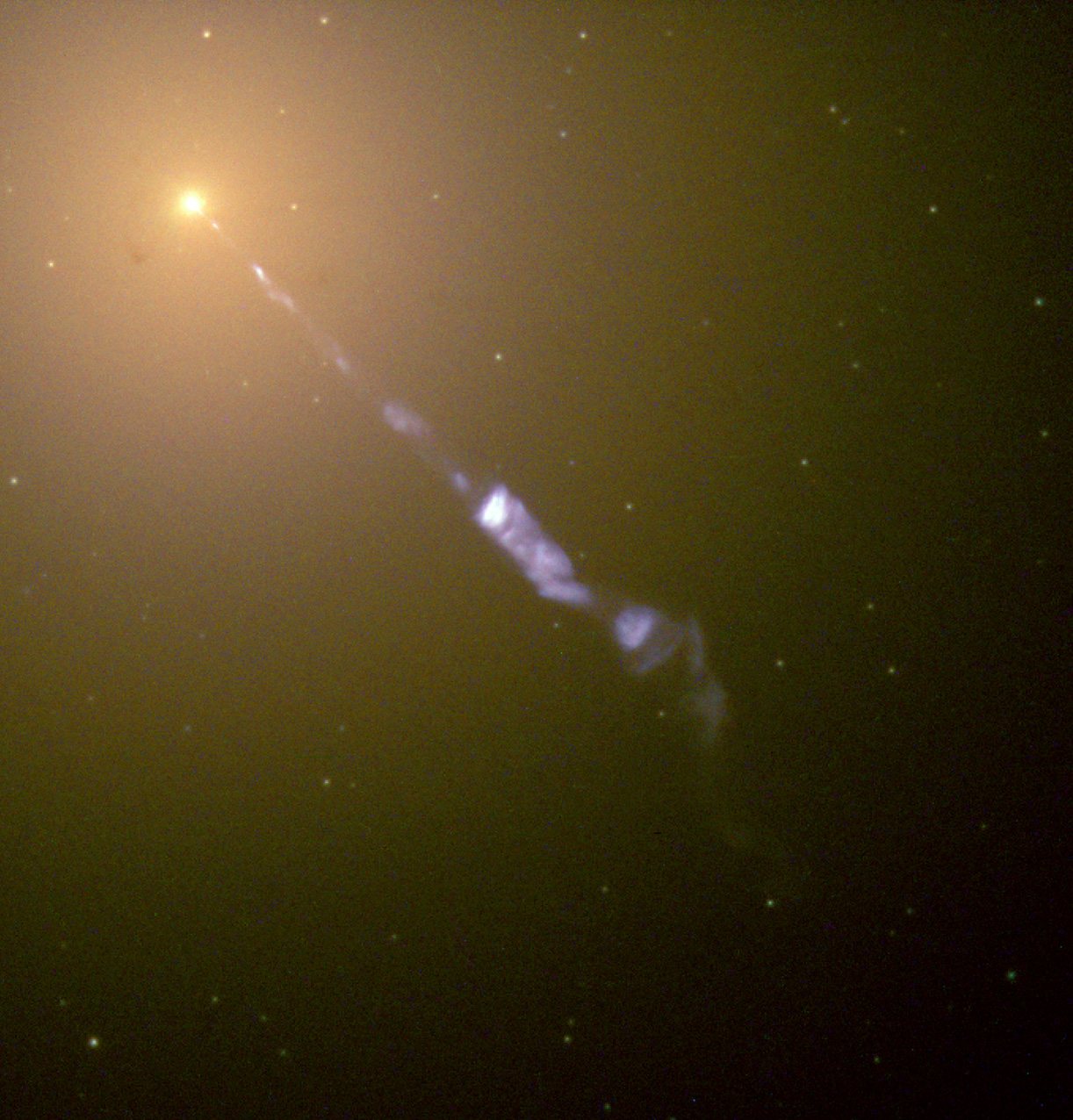
In about one galaxy in ten, the centre outshines all the stars put together. The light comes from gas heating up as it falls towards a giant black hole.
Part 2
The biggest picture
How galaxies are spread through space, and how their distances are found.
- 9Variable stars and the distance ladder
Some stars brighten and fade on a steady beat, and the beat gives away how bright they truly are. That is how the distances to other galaxies were first measured.
- 10The cosmic web
Galaxies are not scattered evenly. They gather into groups, clusters and long threads, with huge empty spaces between, like the walls of a foam.
- 11Galaxy clusters
A cluster is hundreds or thousands of galaxies held together by gravity. Most of what is in one is not galaxies at all: it is hot gas and dark matter.
With moving pictures and photographs
Part 3
The universe itself
Its expansion, its first minutes, and the two things in it nobody has yet explained.
- 12The expanding universe
Distant galaxies are all moving away from us, and from each other. Run the film backwards and you arrive at a hot, dense beginning 13.8 billion years ago.
- 13The first minutes and the oldest light
In its first few minutes the universe made its hydrogen and helium. After 380,000 years it turned clear, and the light set free then is still arriving.
- 14The oldest light
A faint glow of microwaves comes from every direction in the sky. It is the light of the young universe, and its pattern holds the age and make-up of everything.
With moving pictures and photographs
- 15How we know there was a Big Bang
Nobody watched the universe begin. Four separate lines of evidence, found in different ways by different people, all point to the same hot, dense start.
With moving pictures and photographs
- 16The history of the universe on one timeline
13.8 billion years, from the first light to this evening, squeezed into a single calendar year so that the gaps between events can be felt.
With moving pictures and photographs
- 17Dark matter and dark energy
Everything we can see adds up to about 5 per cent of the universe. The rest is known only by what it does, and nobody knows what it is.
- 18How big is the universe?
There is an edge to what can be seen, 46 billion light years away in every direction. It is not the edge of the universe, and nobody knows how far the rest goes.
With moving pictures and photographs
- 19How it all ends
The Sun will die, the galaxies will run out of gas, and the last stars will go out. What happens after that depends on something nobody yet understands.
With moving pictures and photographs
Go and look
- Fly out to the cosmic web
About 43,000 real galaxies, each where it was measured to be.