
Learn / White dwarfs, neutron stars and black holes
How it works
Cause and effect, with real numbers.
- First look
- How it works
- The physics, still to be written
- The frontier, still to be written
How it works
Cause and effect, with real numbers
A neutron star is one of the three things a star can leave behind when it dies. Which one depends on how heavy the crushed core is.
| What is left | When | Size |
|---|---|---|
| White dwarf | A star like the Sun fades without exploding | About the size of the Earth |
| Neutron star | A massive star explodes and its core is between about 1 and 3 times the Sun’s mass | About 20 km across |
| Black hole | The core is heavier than that | No surface at all |
How one forms. When a massive star runs out of fuel, its core collapses. The pressure is so great that every proton and electron is crushed together into a neutron. If the core holds between about 1 and 3 times the mass of the Sun, the newly made neutrons can resist being squeezed any further, and the collapse stops. A heavier core keeps going and becomes a black hole.
How dense. A sugar cube of neutron star would weigh about a trillion kilograms on the Earth. That is a billion tonnes.
Pulsars. Most neutron stars we know of were found as pulsars. A pulsar has a very strong magnetic field, which drives particles out along its two magnetic poles, and those particles make powerful beams of light. The magnetic poles are usually not lined up with the axis the star spins on, so the beams swing round as it turns. We see a pulse each time a beam crosses us, at intervals from thousandths of a second to a few seconds. The light is on all the time. Like a lighthouse, you only see it when it points at you.
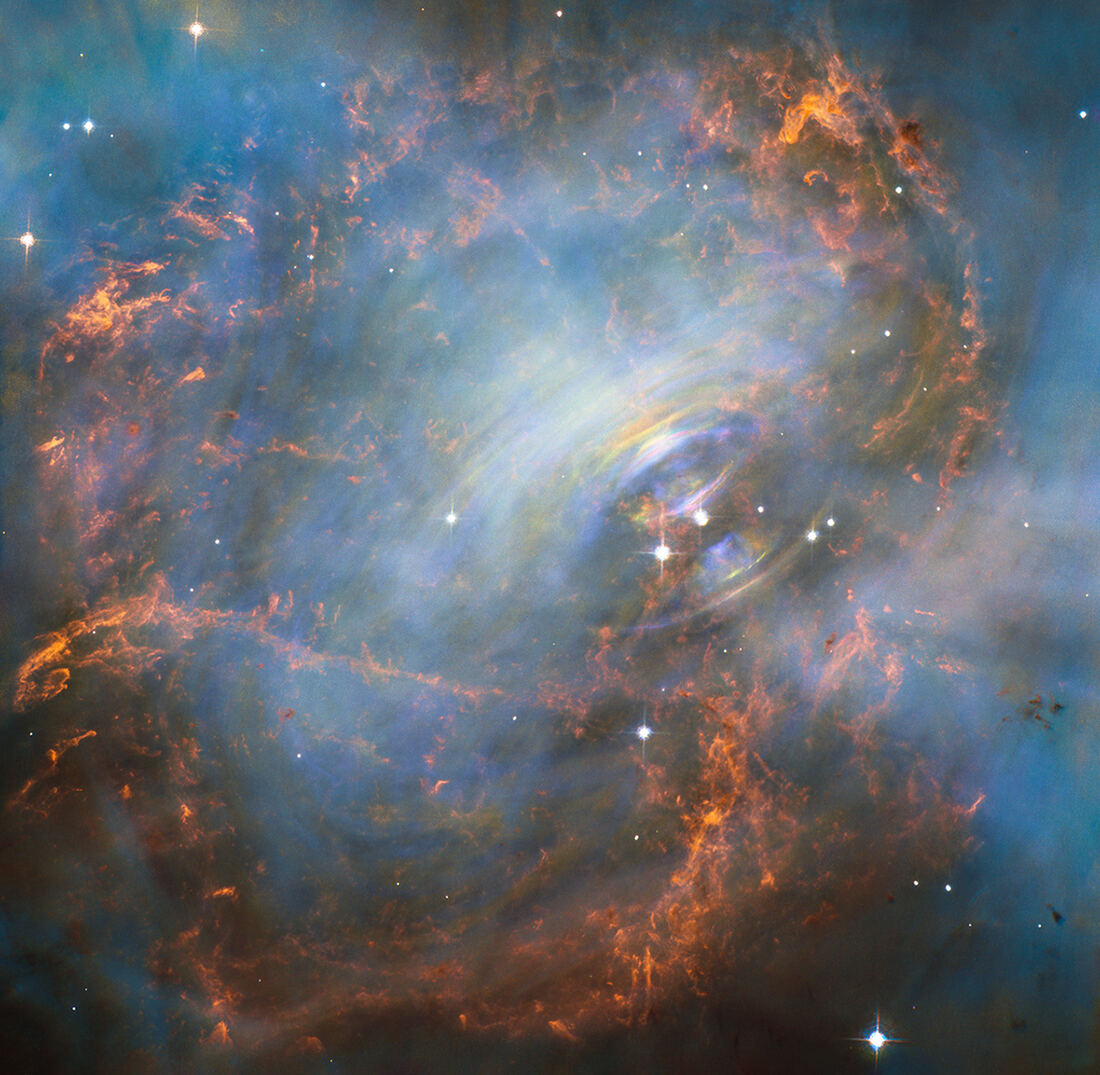
The Crab. The Crab Nebula is the cloud left by the supernova of 1054, about 6,500 light years away and six light years across. The pulsar at its centre turns 30 times a second. Worked out here: for a ball 20 km across, that means a point on its equator is moving at nearly 1,900 km every second.
How they were found. In 1967, at Cambridge, Jocelyn Bell and Antony Hewish picked up a radio source that pulsed at extremely regular intervals. Nothing like it was known. It turned out to be a spinning neutron star, and the discovery proved that such stars exist. Hewish shared the Nobel Prize in Physics in 1974 for his part in the discovery.
Magnetars. An ordinary neutron star has a magnetic field trillions of times stronger than the Earth’s. A magnetar’s is another thousand times stronger. The crust of a neutron star is locked to its magnetic field, so when the crust slips, the field is shaken too, and a magnetar can let go a vast burst of energy. In one burst lasting a tenth of a second, the magnetar SGR 1806-20 gave out more energy than the Sun has in the last 100,000 years.
A clock that tested Einstein. A pulsar keeps time very steadily, which makes it a measuring tool. In 1974 Russell Hulse and Joseph Taylor found a pulsar in orbit round another star of about the same mass, the two going round each other in less than eight hours. Einstein’s theory of gravity says such a pair should lose energy by giving off gravitational waves, and so draw slowly closer. Timing the pulses showed exactly that: the orbit is getting shorter by about 75 millionths of a second every year. The measured change agrees with the calculated one, which the Nobel committee called an indirect proof that gravitational waves exist, long before any were detected directly. Hulse and Taylor were given the prize in 1993.
Hard to see. Many neutron stars are probably never noticed, because they simply do not give out enough radiation to detect. A handful have been found sitting quietly at the centre of the cloud left by their supernova, glowing in X-rays.
Where this comes from
- NASA Imagine the Universe, Neutron stars
- NASA, Messier 1 (the Crab Nebula)
- Nobel Prize in Physics 1974, Antony Hewish
- Nobel Prize in Physics 1993, press release
The words are written for this site. Sums in the text are worked from the figures in these sources.