
Learn / Light, and how we know anything
How it works
Cause and effect, with real numbers.
- First look
- How it works
- The physics, still to be written
- The frontier, still to be written
How it works
Cause and effect, with real numbers
| Messenger | What it is | Why it is useful | Why it is hard |
|---|---|---|---|
| Light | Waves, from radio to gamma rays | Easy to catch, and there is a great deal of it | Blocked by dust, gas and the insides of stars |
| Neutrinos | Particles with almost no mass and no charge | Come straight out of places light is trapped in, and travel in straight lines | Nearly all of them pass through the detector too |
| Cosmic rays | The centres of atoms, moving at nearly the speed of light | Carry far more energy than any machine on the Earth can give a particle | Magnetic fields bend their paths, so they do not point back to where they began |
| Gravitational waves | Ripples in space itself | Pass through everything, and give the masses of what collided | The stretch to be measured is far smaller than an atom |
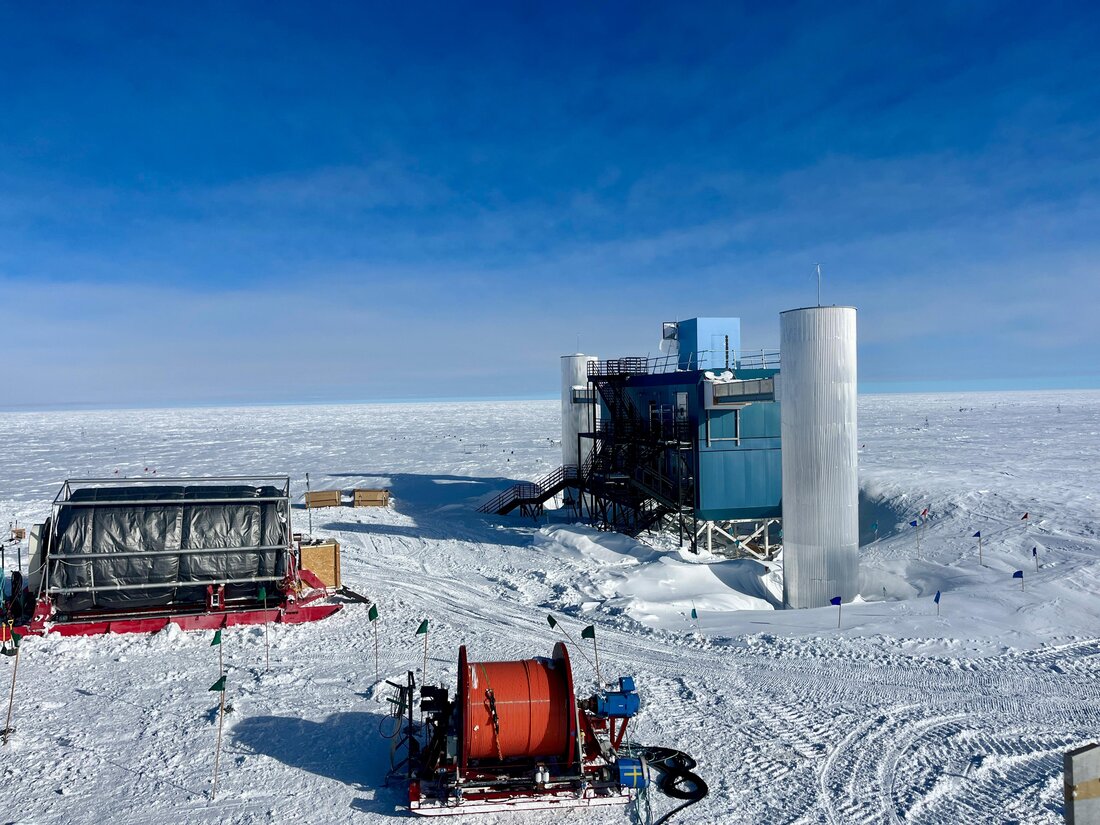
A telescope that looks down. The detector at the South Pole is called IceCube. It was finished in December 2010. Its sensors sit between about 1,450 and 2,450 metres below the surface. It looks down as well as up, and uses the whole Earth as a shield: anything arriving from below must have come through the planet, and only a neutrino can do that.
Two things it has found. On 22 September 2017 it caught one neutrino of very high energy and sent out an alert the same day. About 20 observatories turned to look. In that spot was a galaxy with a giant black hole firing a jet straight at us, about 4 billion light years away, and it was flaring. It was the first time a neutrino of that kind had been traced to its source. In 2023 the team picked 60,000 neutrinos out of ten years of records and found the first sign of the Milky Way glowing in neutrinos.
What cosmic rays are. About 90 in every 100 are the centres of hydrogen atoms, about 9 are helium, and the last 1 is everything heavier. Most are thought to be flung out by the blast waves of exploded stars. Because they carry an electric charge, the magnetic fields of the galaxy, the Sun and the Earth bend their paths and scramble where they seem to come from.
The 1991 particle. On the night of 15 October 1991 a detector in Utah called the Fly’s Eye recorded the shower from a single particle carrying 51 joules. That is the energy of a tennis ball of 58 grams moving at about 150 km an hour (worked out here), packed into one centre of an atom. It is still the most energetic cosmic ray ever recorded, and nobody knows what threw it. The largest detector built to look for more is in Argentina: about 1,600 tanks of water spread over 3,000 square kilometres.
More than one at once. The best cases are the ones caught two ways. Neutrinos and light from the 1987 supernova showed that the core of a dying star really does collapse. Ripples and light from the 2017 neutron stars showed where some of the heaviest elements are made. See Gravitational waves and Where the elements come from.
Where this comes from
- IceCube Neutrino Observatory, The detector
- IceCube, Neutrinos point to long-sought cosmic ray accelerator (2018)
- IceCube, Our galaxy seen through a new lens (2023)
- NASA Imagine the Universe, Cosmic rays
- Bird and others 1995, Detection of a cosmic ray with measured energy well beyond the expected cutoff
- University of Utah, Solving the mystery of the OMG particle (2023)
- Abbott et al. 2017, The Astrophysical Journal Letters 848, L12
The words are written for this site. Sums in the text are worked from the figures in these sources.