
Learn / White dwarfs, neutron stars and black holes
Magnetars and gamma-ray bursts
How it works
Cause and effect, with real numbers.
- First look
- How it works
- The physics, still to be written
- The frontier, still to be written
How it works
Cause and effect, with real numbers
How strong? Magnetic strength is measured in tesla. These figures are from Wikipedia’s article on magnetars.
| Magnet | Strength in tesla |
|---|---|
| The Earth’s field, which turns a compass | about 0.00005 |
| A strong rare-earth magnet | about 1.25 |
| An ordinary neutron star | about 100 million |
| A magnetar | 1 billion to 100 billion |
The strongest magnetar field is about two thousand million million times the Earth’s. Worked out here. A spoonful of a neutron star would weigh more than 100 million tonnes, and a magnetar turns slowly for a neutron star, once in 2 to 10 seconds.
Where the idea came from. In the 1970s and 1980s satellites kept picking up flashes of gamma rays that came again and again from the same few places. On 5 March 1979 one flash was more than 100 times as strong as anything seen from beyond the Solar System before. It swamped the detectors on two Soviet Venus spacecraft, and 11 seconds later reached a third spacecraft elsewhere. In 1992 Robert Duncan and Christopher Thompson proposed that the sources were neutron stars with fields a thousand times stronger than usual. By 2021 astronomers had confirmed 31 magnetars among roughly 3,000 known neutron stars.
A short life. A magnetar’s field fades in about 10,000 years, and the flaring stops. So for every one seen, a great many must have gone quiet. One estimate is 30 million or more in our galaxy.
The flare of 2004. The magnetar is called SGR 1806−20. It is at most 20 km across and turns once in 7.5 seconds. Its distance is given as about 42,000 light years. The energy let out in that tenth of a second was about 1 followed by 40 noughts in joules, and the gamma rays made the top of the Earth’s air swell for a moment. An earlier flare, on 27 August 1998, came from the magnetar inside the ring of dust, 20,000 light years away. It kept the night-time upper air almost as electrified as it is by day.
Radio flashes. Since 2007 radio telescopes have caught bright flashes lasting a thousandth of a second from far galaxies, and nobody knew what made them. On 28 April 2020 a magnetar in our own galaxy gave off just such a flash. At least some of them, then, come from magnetars.
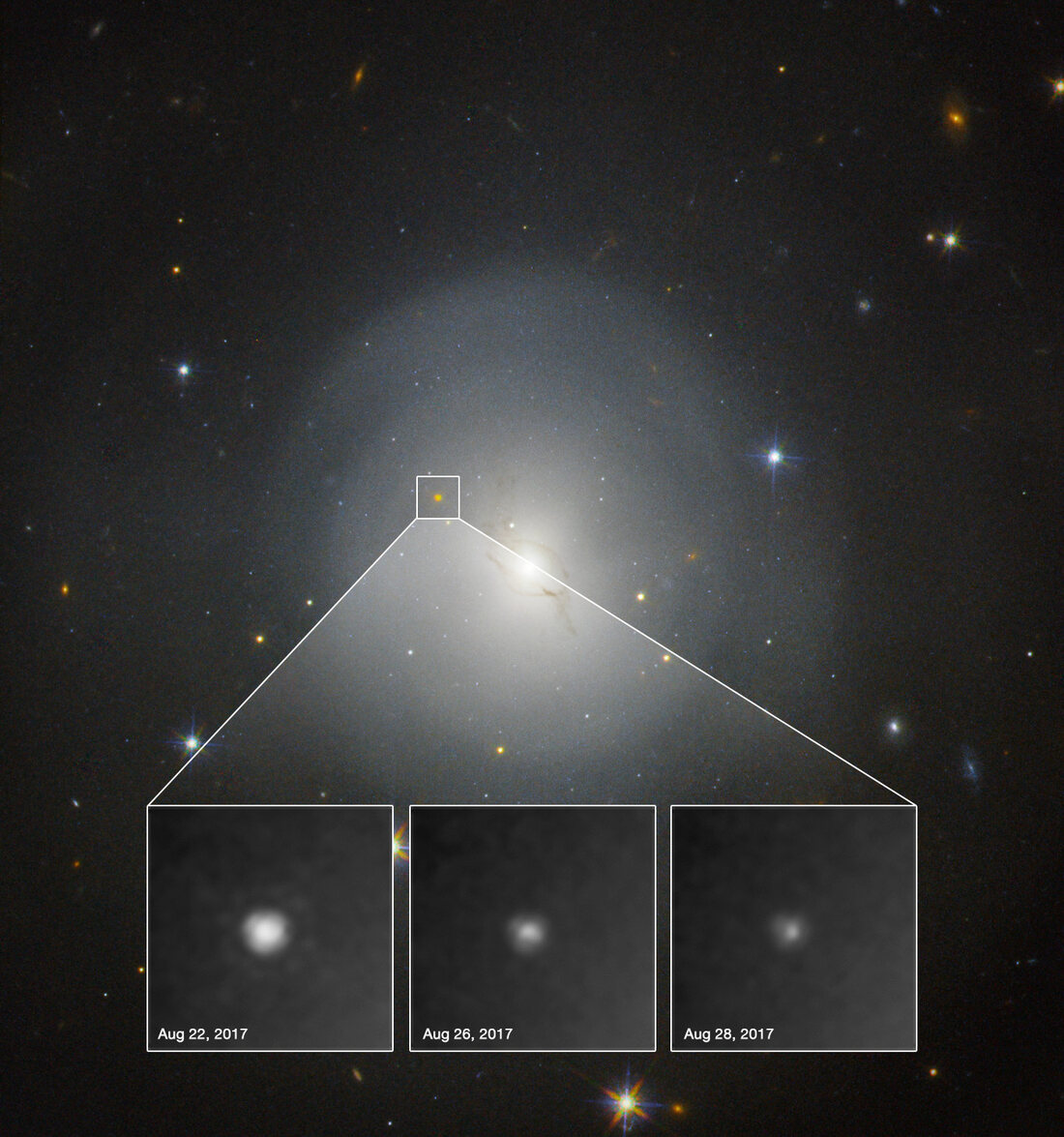
Two kinds of burst. About 7 in 10 gamma-ray bursts last longer than two seconds, typically about 30. These are the collapsing stars. The rest are shorter than two seconds, typically about 0.3, and are the colliding neutron stars. A typical burst gives out as much energy in a few seconds as the Sun will in its 10 billion years. The jets are between 2 and 20 degrees wide, so most bursts in the universe point somewhere else and are never seen from here.
Working out how far. For thirty years nobody knew whether the bursts came from the edge of the Solar System or the edge of the universe. In February 1997 the Italian and Dutch satellite BeppoSAX caught a burst and then found its fading glow in X-rays, quickly enough for telescopes on the ground to look. A burst that May was the first to have its distance measured: 6 billion light years. On 19 March 2008 the glow of a burst 7.5 billion light years away was, for about half a minute, just bright enough to have been seen by eye.
The BOAT. Its catalogue name is GRB 221009A. The main burst lasted about ten minutes. It was picked up by Voyager 1, far beyond the planets, and by spacecraft circling Mars. A detector in China recorded particles of light from it each carrying about 7 million million times the energy of a particle of visible light. Worked out here from the 18 million million electron volts reported. Twenty separate dust rings were counted. The James Webb Space Telescope later found the exploding star that caused it. The figure of once in ten thousand years has been questioned.
Are we in danger? A burst a few thousand light years away, with its jet pointed straight at the Earth, could strip much of the ozone layer that keeps out the Sun’s ultraviolet. Some scientists have suggested that this happened about 450 million years ago and helped to cause a great dying in the seas. It is only a suggestion. Bursts are rare in a galaxy like ours, and no known star is both close enough and aimed at us.
Where this comes from
- Wikipedia, Magnetar
- Wikipedia, SGR 1806-20
- Wikipedia, SGR 1900+14
- Wikipedia, Gamma-ray burst
- Wikipedia, GRB 221009A
- NASA Scientific Visualization Studio, NASA missions detect record-breaking burst
The words are written for this site. Sums in the text are worked from the figures in these sources.