
Learn / Life
Looking for life in the Solar System
How it works
Cause and effect, with real numbers.
- First look
- How it works
- The physics, still to be written
- The frontier, still to be written
How it works
Cause and effect, with real numbers
The four places.
| Where | Why look | Who has been, and who is going |
|---|---|---|
| Mars | Rivers and lakes long ago | Viking 1 and 2 landed in 1976. Perseverance has worked in Jezero Crater since 2021 |
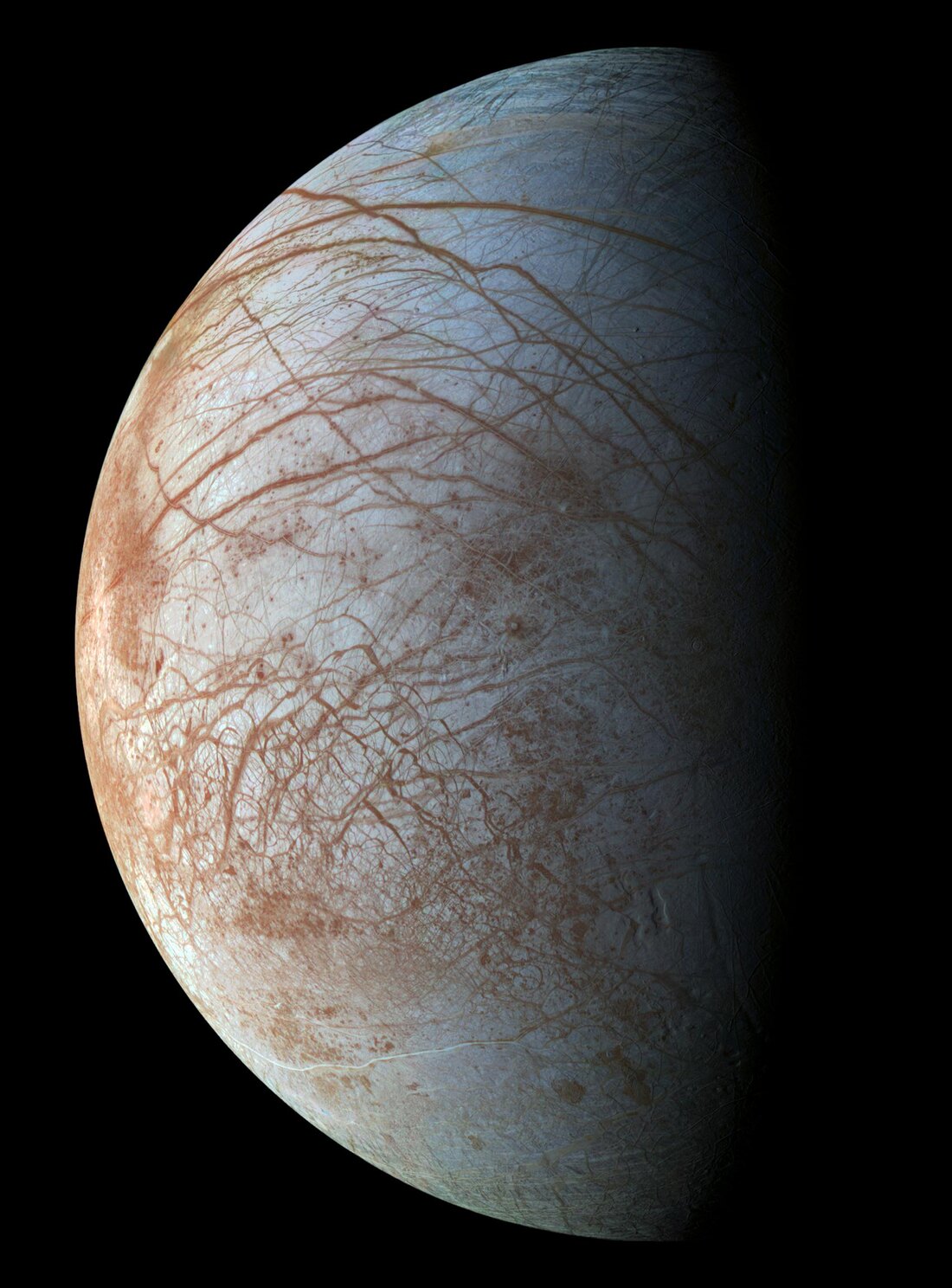
| Europa, moon of Jupiter | A salt ocean under the ice, more than twice the Earth’s | Europa Clipper: launched 14 October 2024, arrives April 2030, 49 close passes |
| Enceladus, moon of Saturn | An ocean that sprays into space, with salts, carbon compounds and signs of hot vents | Cassini found the jets in 2005 and flew through them |
| Titan, moon of Saturn | Thick air, carbon chemistry, seas of methane, and a water ocean deep below | Huygens landed in 2005. Dragonfly: launch no earlier than July 2028, arrival late 2034 |
The spotted rock. The rock is called Cheyava Falls, and the piece drilled from it is called Sapphire Canyon. The study, led by Joel Hurowitz, was published in the journal Nature in September 2025. The spots hold two minerals, one made of iron and phosphorus and one of iron and sulphur, in rock that is also rich in carbon compounds. On Earth, microbes that feed on such compounds leave these minerals behind. But heat or acid can make them too, without any life. The rock shows no sign of either, yet the team said plainly that they could not rule out a lifeless cause. One of the mission’s scientists put the standard this way: claims of life need extraordinary evidence.
What Viking found. The soil gave off gas when a liquid food was added, which is what microbes would do. But the lander’s other instrument found none of the carbon compounds that living things are made of. NASA’s summary is that the experiments found unexpected chemical activity in the soil and no clear evidence of living microbes.
The hot vents of Enceladus. The tiny grains are silica, and grains of that size form only where liquid water touches rock at more than about 90 °C. So the floor of Enceladus’s ocean must have hot vents, like those on the Earth’s sea floor where life thrives without sunlight. The carbon compounds in the jets were about twenty times as plentiful as had been expected.
Titan’s two chances. Titan might harbour life in two quite different places: in its seas of methane on the surface, or in the ocean of water, probably mixed with salts and ammonia, that lies 55 to 80 kilometres down under the ice. Dragonfly will fly from place to place on the surface, sampling the ground. Its leader describes its job as studying the chemistry that came before life.
What would count. No single measurement will settle it. A convincing discovery would need several independent signs that agree, and every lifeless explanation ruled out.
Where this comes from
- NASA, Viking
- NASA, NASA says Mars rover discovered potential biosignature last year (10 September 2025)
- NASA, Europa Clipper
- NASA, Enceladus
- NASA, Titan facts
- NASA, Dragonfly
The words are written for this site. Sums in the text are worked from the figures in these sources.