
Learn / Exploring space
How it works
Cause and effect, with real numbers.
- First look
- How it works
- The physics, still to be written
- The frontier, still to be written
How it works
Cause and effect, with real numbers
The station in numbers. These are NASA’s own figures.
| Length, end to end | 109 metres |
| Mass | 419,725 kg |
| Room to live in | 388 cubic metres, more than a six-bedroom house |
| Speed | about 8 km a second |
| Time to go once round the Earth | about 90 minutes |
| Usual crew | 7 |
| Sleeping cabins, bathrooms | 6 and 2 |
| Power from its solar panels | 75 to 90 kilowatts |
| Lived in without a break since | November 2000 |
Five space agencies from 15 countries built it and run it together.
Why floating is falling. Gravity weakens with distance from the centre of the Earth, not from its surface. The ground is 6,371 km from the centre and the station about 6,771 km, which is only 6 per cent further. That makes gravity there about 89 per cent as strong as on the ground. Worked out here. What the crew have lost is not gravity but the floor pushing back.
What it does to the body. NASA lists five dangers of living in space: radiation, being shut in and cut off, distance from the Earth, the change in gravity, and living in a sealed and hostile place. The change in gravity is felt first. Bones that carry weight lose 1 to 1.5 per cent of their mineral a month. Muscle goes faster than it would on the ground. The blood and other fluids of the body, with nothing to pull them down, move up towards the head, which can press on the eyes and blur the sight. Exercise, on a treadmill, a cycle and a machine that stands in for weights, slows the loss of bone and muscle but does not stop it.
Radiation. The Earth’s air and magnetic field stop most of the fast particles from the Sun and from the galaxy. The station is still inside the magnetic field, which gives its crew some shelter. On the way to the Moon or Mars there is none. The harm it does builds up slowly, over years.
Water. Without recycling, each person would need about a gallon of water sent up every day, which is 3.8 litres. The station’s recovery system cuts that by 65 per cent, to about a third of a gallon.
Sixteen sunrises. One trip round the Earth takes about 90 minutes, and there are 1,440 minutes in a day, so the station goes round 16 times. Worked out here, and it matches NASA’s count.
Going outside. The first person to leave a spacecraft and float in space was the Soviet cosmonaut Alexei Leonov, in March 1965. For nearly twenty years after that everyone who went outside was tied on. Bruce McCandless flew free of the Space Shuttle Challenger using a backpack with small gas jets, and a crewmate photographed him through the window when he was at his furthest from the ship.
The longest stays. Valeri Polyakov, a Russian doctor, lived on the space station Mir from 8 January 1994 to 22 March 1995: 437 days in one stretch, which is still the record. He went partly to find out whether a person could stand a journey as long as one to Mars.
Where this comes from
- NASA, International Space Station facts and figures
- NASA, The human body in space
- NASA image library, Shannon Walker on the treadmill (ISS024-E-007998)
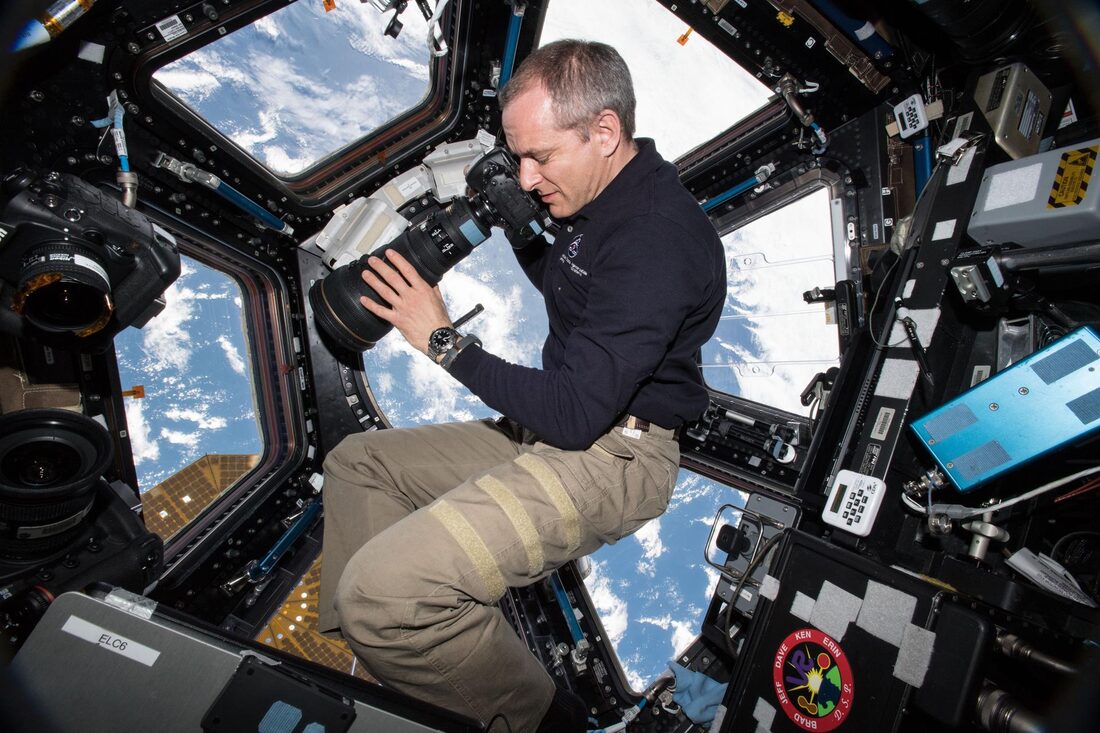
- NASA image library, David Saint-Jacques in the cupola (iss058e003901)
- NASA image library, Bruce McCandless flying free (S84-27031)
- Wikipedia, Valeri Polyakov
- Wikipedia, List of spaceflight records
The words are written for this site. Sums in the text are worked from the figures in these sources.