
Learn / Life
How it works
Cause and effect, with real numbers.
- First look
- How it works
- The physics, still to be written
- The frontier, still to be written
How it works
Cause and effect, with real numbers
The first search. Drake’s search was called Project Ozma. It used the 85-foot (26 metre) dish at Green Bank in West Virginia, from April to July 1960. The two stars were Tau Ceti and Epsilon Eridani, each about 11 light years away. He tuned to 1,420 megahertz, the natural radio note of hydrogen, on the reasoning that any astronomer anywhere would know it. Apart from one false alarm, probably from an aircraft’s radar, there was only static.
Reading “6EQUJ5”. The telescope’s computer printed one character for the strength of the signal in each ten seconds or so: the digits 1 to 9, then A for 10, B for 11 and so on. The famous six characters are therefore six numbers.
| Character | 6 | E | Q | U | J | 5 |
|---|---|---|---|---|---|---|
| Strength, in multiples of the background | 6 | 14 | 26 | 30 | 19 | 5 |
It is not a message. It is the shape a steady source makes as it drifts through the telescope’s view. The telescope, called Big Ear, could not turn: it watched whatever the Earth’s rotation carried past, and any one spot stayed in view for 72 seconds. The signal came from the direction of the constellation Sagittarius, at a pitch very close to hydrogen’s. Searches in 1987, 1989, 1995 to 1996, 1999 and 2022 found nothing there. In 2024 one team suggested a natural cause: a cold cloud of hydrogen suddenly made to shine by an outburst from a star behind it. That is not confirmed either.
What the Arecibo message says. 1,679 is 23 times 73, and no other pair of whole numbers gives it, so there are only two ways to set the message out in rows, and only one makes sense. The picture shows the numbers 1 to 10, the atoms life is made of, the shape of DNA, a human figure, the Solar System and the telescope that sent it. Its authors, led by Frank Drake, meant it more as a show of what could be done than a real attempt to talk.
A hundred years, a hundred light years. Radio travels at the speed of light, so a signal sent a hundred years ago is now a hundred light years away. The disc of the Milky Way is about 100,000 light years across. A ball 200 light years across is one five-hundredth of that. Worked out here, in round numbers.
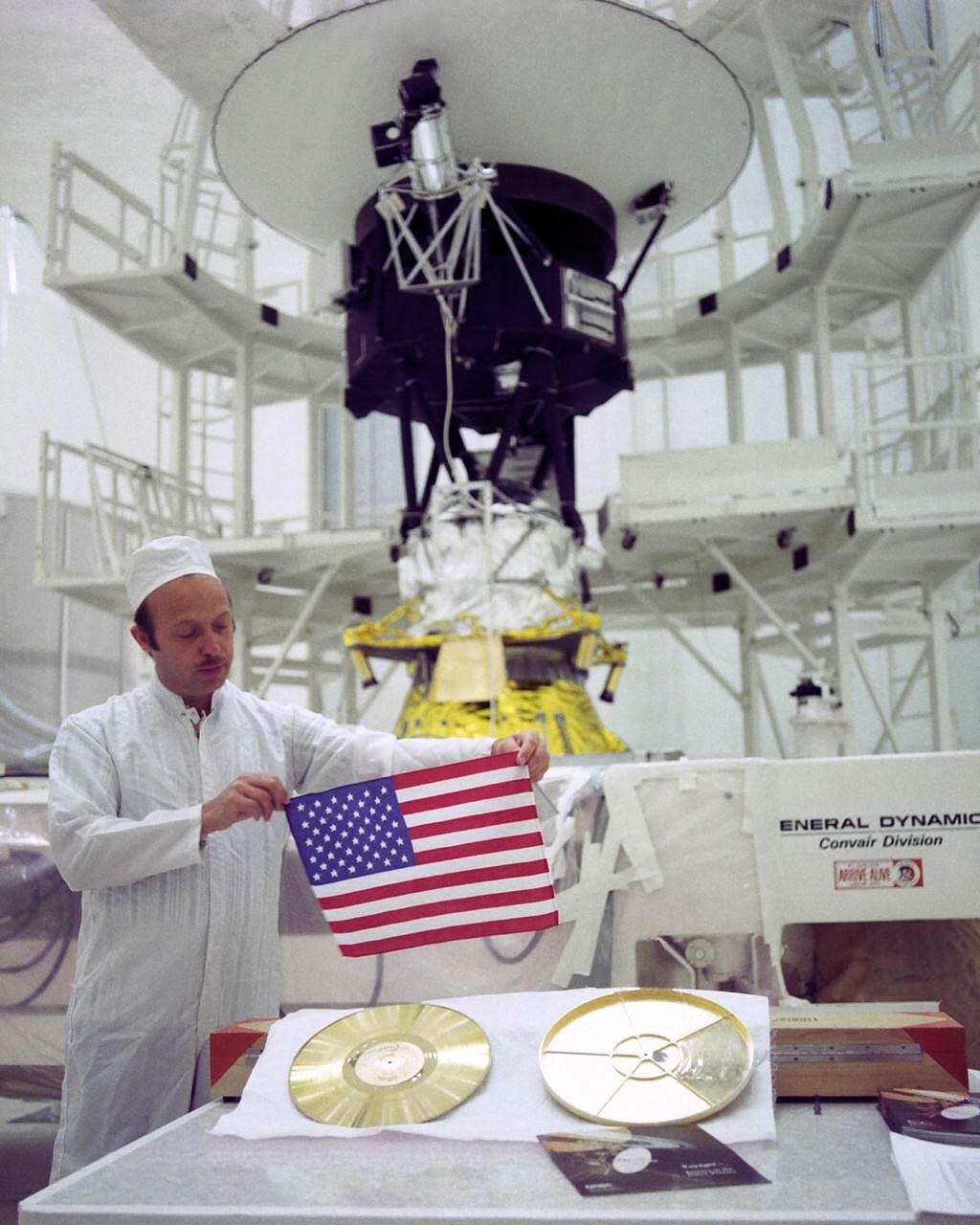
The record’s makers. The contents of the Voyager record were chosen by a committee led by Carl Sagan. The man in the photograph is John Casani, who managed the Voyager project. The spacecraft behind him is Voyager 2.
The puzzle’s possible answers. Fermi asked his question on the way to lunch at Los Alamos in New Mexico. The answers offered since fall into a few families: life, or clever life, is very rare; civilisations destroy themselves or fade quickly; they send signals for only a short time; or they are there and choose to keep away. None can be tested yet except by more searching.
Where this comes from
- SETI Institute, Project Ozma
- Wikipedia, Wow! signal
- Wikipedia, Arecibo message
- NASA, Voyager: what is on the Golden Record
- NASA, Mementos of Earth (PIA17035)
- Wikipedia, Fermi paradox
- ESA/Hubble, Hubble image of globular cluster M13 (opo0840a)
The words are written for this site. Sums in the text are worked from the figures in these sources.