
Learn / Planets
Inside planets and their magnetic shields
How it works
Cause and effect, with real numbers.
- First look
- How it works
- The physics, still to be written
- The frontier, still to be written
How it works
Cause and effect, with real numbers
The layers of the Earth.
| Layer | What it is | Thickness |
|---|---|---|
| Crust | Solid rock | About 30 km on average under the land |
| Mantle | Hot rock that creeps very slowly | About 2,900 km |
| Outer core | Molten iron and nickel | About 2,300 km |
| Inner core | Solid iron and nickel, as hot as 5,400 °C | 1,221 km in radius |
These rounded figures add up to a little more than the Earth’s average radius of 6,371 km, which is what rounding does. The inner core is solid although it is the hottest part, because the weight of everything above presses the metal too hard for it to melt.
The shadow. The two kinds of earthquake wave are called P waves and S waves. A P wave squeezes and stretches the rock along its path, as sound does, and can cross a liquid. An S wave shakes the rock from side to side, and a liquid cannot carry it. The molten outer core stops S waves altogether and bends P waves, so a band of the Earth between 104 and 140 degrees round from an earthquake receives no direct P waves at all. The size of that shadow gives the size of the core.
The same trick on Mars. NASA’s InSight lander sat on Mars from November 2018 to December 2022 with a seismometer on the ground beside it. It recorded more than 1,300 marsquakes. From them, the core of Mars is molten and about 1,800 km in radius, and the crust under the lander is 25 to 40 km thick. Mars is so far the only other planet measured this way.
Why Mars lost its air. MAVEN measured two kinds of argon high in the Martian air. Argon joins with nothing, so it cannot be locked away in rock: the only way to lose it is to have it knocked into space by particles of the solar wind. The lighter kind is knocked away more easily, and from how much of it is missing the team worked out that about 65 per cent of all the argon Mars ever had is gone. The other gases have gone the same way and by other routes too.
The Earth’s magnet turns over. The north and south ends of the Earth’s magnetism have swapped places many times, and the record is frozen into old rocks. NASA’s summary is that another flip is very unlikely for at least a thousand years.
The worked sum. 12,262 metres is 12.262 km. Divided by 6,371 km that is 0.0019, or about one part in 520. Worked out here.
Where this comes from
- NASA, Earth facts
- USGS, The shadow zone
- NASA, Jupiter facts
- NASA, Mars facts
- NASA, InSight science highlights
- University of Colorado, MAVEN findings reveal how Mars' atmosphere was lost to space (2017)
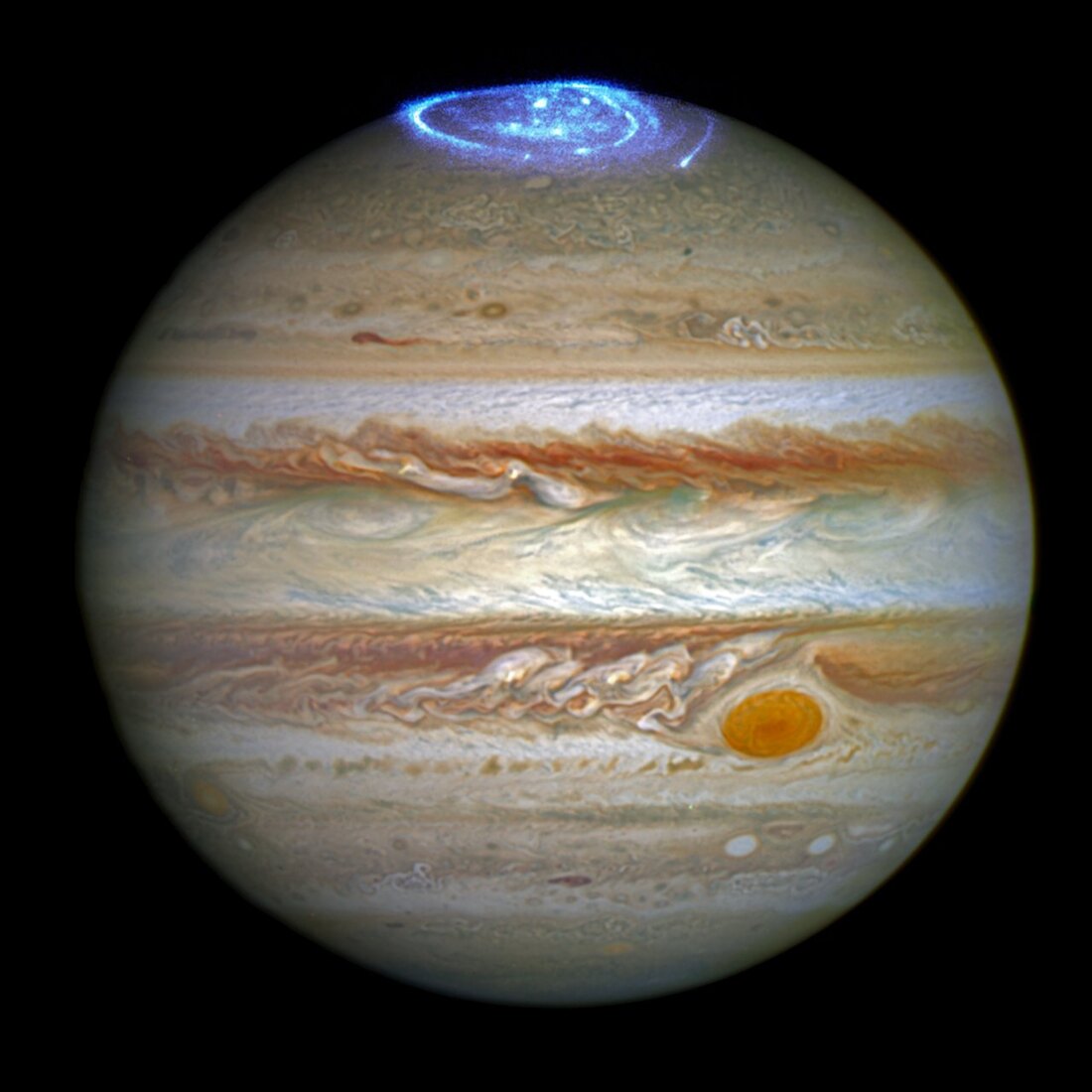
- ESA/Hubble, Hubble captures vivid auroras in Jupiter's atmosphere (heic1613)
The words are written for this site. Sums in the text are worked from the figures in these sources.