
Learn / The universe
How we know there was a Big Bang
How it works
Cause and effect, with real numbers.
- First look
- How it works
- The physics, still to be written
- The frontier, still to be written
How it works
Cause and effect, with real numbers
| The evidence | What was predicted | What was found |
|---|---|---|
| Galaxies moving apart | Speed in step with distance | About 21 km a second faster for every million light years further off |
| The oldest light | A faint, even glow from the whole sky | Microwaves at 2.725 degrees above absolute zero, the same in every direction to 1 part in 100,000 |
| The first elements | About a quarter helium by mass, nearly all the rest hydrogen | 24.5 per cent helium in gas hardly touched by stars |
| A changing past | Far-off galaxies should look younger | They are smaller and less orderly |
Each of these has its own lesson. See The expanding universe, The oldest light and The first minutes.
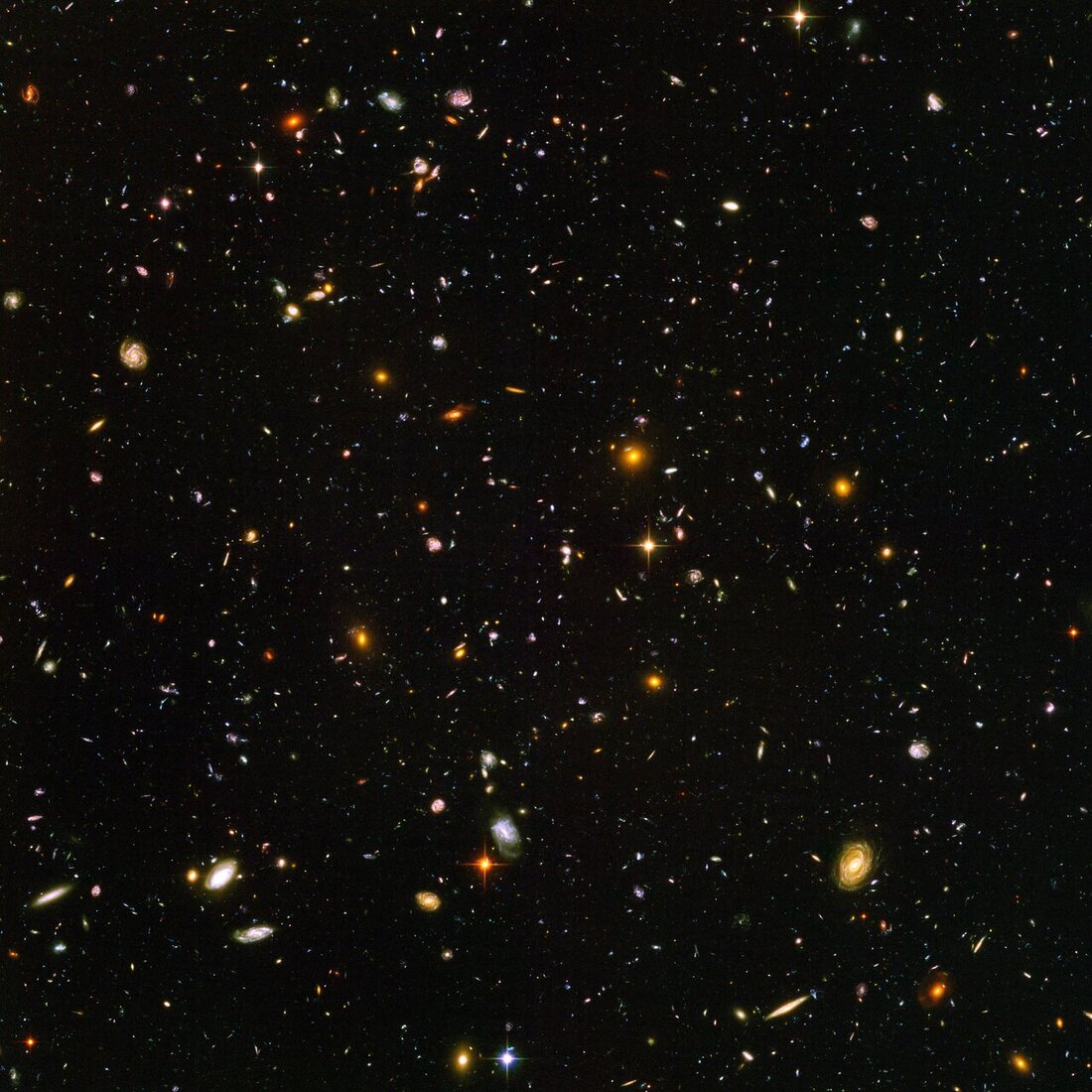
The photograph. The Hubble Ultra Deep Field is a patch of sky about a tenth as wide as the full Moon. Hubble stared at it for a total of 11.3 days between September 2003 and January 2004. Nearly 10,000 galaxies showed up. About a hundred of the smallest and reddest are seen as they were when the universe was about 800 million years old.
The name. “Big Bang” is misleading. It was not an explosion into empty space, because there was no space outside it. Every part of space began stretching away from every other part, everywhere at once. There is no centre and no edge to point at.
What the theory does not cover. It describes how the hot, dense universe expanded and cooled. It does not describe the very first instant, where the known laws of physics stop working, and it does not say why there was anything to expand.
Loose ends. A well-tested theory can still have puzzles. The amount of lithium predicted is about three times what is found in the oldest stars. And two ways of measuring how fast the universe is expanding today give answers that do not quite agree. Neither puzzle touches the four lines of evidence, but both may be pointing at something not yet understood.
Where this comes from
- NASA, The Big Bang
- ESA, Planck and the cosmic microwave background
- Particle Data Group, review of Big Bang nucleosynthesis (2024)
- ESA/Hubble, Hubble sees galaxies galore: the Ultra Deep Field (2004)
The words are written for this site. Sums in the text are worked from the figures in these sources.