
Learn / Stars
How it works
Cause and effect, with real numbers.
- First look
- How it works
- The physics, still to be written
- The frontier, still to be written
How it works
Cause and effect, with real numbers
Nobody has watched a star live out its life. A human lifetime is far too short. What we have instead is millions of stars at every age, like a photograph of a crowd, and the physics to put them in order. Most of this lesson is that reasoning, tested against what telescopes see.
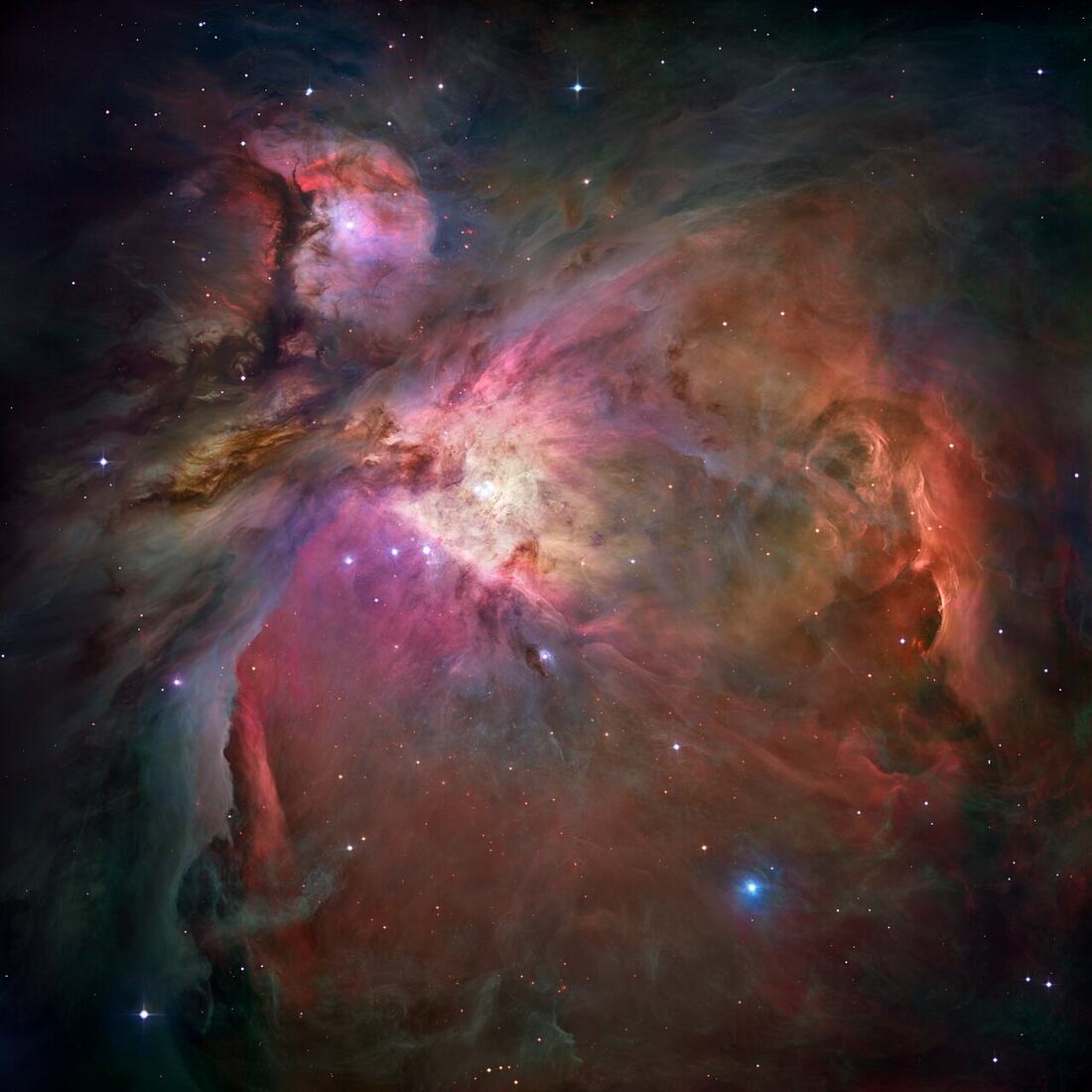
Birth. Stars form inside cold clouds of gas and dust called nebulae. Where a clump of the cloud is dense enough, its own gravity makes it fall inwards. The falling gas heats up and becomes a protostar, hidden in dust and glowing only with the heat of its collapse. Spare material settles into a spinning disc around it, where planets may form. After some tens of millions of years, for a star like the Sun, the core reaches about 10 million degrees and fusion begins. Stars are rarely born alone: one cloud makes hundreds or thousands together. The Orion Nebula, about 1,350 light years away and just visible without a telescope, is a place where this is happening now.
The long middle. A star then spends about nine tenths of its life on the main sequence, turning hydrogen into helium in its core. The heavier the star, the shorter this lasts: about 10 billion years for the Sun, a few tens of millions for a star ten times heavier.
Giant. When the hydrogen in the core is used up, the core shrinks and heats, and hydrogen goes on burning in a shell around it. The extra heat makes the outer layers swell to a hundred times their size or more, and cool to a red glow. The star is now a red giant. In about 5 billion years the Sun will do this, and will probably swallow Mercury and Venus. Whether it reaches the Earth is not settled. In the core, helium starts fusing into carbon and oxygen.
From here the road divides.
| A star like the Sun | A star of more than about 8 Suns | |
|---|---|---|
| Fuses | Hydrogen, then helium | On through carbon, neon, oxygen and silicon, as far as iron |
| The end | Outer layers drift away as a glowing shell of gas | The core collapses in under a second and the star explodes: a supernova |
| What is left | A white dwarf | A neutron star or a black hole |
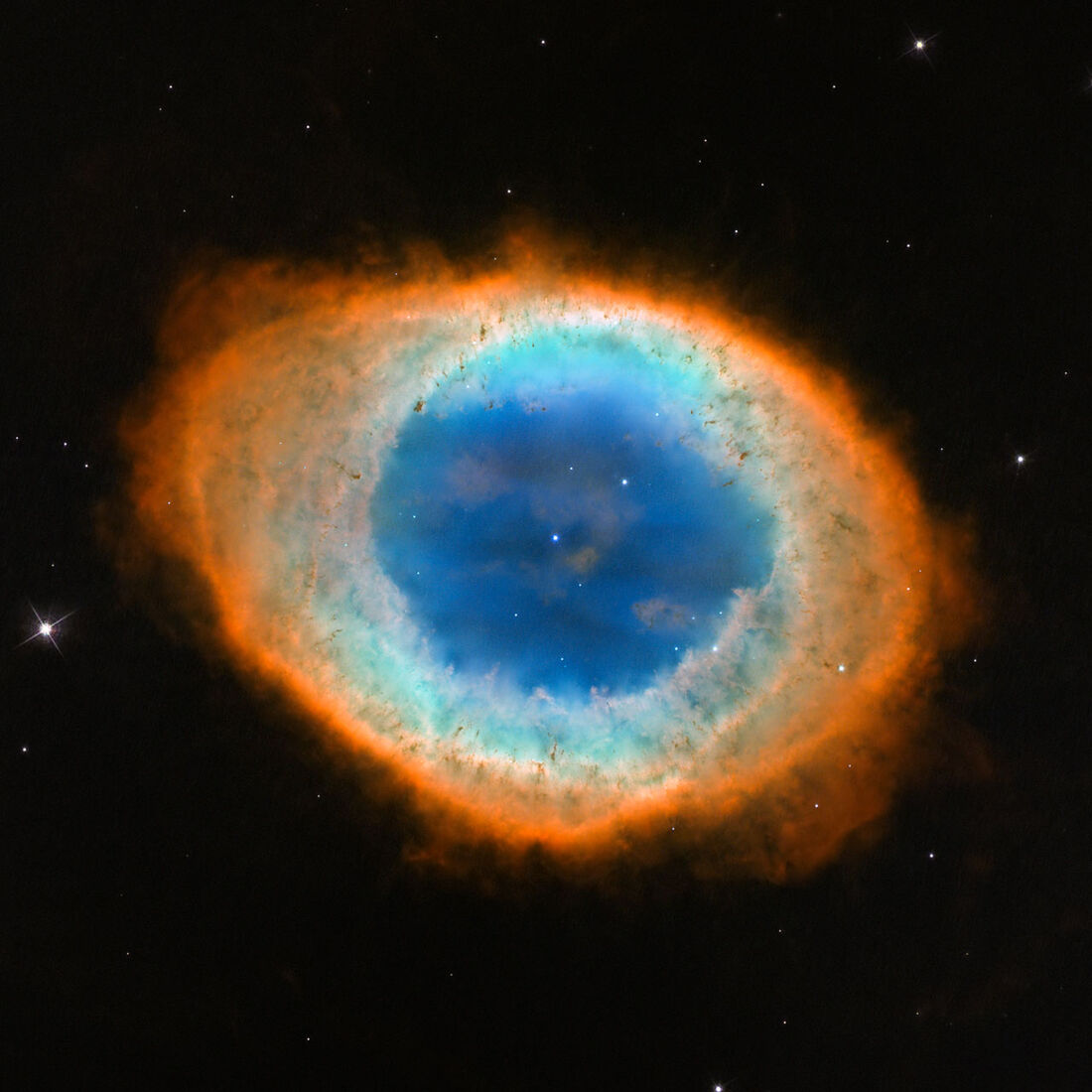
The quiet end. A star like the Sun cannot squeeze its core hard enough to burn carbon. Its outer layers drift off into space, lit for a few thousand years by the bare core. That core is a white dwarf: about half the Sun’s mass packed into a ball the size of the Earth. A teaspoon of it would weigh several tonnes. It makes no new energy and simply cools.
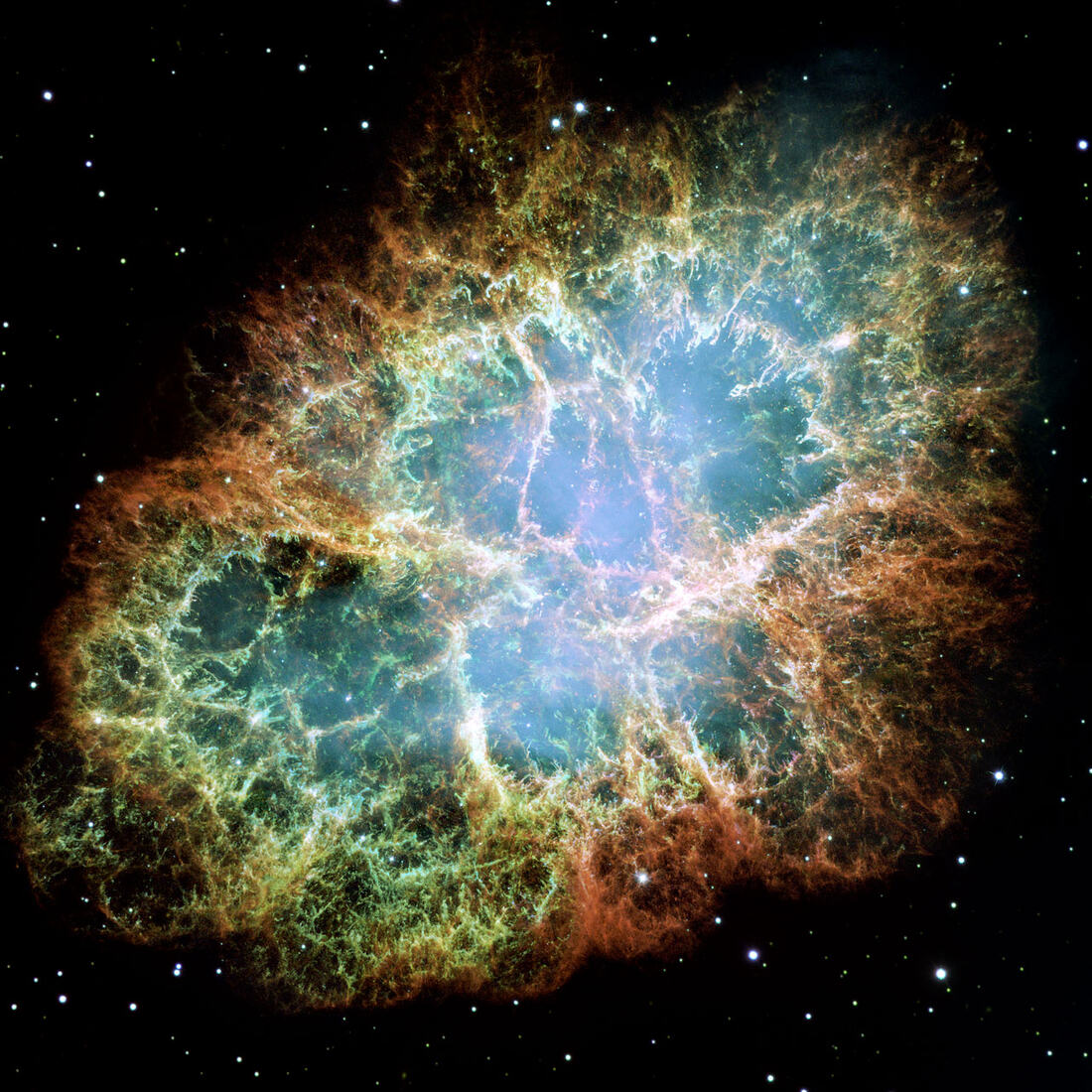
The violent end. A heavy star keeps finding a new fuel, each burning faster than the last, until its core is iron. Fusing iron gives no energy back. With nothing left to hold it up, the core falls in on itself, and the rest of the star is thrown outwards. For a few weeks a single supernova can outshine a whole galaxy of stars.
Why it matters to us. The universe began with hydrogen, helium and almost nothing else. Nearly every heavier element was made later inside stars, or when they died, and scattered into the clouds that form new ones. The oxygen you breathe, the calcium in your bones and the iron in your blood were all made that way, before the Sun existed.
Where this comes from
The words are written for this site. Sums in the text are worked from the figures in these sources.