
Learn / Planets round other stars
How it works
Cause and effect, with real numbers.
- First look
- How it works
- The physics, still to be written
- The frontier, still to be written
How it works
Cause and effect, with real numbers
The count, from NASA’s Exoplanet Archive on 11 November 2026:
| How it was found | Planets | What it gives | What it finds most easily |
|---|---|---|---|
| Dimming (transit) | 4,797 | Width, and the length of the year | Planets close to their star, whose paths happen to cross it |
| Wobble (radial velocity) | 1,205 | Mass, and the length of the year | Heavy planets close to their star |
| Bent light (microlensing) | 292 | Mass, and distance from the star | Planets further out, and planets with no star |
| A direct picture | 98 | Brightness, and with luck what the air is made of | Young, hot giants far from their star |
| Everything else | 72 |
“Everything else” is seven rarer methods, most of them forms of timing: a planet that arrives early or late at its own transit because another planet is pulling on it, or a dead star whose regular pulses drift.
Why most of them are close in. A planet near its star crosses it often, so the dips come round quickly and can be checked. It also swings its star harder. So the two main methods both find close-in planets most easily, and a planet like Jupiter, taking twelve years to go round, needs twelve years of watching to show up once. The list is what was easiest to find. It is not a fair sample of what is there.
Why transits are rare. A planet only crosses its star as seen from here if its orbit is tilted almost exactly edge-on to us. Most are not. For every planet found by its dip there are many more whose paths miss, which is why Kepler had to watch so many stars at once.
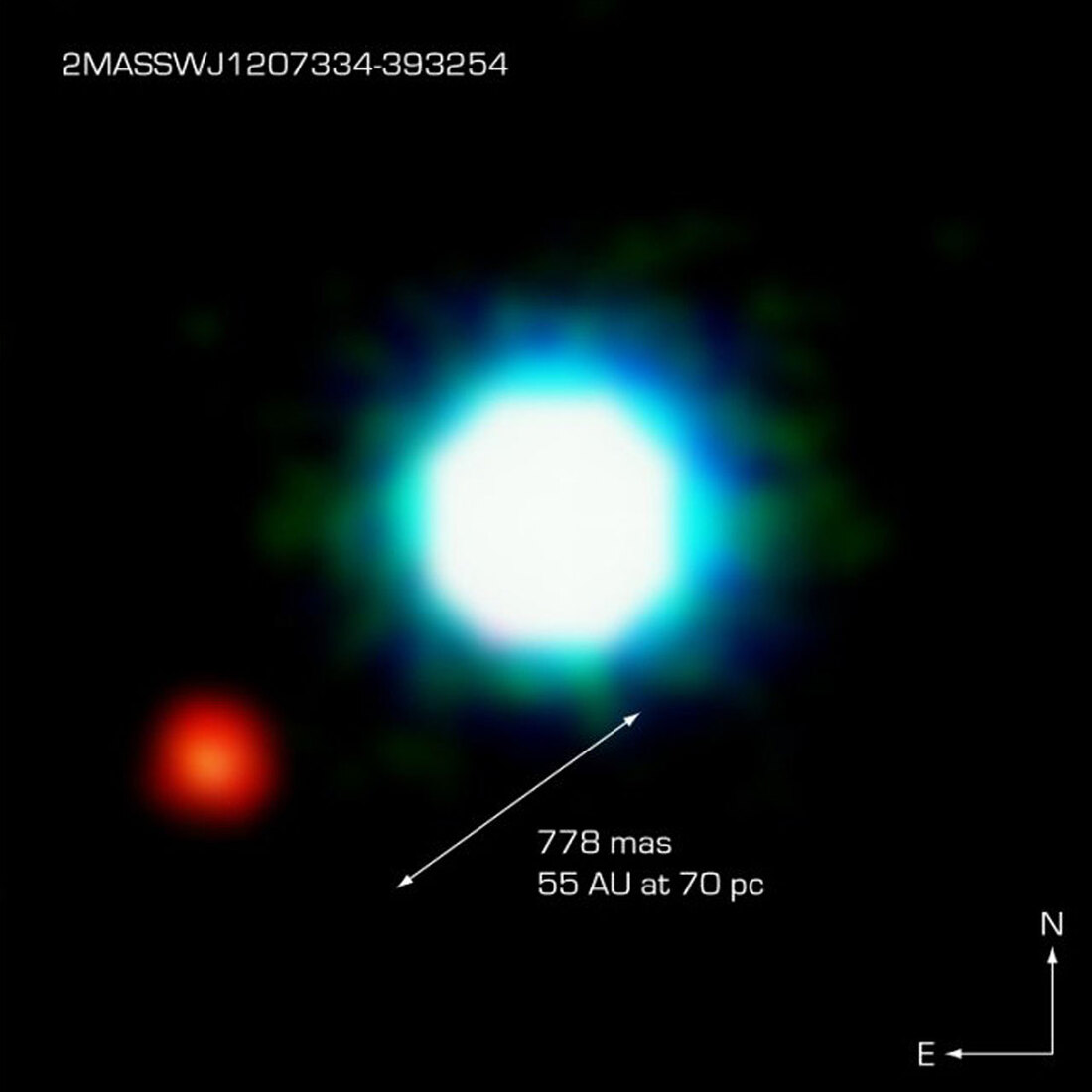
The picture. The planet in the photograph circles a brown dwarf called 2M1207, more than 200 light years away, and lies nearly twice as far from it as Neptune is from the Sun. The picture was taken in infrared light with one of the four 8.2-metre telescopes of the Very Large Telescope in Chile. A mirror that changes shape many times a second took out the blurring of the air. The labels on it are ESO’s own.
Blocking the star. To photograph a planet beside a proper star, the star’s light has to be blocked inside the telescope. The device that does this is called a coronagraph. So far it has mainly shown giant planets that are still hot from forming.
Reading the air. When a planet crosses its star, a little of the starlight passes through the planet’s air on the way, and the gases there leave their marks in it. This is how water vapour and helium have been found in the air of planets that nobody has ever seen. See Reading starlight.
Where this comes from
- NASA Exoplanet Archive, planets by discovery method (counted 11 November 2026)
- NASA, How we find and characterize exoplanets
- NASA Exoplanet Catalog, 51 Pegasi b
- ESO, The brown dwarf 2M1207 and its planetary companion (2005)
- NASA, Roman Space Telescope: microlensing
The words are written for this site. Sums in the text are worked from the figures in these sources.