
Learn / The universe
How it works
Cause and effect, with real numbers.
- First look
- How it works
- The physics, still to be written
- The frontier, still to be written
How it works
Cause and effect, with real numbers
Why “powers of ten” are needed. The times in this lesson are too long for ordinary words. Each step in the table is ten times longer than a line that reads one power lower, so the gap between two rows is far greater than everything above them put together.
| When (years from the beginning) | What |
|---|---|
| 13.8 billion | Now |
| About 10 billion for the Sun, so near 20 billion on this clock | The Sun has become a red giant and then a white dwarf |
| Up to about 14 trillion | The longest any star alive today can keep shining |
| 100 trillion (10 to the power 14) | The last stars are made; the age of stars ends |
| 10 to the power 15 up to 10 to the power 37 | Only dead stars, planets and black holes. If the particles inside atoms slowly break down, as some theories say, solid matter is gone by the end of this |
| 10 to the power 38 up to 10 to the power 100 | Only black holes, slowly leaking away |
| After 10 to the power 100 | A thin haze of light and stray particles |
The last four rows are from Fred Adams and Gregory Laughlin’s paper of 1997, which is still the standard sketch of the far future. They said themselves that it grows less certain the further it reaches. Nobody has ever seen the particles in an atom break down, and nobody has seen a black hole leak. Both are predictions.
Two small sums. The Sun is 4.57 billion years old and becomes a red giant at 10 to 11 billion, so that is 5.4 to 6.4 billion years away. And 14 trillion years is about 1,000 times 13.8 billion. Both worked out here.
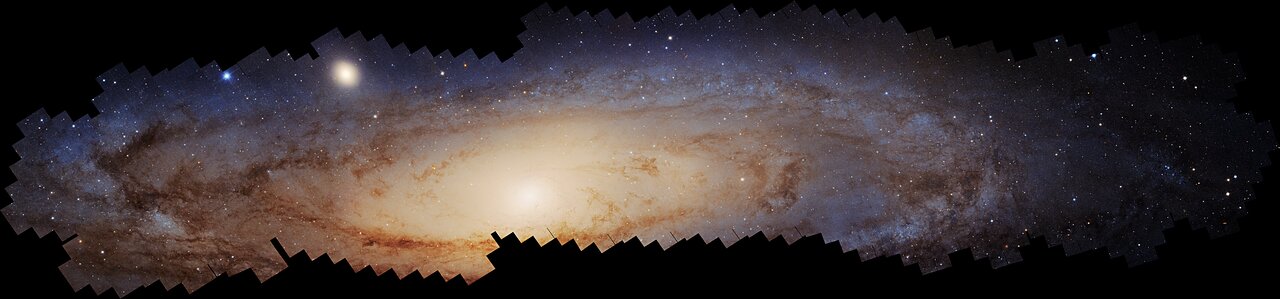
Andromeda, more carefully. The study was led by Till Sawala of the University of Helsinki and published in Nature Astronomy on 2 June 2025. It used measurements from the Hubble and Gaia spacecraft and ran the future many times over, each run starting from slightly different values within the errors of measurement. In about half the runs the two galaxies swing past each other, slow down and later merge. In most of the others they never come near enough. A head-on crash within 4 to 5 billion years, once thought certain, came out at about 2 in 100.
What the Big Rip needs. The idea was set out by Robert Caldwell, Marc Kamionkowski and Nevin Weinberg in 2003. It needs dark energy of a kind whose strength grows as space expands. Measurements so far do not call for that.
What was found in 2025. The Dark Energy Spectroscopic Instrument in Arizona measured the distances of nearly 15 million galaxies and quasars. Put together with other measurements, its results fit better if dark energy has been getting weaker than if it has stayed the same. Physicists count a result as a discovery when the odds of a fluke are below about one in 3.5 million, which they call “5 sigma”. These results reach between 2.8 and 4.2 sigma, depending on which other measurements are added.
Where this comes from
- ESA, Gaia reveals the past and future of the Sun (11 August 2022)
- ESA/Hubble, Apocalypse when? Hubble casts doubt on certainty of galactic collision (2 June 2025)
- NASA, Types of stars
- Adams and Laughlin, A dying universe: the long-term fate and evolution of astrophysical objects (1997)
- Caldwell, Kamionkowski and Weinberg, Phantom energy and cosmic doomsday (2003)
- University of California, Santa Cruz, on the DESI results of 19 March 2025
The words are written for this site. Sums in the text are worked from the figures in these sources.