
Learn / Galaxies
How it works
Cause and effect, with real numbers.
- First look
- How it works
- The physics, still to be written
- The frontier, still to be written
How it works
Cause and effect, with real numbers
What comes first. Most of the matter in the universe is dark matter, which pulls with gravity but gives off no light. It gathered into clumps first, and ordinary gas fell into the clumps and cooled there until it could make stars. That is why galaxies sit where the cosmic web is thickest: both were shaped by the same pull.
The rise and fall of star making. These figures are from Piero Madau and Mark Dickinson’s review of 2014, which gathers the measurements of many surveys.
| Peak of star making | About 3.5 billion years after the beginning |
| How it has fallen since | It drops to about a third in every 3.9 billion years |
| Stars formed before the peak | About a quarter of all stars today |
| Half of all stars formed by | About 5 billion years after the beginning (the review gives redshift 1.3; turned into years here) |
| Stars formed in the first billion years | Fewer than 1 in 100 |
Carried forward to today, that fall leaves the rate at about one fourteenth of its peak. Worked out here from the two figures above.
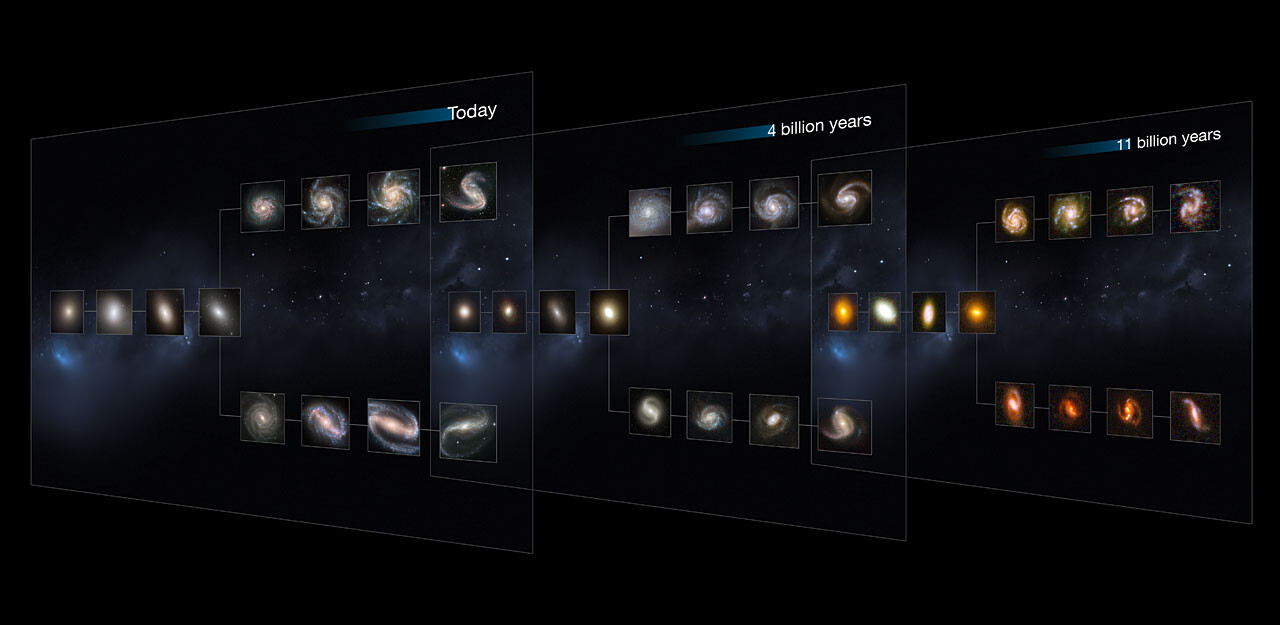
Why some galaxies stop. A galaxy makes stars only while it has cold gas. The big red galaxies have used theirs up, lost it, or had it heated until it cannot gather into stars. The same review found that the growth of the giant black holes in the middles of galaxies rose and fell in step with the making of stars, which is a sign that the two are linked. How is still being worked out.
The galaxy the Milky Way ate. The team that found it, led by Amina Helmi, named it Gaia-Enceladus. It was about the size of one of the Magellanic Clouds, the two small galaxies that can be seen from the southern half of the Earth. The Milky Way was much smaller then, so the two were matched about four to one. The collision is thought to have puffed up the Milky Way’s early disc of stars.
The record will not stand. JADES-GS-z14-0 was the most distant galaxy with a measured distance when its picture was published on 30 May 2024. Webb is still looking, and records of this kind are made to be broken.
Where this comes from
- ESA/Hubble, Hubble Ultra Deep Field (heic0406a)
- ESA/Webb, JADES-GS-z14-0 (30 May 2024)
- Madau and Dickinson, Cosmic star formation history (2014)
- ESA/Hubble, Hubble explores the origins of modern galaxies (heic1315)
- ESA, Galactic ghosts: Gaia uncovers major event in the formation of the Milky Way (31 October 2018)
The words are written for this site. Sums in the text are worked from the figures in these sources.