
Learn / The universe
How it works
Cause and effect, with real numbers.
- First look
- How it works
- The physics, still to be written
- The frontier, still to be written
How it works
Cause and effect, with real numbers
Three different distances. When something is very far away, “how far?” has more than one answer.
| The question | For the oldest light |
|---|---|
| How long was the light on its way? | 13.8 billion years |
| How far off was its source when the light left? | About 42 million light years |
| How far off is that source now? | About 46 billion light years |
The third is the one meant when the observable universe is said to be 46 billion light years in radius. It is about 3.4 times the figure most people expect, and about 1,100 times the distance at the start. Both worked out here.
Does that break the speed of light? No. Nothing travels through space faster than light. But space itself can stretch, and when there is a great deal of space between two galaxies, the gap between them can grow faster than light could cross it. Tamara Davis and Charles Lineweaver set this out in 2003 and showed that many of the galaxies already in our pictures are, and always have been, moving away faster than light in this sense.
A horizon that closes in. The expansion is speeding up, and that sets a second limit. Light leaving a galaxy today will never reach us if the galaxy is now more than about 16 billion light years away. We go on seeing such galaxies by the old light already on its way, but nothing that happens there from now on will ever be seen from here.
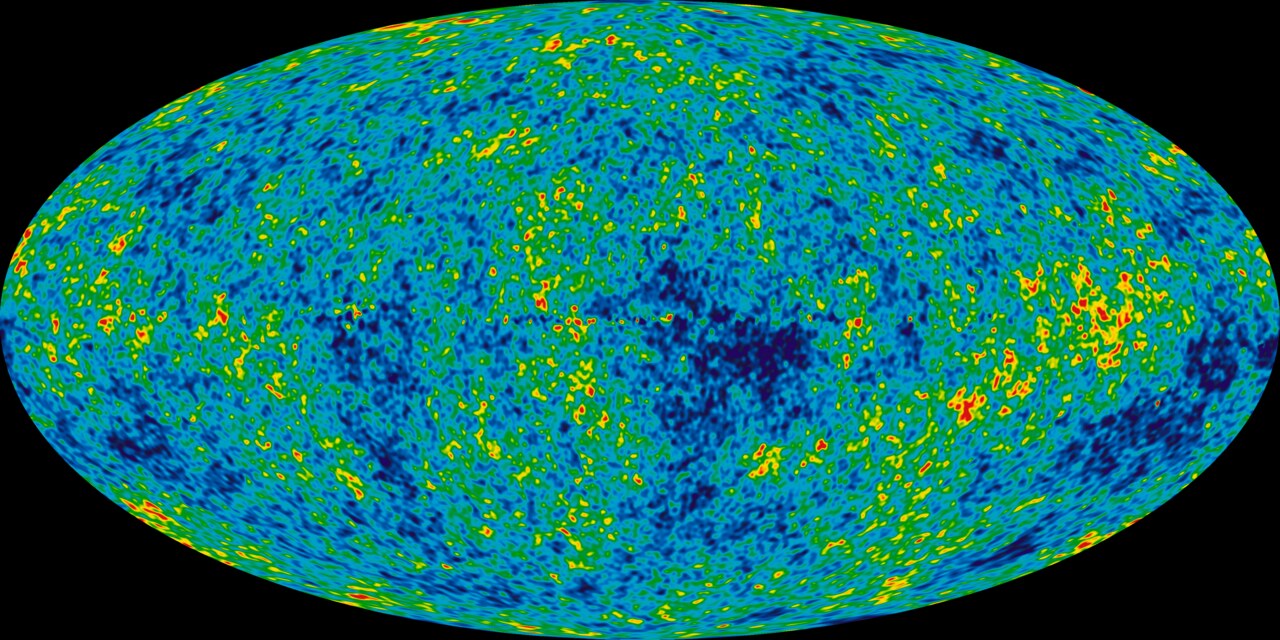
What “flat” means. On a flat sheet the angles of a triangle add up to 180 degrees. On a ball they add up to more. Space can be tested in the same way, using the sizes of the patches in the oldest light as the far side of an enormous triangle. NASA’s WMAP spacecraft found space flat to within 0.4 per cent.
What cannot be said. Whether the universe is infinite is not something any measurement can settle, because no measurement can reach past the edge of sight. Science can say how big the visible part is, and that the rest is at least very much bigger. Beyond that, it is honest to say nobody knows.
Where this comes from
- Wikipedia, Observable universe
- Astronomy magazine, The size of the universe (June 2024)
- NASA, WMAP overview
- Davis and Lineweaver, Expanding confusion (2003)
- ESA/Hubble, Hubble's deepest view ever of the Universe (heic0406)
The words are written for this site. Sums in the text are worked from the figures in these sources.