
Learn / Exploring space
How it works
Cause and effect, with real numbers.
- First look
- How it works
- The physics, still to be written
- The frontier, still to be written
How it works
Cause and effect, with real numbers
Action and reaction. The push a rocket engine gives, called thrust, depends on two things: how much gas it throws out each second, and how fast that gas is going. The first stage of the Saturn V shows the size of both. It held about 2,077 tonnes of kerosene and liquid oxygen and emptied itself in about 150 seconds, which is nearly 14 tonnes a second. NASA gives its thrust as 34.5 million newtons. Dividing one by the other gives the speed of the exhaust: about 2.5 km a second. Worked out here.
Why it lifts off at all. A rocket rises only if its thrust is greater than its weight. On the pad the Saturn V weighed between 27.7 and 29.1 million newtons, depending on the flight, against a thrust of 34.5 million. Worked out here from the launch masses. As the tanks emptied the rocket grew lighter while the thrust stayed much the same, so it climbed faster and faster.
Why most of a rocket is fuel. The speed a rocket gains depends on the speed of its exhaust and on how many times heavier it is full than empty. That second number counts for less than you would hope. To gain twice the speed with the same engine, the rocket must be not twice as many times heavier when full, but that number multiplied by itself. NASA’s own worked example, for an engine burning hydrogen and oxygen and a rocket going to orbit in one piece, comes out at a rocket ten times heavier full than empty: nine tenths fuel and oxygen.
The three stages of the Saturn V.
| Stage | Engines | Burned | Mass full | Mass empty | Burn time |
|---|---|---|---|---|---|
| First | 5 | Kerosene and liquid oxygen | 2,214 tonnes | 137 tonnes | about 150 seconds |
| Second | 5 | Liquid hydrogen and liquid oxygen | 470 tonnes | 43 tonnes | 395 seconds |
| Third | 1 | Liquid hydrogen and liquid oxygen | 120.5 tonnes | 15.2 tonnes | 165 seconds, then 312 more |
Add the fuel and oxygen in the three stages and you get about 2,600 tonnes, out of a launch mass that ran from 2,822 to 2,965 tonnes from one flight to another. Worked out here from the table. The third stage burned twice: once to reach orbit round the Earth, and again to set off for the Moon. NASA gives the load it could send to the Moon as 43,500 kg.
What staging buys. Dropping the first stage rid the Saturn V of 137 tonnes of empty tank and engine that would otherwise have had to be carried all the way. Each stage after that had less to push, so each kilogram of fuel did more. Thirteen Saturn Vs flew, between 1967 and 1973.
Goddard’s rocket. It burned petrol and liquid oxygen, climbed 41 feet, which is 12.5 metres, and landed 184 feet, or 56 metres, away. Six years earlier Goddard had written that a rocket might one day reach the Moon, and newspapers had laughed at him. In the 1930s his rockets reached heights of about 2,400 metres.
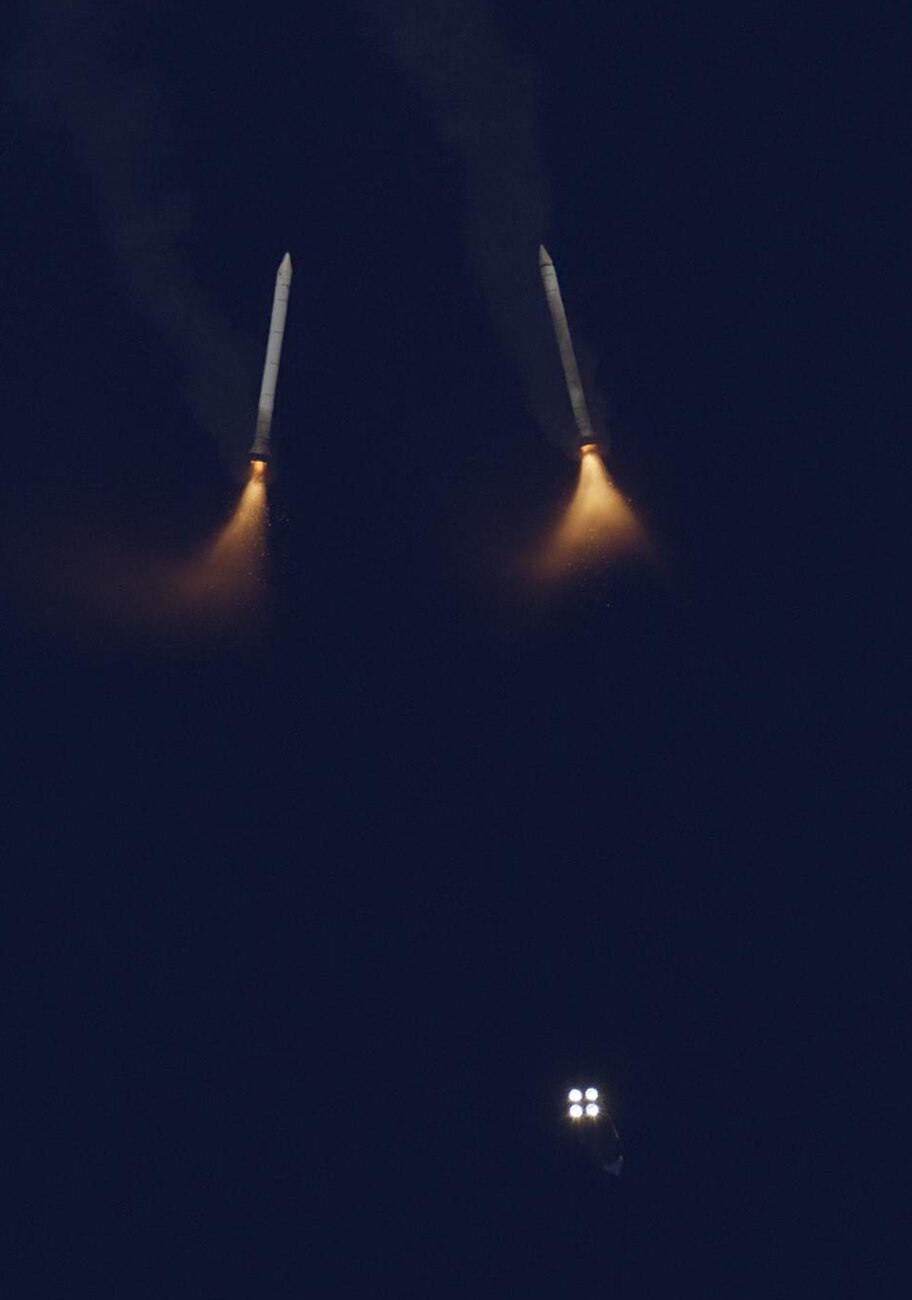
Landing a booster. After a Falcon 9’s first stage has done its work it turns, steers itself down through the air with four grid-shaped fins, relights its engines to slow down and lands on four legs that fold out. By 7 November 2026 the Falcon 9 had been launched 701 times, and its boosters had landed 659 times in 670 attempts.
Where this comes from
- NASA Glenn Research Center, Rocket thrust
- NASA Glenn Research Center, Ideal rocket equation
- NASA, Dr Robert H. Goddard, American rocketry pioneer
- NASA image library, Goddard and the rocket of 16 March 1926
- NASA, What was the Saturn V?
- Wikipedia, Saturn V (stage masses and burn times)
- Wikipedia, Falcon 9 (landings, as of 7 November 2026)
- NASA image library, Falcon 9 landing after the Crew-13 launch
The words are written for this site. Sums in the text are worked from the figures in these sources.