
Learn / Gravity and orbits
How it works
Cause and effect, with real numbers.
- First look
- How it works
- The physics, still to be written
- The frontier, still to be written
How it works
Cause and effect, with real numbers
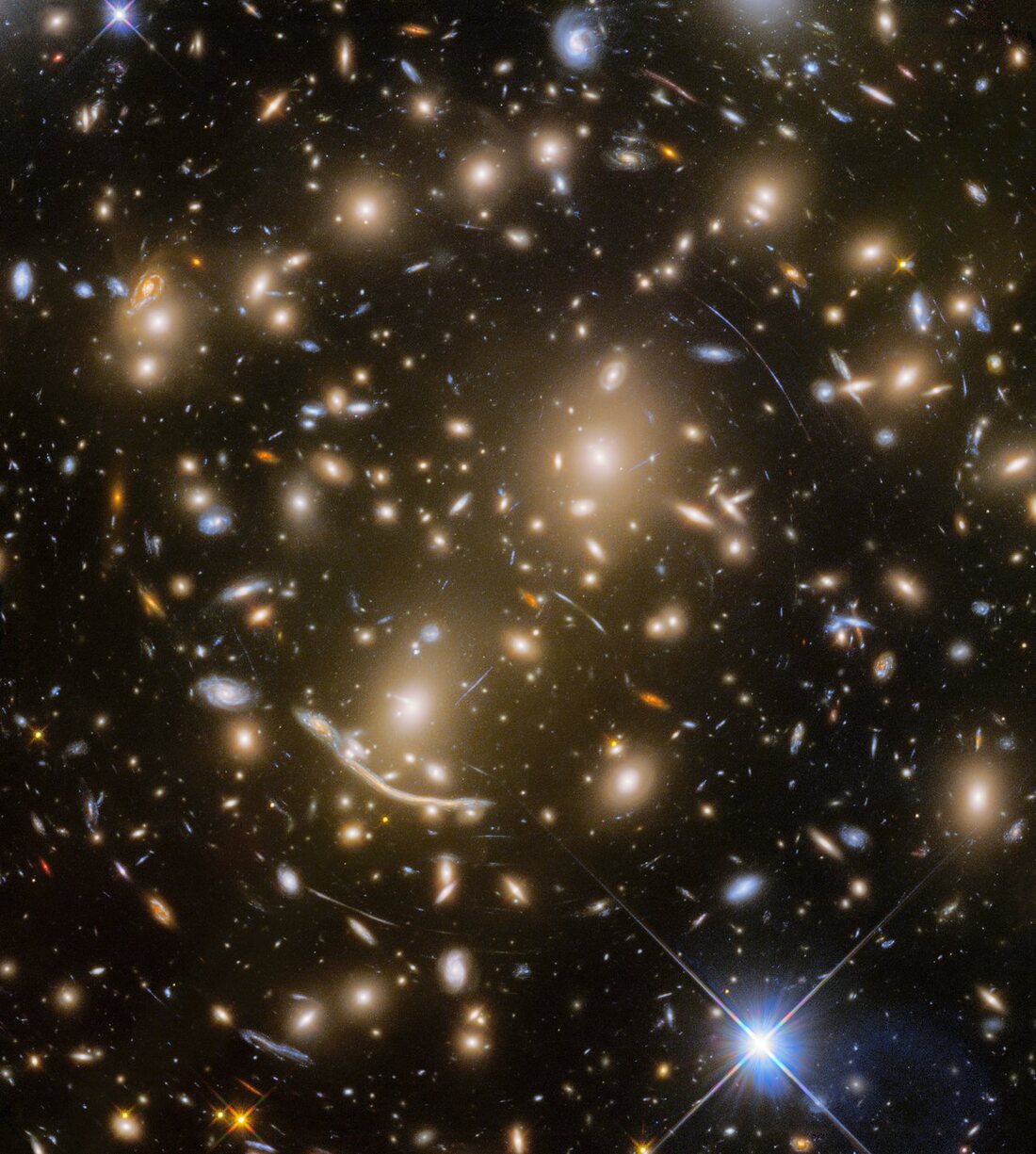
Not a good lens. A glass lens bends light most at its edge and brings it to one sharp point. Gravity does the opposite: it bends light most close to the mass and less further out. So a galaxy never gives a sharp picture. It gives arcs, rings and copies, like a candle seen through the foot of a wine glass.
The first one. In 1979 astronomers found two quasars side by side that turned out to be exactly alike. They were one quasar seen twice, with a galaxy in between. It is known as the Twin Quasar, and it was the first gravitational lens ever found. The 1919 eclipse had shown the Sun bending starlight by a tiny amount. This was the same effect across billions of light years.
Two copies, two journeys. The light of the two copies takes different roads round the galaxy, and one road is longer. The quasar flickers, and each flicker shows up in one copy and then, 417 days later, in the other. The copies show the same thing at two different times.
| What is seen | What lines up | Example |
|---|---|---|
| Arcs and streaks | Far galaxies behind a whole cluster | Abell 370 |
| A ring | A far galaxy almost exactly behind a near one | The Cosmic Horseshoe, found in 2007 |
| Several copies | A far quasar a little off the line | The Einstein Cross, four copies. The Twin Quasar, two |
| A brightening that comes and goes | One star passing in front of another | Microlensing |
Weighing what cannot be seen. How far the light is bent depends on how much mass is in the way, and on nothing else. It makes no difference whether the mass shines. So the arcs round a cluster can be used to work out how much matter the cluster holds and where it sits. The answer always comes out far greater than the stars and gas that can be seen. This is one of the main reasons for thinking most matter is dark. See Dark matter and dark energy.
A free telescope. Earendel’s light set out when the universe was 7 per cent of its present age. The star has at least 50 times the mass of the Sun. The record before it, also set by Hubble with the help of a lens, was a star seen when the universe was about 30 per cent of its present age.
Planets by flicker. Most ways of finding planets work best for planets close to their stars. Microlensing is best at finding planets further out, from the distance where water could be liquid and beyond. It can even pick up planets drifting through space with no star at all.
Where this comes from
- ESA/Hubble, Seeing double: the Twin Quasar (2014)
- Kundić and others 1997, A robust determination of the time delay in 0957+561A,B
- ESA/Hubble, Hubble captures a “lucky” galaxy alignment (2011)
- ESA/Hubble, Hubble finds the most distant star ever seen (2022)
- NASA, Roman Space Telescope: microlensing
- NASA Exoplanet Archive, planets by discovery method (counted 11 November 2026)
The words are written for this site. Sums in the text are worked from the figures in these sources.