
Learn / Stars
How it works
Cause and effect, with real numbers.
- First look
- How it works
- The physics, still to be written
- The frontier, still to be written
How it works
Cause and effect, with real numbers
Why swell? It seems backwards that a star running out of fuel should grow. The key is the centre. When the hydrogen there is gone, nothing holds the centre up, so it shrinks under its own weight and heats. Hydrogen just outside it begins to burn in a thin shell, faster than the centre ever burned. All that extra heat pushes the outer layers out, and as they spread they cool, from white-yellow to orange-red. So a red giant is two things at once: a small, dense, very hot centre, and a vast, thin, cool wrapping.
The Sun’s turn. The Sun will stay a red giant for about a billion years. Near the end its centre will reach about 100 million degrees, hot enough for helium to burn into carbon and oxygen. In a star of the Sun’s mass this starts in a sudden burst called the helium flash, hidden deep inside. By then the Sun will have blown about 38 per cent of its mass away into space. At last the outer layers drift off as a glowing shell called a planetary nebula, and the bare centre is left as a white dwarf.
How big, compared with the planets? The Sun is 1.39 million km wide. These widths are from Wikipedia, and the last column was worked out here from them.
| Star | Kind | Width, Sun = 1 | In the Sun’s place it would reach |
|---|---|---|---|
| Arcturus | Red giant | 25 | A third of the way to Mercury |
| Aldebaran | Red giant | 45 | Half way to Mercury |
| Rigel | Blue supergiant | 74 | Nearly to Mercury |
| The Sun in 5 billion years | Red giant | more than 200 | About as far as the Earth |
| Antares | Red supergiant | 680 | Twice as far as Mars |
| Betelgeuse | Red supergiant | 640 to 764 | Into the belt of asteroids beyond Mars |
| WOH G64 | Red supergiant | about 1,540 | Past Jupiter, three-quarters of the way to Saturn |
Not all supergiants are red. Rigel, the blue-white foot of Orion, is a supergiant too. It is 74 times as wide as the Sun, but its surface is at about 12,100 kelvin, twice as hot as the Sun’s, and it gives out about 120,000 times the Sun’s light. It is about 8 million years old. Heavy stars can swing between blue and red more than once before the end.
How empty? Betelgeuse has perhaps 14 times the mass of the Sun, spread through a space that would hold about 340 million Suns. On average that makes it about 20,000 times thinner than the air at sea level. Worked out here, taking it as 700 times the Sun’s width. A supergiant has been called a red-hot vacuum, and the edge of one is not a surface at all but a slow fading out.
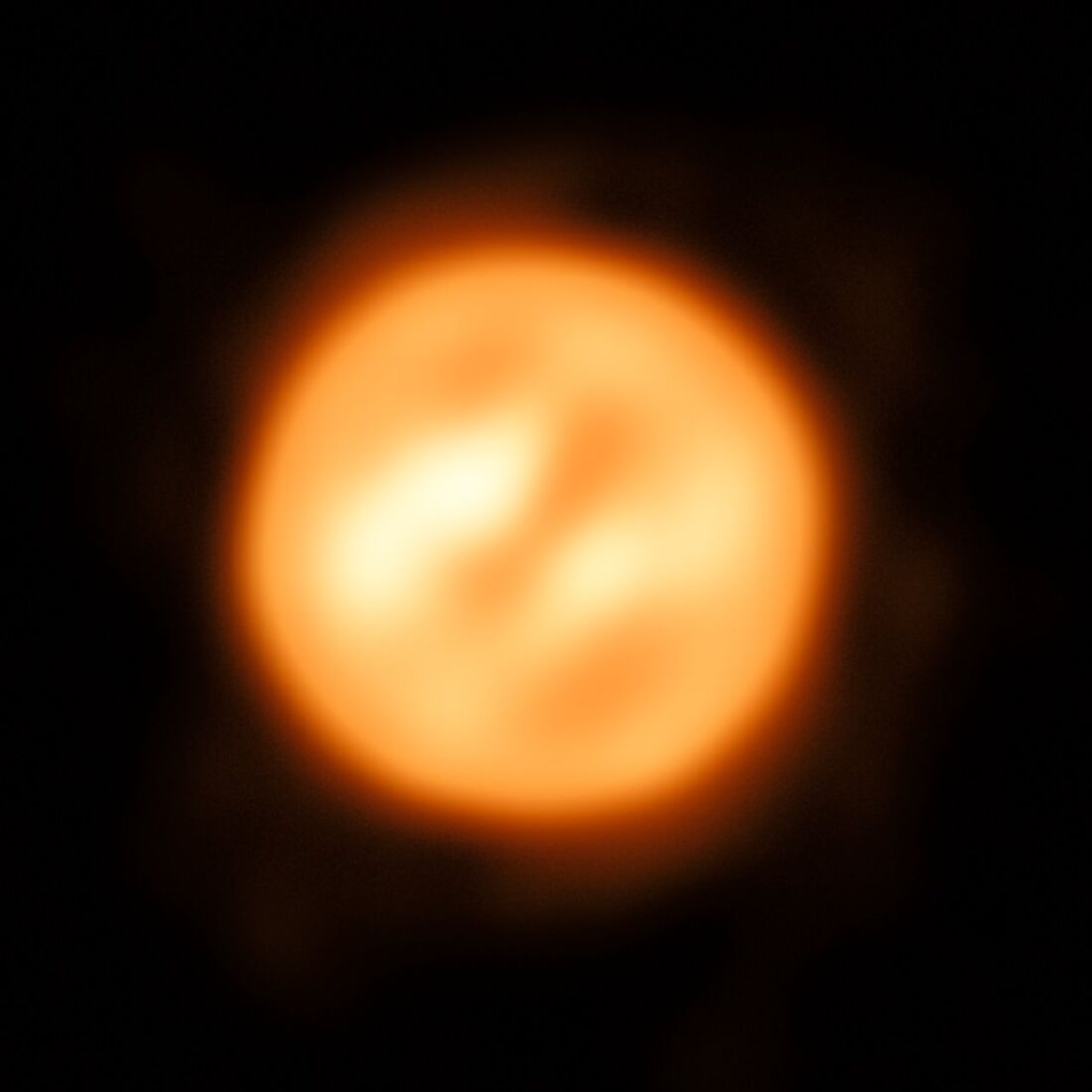
Measuring a star’s face. Every star but the Sun looks like a point, even in most telescopes. On 13 December 1920 Albert Michelson and Francis Pease measured the width of Betelgeuse at Mount Wilson in California, by combining light from two mirrors set 6 metres apart on the front of the telescope. It was the first star after the Sun to have its size measured. The modern pictures are made the same way, with whole telescopes tens of metres apart.
The dimming of Betelgeuse. It began in October 2019. By the middle of February 2020 the star had dropped out of the ten brightest in the sky, to about the twentieth. By April 2023 it was brighter than usual. Betelgeuse always varies, with one beat of about 400 days and a slower one of about 2,100.
The record. Sizes this large are hard to pin down, because the distances are uncertain and the stars have no sharp edge. Stars once quoted at over 1,700 times the Sun’s width have been revised down. WOH G64 is put at 1,540, give or take 77, in Wikipedia’s list of the largest stars, which calls it possibly the largest known. The European Southern Observatory’s announcement gave roughly 2,000. Theory suggests that a red supergiant cannot be much bigger than about 1,500 to 1,700 times the Sun without blowing its own outer layers away.
Where this comes from
- Wikipedia, Red giant
- Wikipedia, Arcturus
- Wikipedia, Aldebaran
- Wikipedia, Rigel
- Wikipedia, Betelgeuse
- Wikipedia, List of largest stars
- ESO, First close-up picture of a star outside our galaxy
The words are written for this site. Sums in the text are worked from the figures in these sources.