
Learn / Galaxies
How it works
Cause and effect, with real numbers.
- First look
- How it works
- The physics, still to be written
- The frontier, still to be written
How it works
Cause and effect, with real numbers
| What is in a cluster | How it is seen | How much |
|---|---|---|
| Galaxies | Ordinary light | Hundreds to thousands of them, and the smallest share of the mass |
| Hot gas between the galaxies | X-rays | More mass than all the galaxies together |
| Dark matter | Only by its gravity | About six times as much as the galaxies and gas together |
Why the gas is so hot. Gas falling into a cluster picks up enormous speed, and when clusters and groups run into each other the gas is squeezed and shocked. All that motion ends up as heat. The gas is very thin, far thinner than the best vacuum on the Earth, but a cluster is so large that there is a great deal of it.
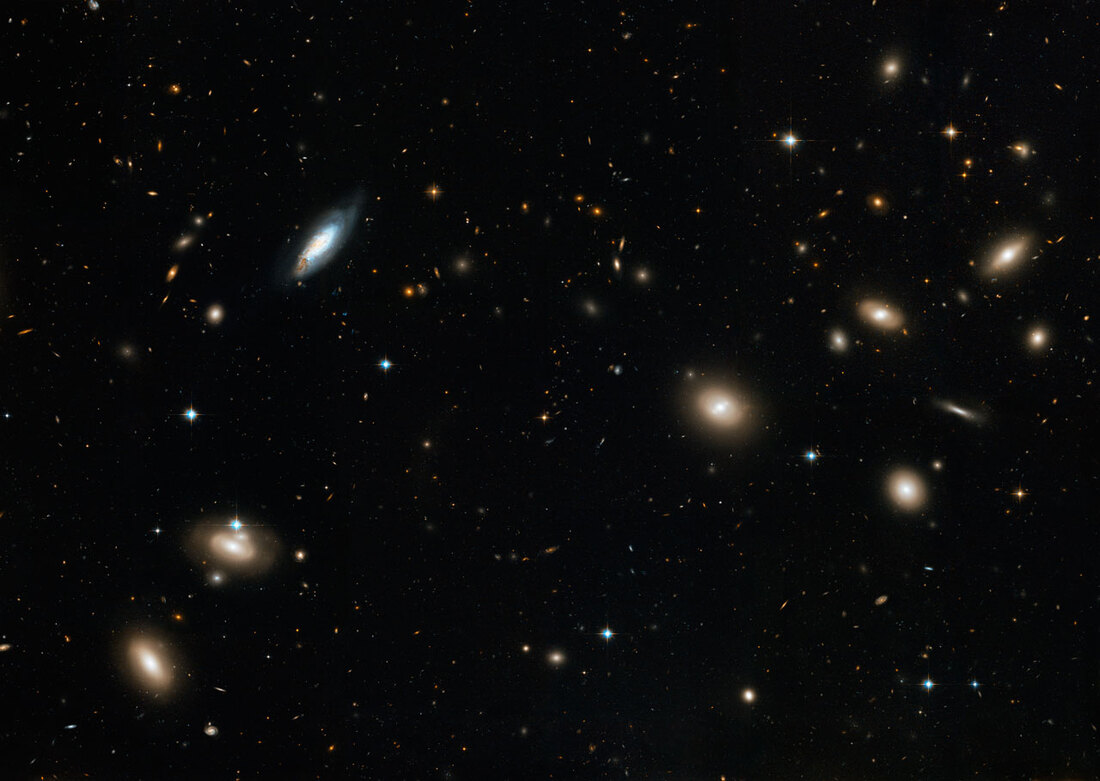
Why the galaxies in the middle are yellow ovals. In the crowded centre of a cluster most galaxies are ellipticals, with old stars and little gas left to make new ones. Spirals like ours are commoner further out. See Kinds of galaxy.
The Bullet Cluster. The X-ray picture in this lesson shows two clusters that have run straight through each other, about 3.8 billion light years away. The bright cone on the right is the gas of the smaller one. In the crash the two clouds of gas dragged on each other and slowed down. The galaxies, with wide gaps between them, mostly sailed through. When astronomers mapped where the mass is, using the bending of light, they found it with the galaxies, well ahead of the gas. So most of the mass is neither gas nor galaxies, and it does not drag on anything. That is the plainest evidence there is that dark matter is real stuff, and not a mistake in the law of gravity. See Dark matter and dark energy.
Groups, clusters, superclusters. A group has a few dozen galaxies. A cluster has hundreds or thousands and is held together for good. Superclusters are larger still, but they are loose gatherings that the expansion of the universe is pulling apart. See The cosmic web.
Where this comes from
- Allen and others, Improved constraints on dark energy from Chandra X-ray observations of the largest relaxed galaxy clusters (2008). Gas about 11 per cent of a cluster's mass
- Chandra X-ray Observatory, Groups and clusters of galaxies
- Chandra X-ray Observatory, 1E 0657-56: the Bullet Cluster (2006)
- ESA/Hubble, The Coma Galaxy Cluster as seen by Hubble (2008)
The words are written for this site. Sums in the text are worked from the figures in these sources.