
Learn / How we found out
From a still Earth to a moving one
How it works
Cause and effect, with real numbers.
- First look
- How it works
- The physics, still to be written
- The frontier, still to be written
How it works
Cause and effect, with real numbers
Measuring the Earth with a shadow. Eratosthenes lived from about 276 to about 195 BC and worked in Alexandria in Egypt. At noon on midsummer’s day the Sun stood straight overhead at Syene, the modern Aswan, and upright posts there cast no shadow. At Alexandria, to the north, a post did cast one, and the angle was a fiftieth of a full circle. So the distance between the two towns, which surveyors gave as 5,000 stadia, had to be a fiftieth of the way round the world: 250,000 stadia. How good that is depends on the length of his stadion, which is still argued over. The Earth is 40,008 km round through the poles, and most estimates put his answer within about a sixth of that.
Somebody had already said it. A Greek called Aristarchus, who lived from about 310 to about 230 BC, proposed that the Earth goes round the Sun. His book is lost. The idea was turned down for a sensible reason. If the Earth moved, the nearer stars should seem to shift against the further ones through the year, and nobody could see any shift. The true answer was that the stars are far further away than anyone then dared to think.
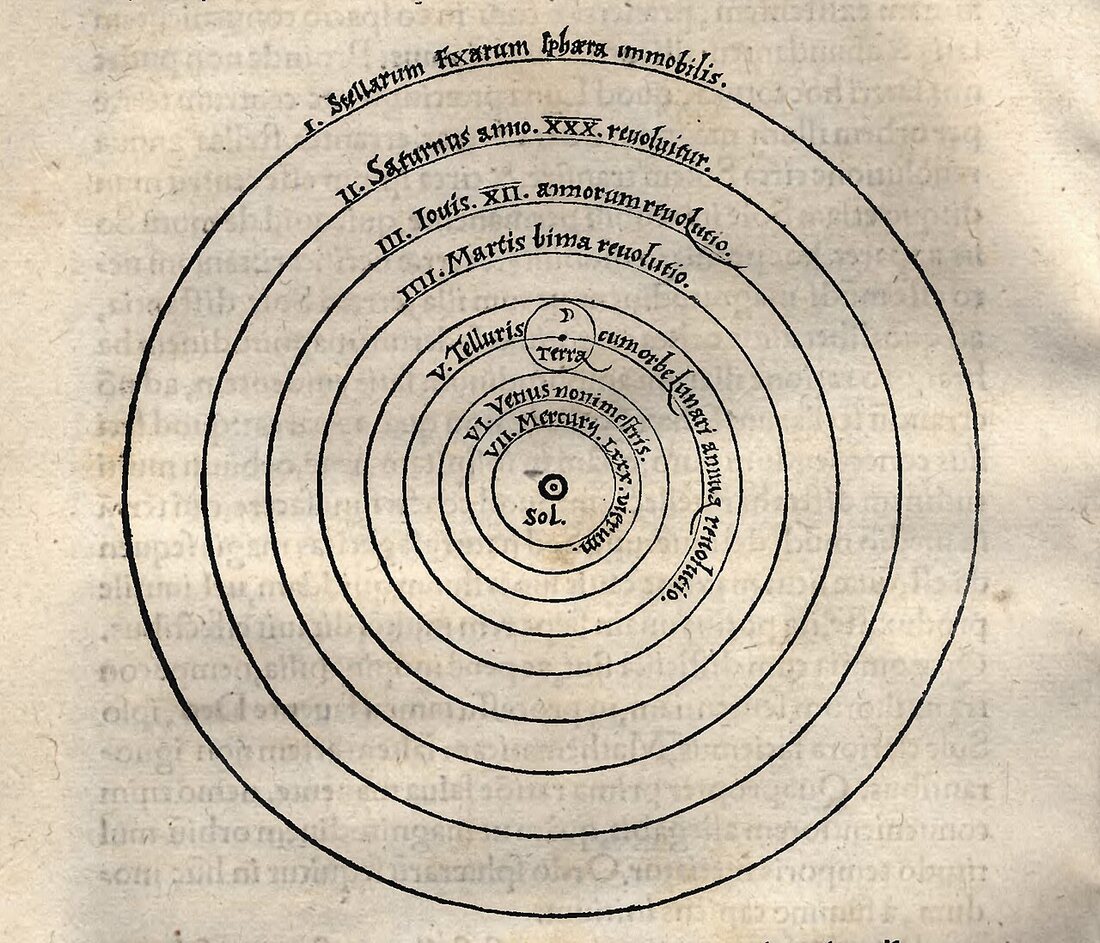
What Copernicus kept. His book was printed in Nuremberg in 1543, the year he died. Its order of the planets is the one still used: Mercury, Venus, the Earth with its Moon, Mars, Jupiter and Saturn. But he held to the old belief that everything in the sky must move in perfect circles at a steady speed, so to match what was seen he still needed small circles riding on large ones. The first printing was 400 copies, and they did not all sell.
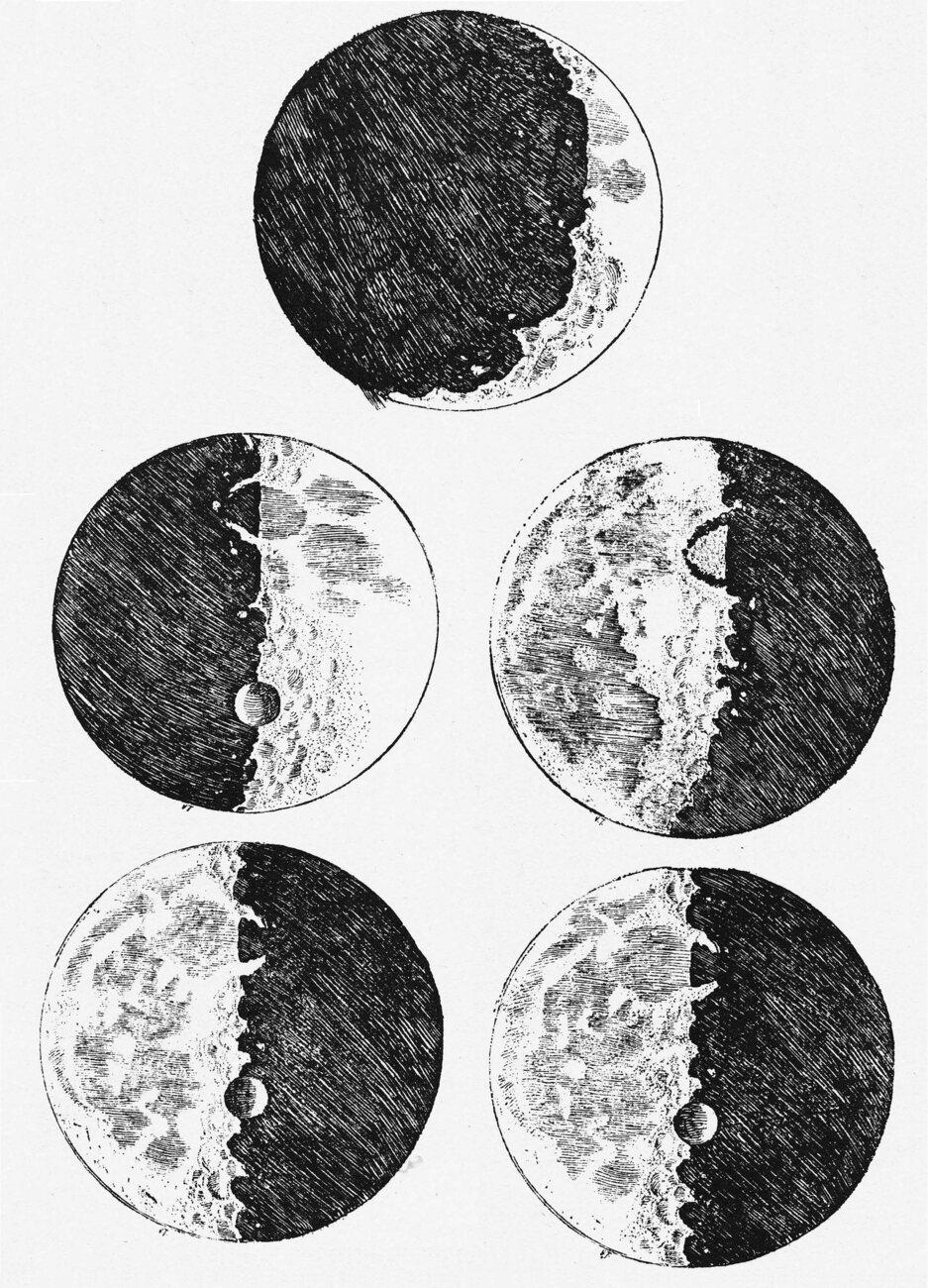
What Galileo saw. His telescope magnified twenty times. As well as the moons of Jupiter, he saw that the Moon has mountains and plains, and that the Milky Way is made of stars too faint to see one by one. Where the eye sees six stars in the Pleiades he counted 35. In December 1610 he found that Venus shows phases like the Moon’s, from a thin crescent to nearly full, which it could never do if it circled the Earth in the way Ptolemy had it. His book came out on 13 March 1610. In 1616 the Church suspended Copernicus’s book, and in 1633 it sentenced Galileo for teaching that the Earth moves.
Kepler’s three laws. The measurements Kepler used were made by the Danish astronomer Tycho Brahe, before the telescope was invented. Mars was the right planet to struggle with, because apart from Mercury its path is the least like a circle of any planet’s.
| Law | In plain words | Published |
|---|---|---|
| First | A planet’s path is an ellipse, with the Sun at a point to one side of the centre | 1609 |
| Second | A planet moves faster when nearer the Sun and slower when further away | 1609 |
| Third | The further out a planet is, the longer its year, by an exact rule | 1619 |
The path of Mars is squashed very little. Its nearest point to the Sun is about a sixth closer than its furthest, and Mars moves about a fifth faster there. Worked out here from the shape of the orbit.
Newton’s test with the Moon. A dropped apple falls 4.9 metres in its first second. The Moon is 384,400 km from the centre of the Earth, about 60 times as far as the apple, which is 6,371 km from it. If the pull weakens as the square of the distance, the Moon should be pulled 60 times 60, or 3,600, times more weakly, and should fall towards the Earth about 1.4 millimetres in a second. That is just the amount by which its path bends away from a straight line each second. Worked out here in round numbers.
How the book came to be written. In 1684 the astronomer Edmond Halley went to Cambridge to ask Newton what path a planet would follow under such a pull. Newton said he had already worked it out. Halley urged him to write it all down, and paid for the printing himself. The book, usually called the Principia, came out in July 1687. It also explained the tides, the paths of comets and why the Earth bulges at the equator.
The last piece. The shift in the stars that the Greeks had looked for was finally measured in 1838, by Friedrich Bessel, for a star called 61 Cygni. It is tiny, because the stars are so far away. The Earth does move. The Church took Copernicus’s book off its list of forbidden books in 1758.
Where this comes from
- Wikipedia, Geocentric model
- Wikipedia, Eratosthenes
- Wikipedia, De revolutionibus orbium coelestium
- Wikipedia, Sidereus Nuncius
- Wikipedia, Kepler’s laws of planetary motion
- Wikipedia, Philosophiæ Naturalis Principia Mathematica
- NASA image library, lunar eclipse of 14 March 2025
The words are written for this site. Sums in the text are worked from the figures in these sources.