
Finding Neptune with a pencil
In 1846 a planet was found where the arithmetic said it had to be: Uranus was being tugged off course, and the tug pointed to Neptune.
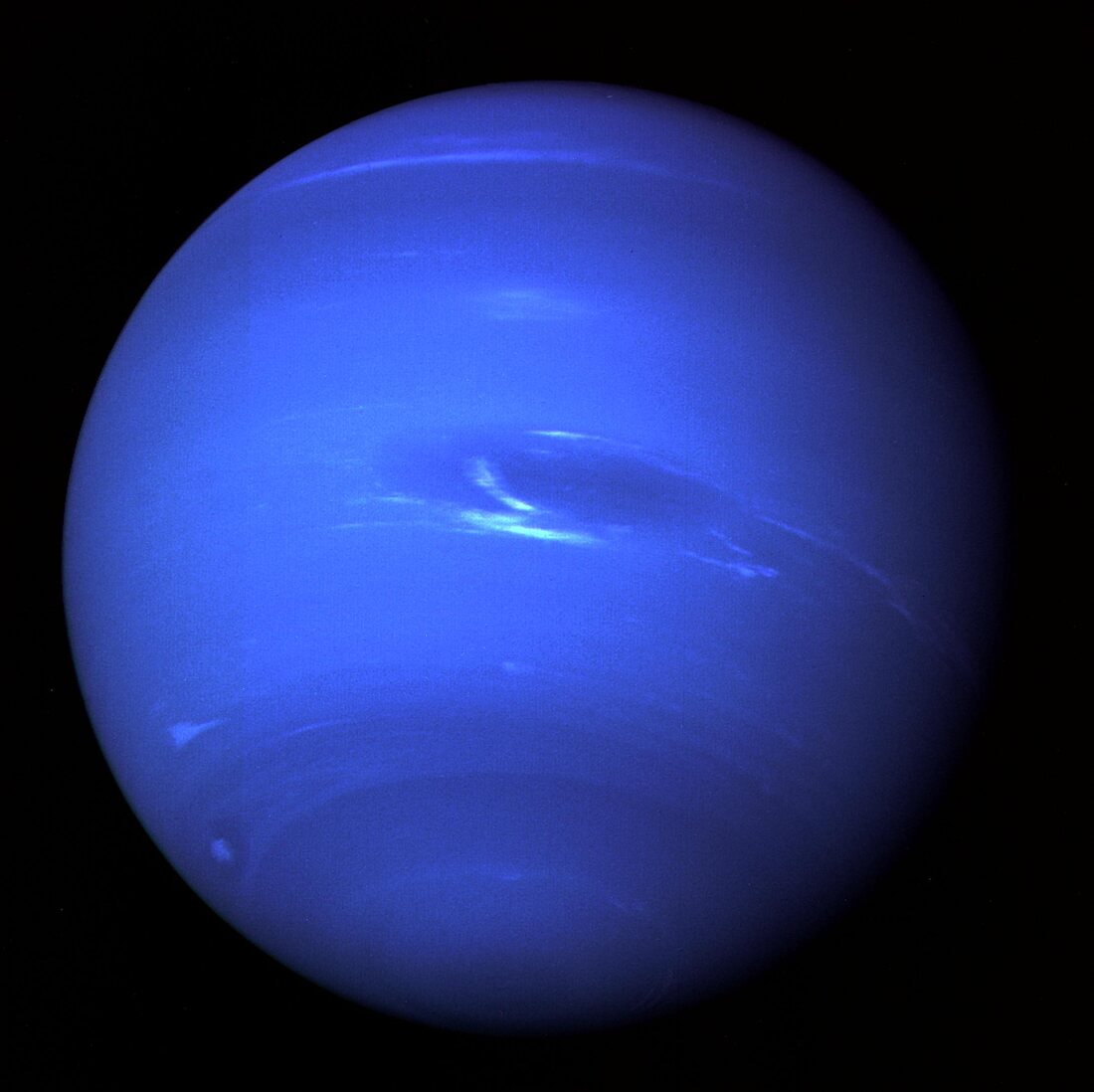
First look
The idea, in plain words
Most planets were found by looking. Neptune was found by doing sums. Two mathematicians, working from nothing but the path of another planet, said where in the sky to point a telescope. On the first night someone looked, it was there. This happened in the 19th century, in 1846.
A planet that would not behave. In 1781 William Herschel found Uranus, the first planet discovered since ancient times. Astronomers then did what they always did: they worked out its orbit from Newton’s law of gravity, allowing for the pulls of Jupiter and Saturn, and printed tables saying where it would be each night for years ahead.
Uranus did not follow the tables. At first it ran a little ahead of where it should have been. Then, from about the 1820s, it began to fall behind. The errors were tiny, far too small to see without a telescope, but they kept growing, and the best astronomers of the day could not make them go away.
Two ideas. Perhaps Newton’s law of gravity was not quite right so far from the Sun. Or perhaps something unseen was pulling on Uranus: another planet, further out. If so, the way Uranus was being pushed and pulled ought to give away where that planet was.
The sums. In England a young Cambridge mathematician, John Couch Adams, began the calculation in 1843. In France Urbain Le Verrier, working on his own, began it in 1845. It was a hard problem: they had to work backwards from the errors to a planet whose mass, distance and position were all unknown.
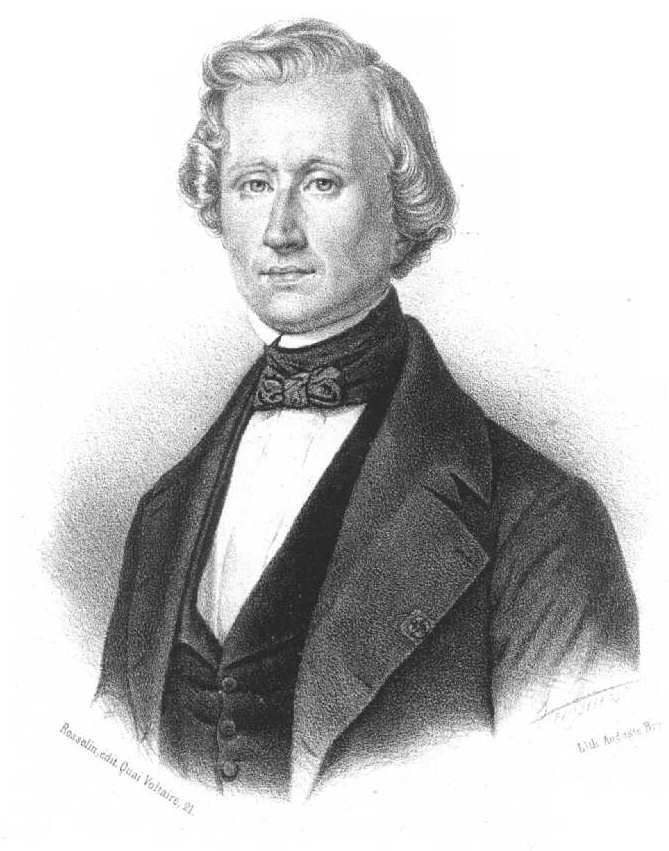
Adams told the observatory at Cambridge, which was slow to search. Le Verrier published his answer in 1846 and, unable to stir up interest in Paris, wrote to Johann Galle at the Berlin Observatory, telling him where to look.
The night of 23 September 1846. Galle got the letter that morning. That night he and a student, Heinrich d’Arrest, pointed their telescope at the place. D’Arrest suggested comparing what they saw with a new, detailed chart of the stars in that part of the sky. Within an hour Galle called out a faint star, and d’Arrest found that it was not on the chart. It was less than one degree from where Le Verrier had said, about two widths of the full Moon. Over the next nights it moved slowly against the stars. It was a planet.
What had been seen before. Galileo had drawn Neptune in his notebook in December 1612 and January 1613, beside Jupiter, without knowing it was a planet. The Cambridge astronomer James Challis, searching on Adams’s numbers, had seen it twice in August 1846 but had not compared his notes in time to notice that it moved. Seeing something is not the same as knowing what it is.
Who gets the credit. For a while there was a bitter argument between England and France. Today both Adams and Le Verrier are given credit for predicting it, and Galle and d’Arrest for finding it.
Why it mattered. Newton’s law of gravity had been used to explain the paths of things already seen. Here it had been used to find something nobody had seen. It was one of the strongest proofs anyone had that the law was right.
Two common mistakes. Neptune was not found by luck: a telescope pointed at random would have had little hope of picking out one faint dot among thousands of stars. And the method does not always work. When Le Verrier later tried the same trick on Mercury, he predicted a planet that is not there, because that time the law itself was the problem. How it works tells that story.
How it works
Cause and effect, with real numbers
The timeline.
| When | What happened |
|---|---|
| 28 December 1612 | Galileo draws Neptune as a star beside Jupiter |
| 13 March 1781 | William Herschel finds Uranus |
| 1821 | Alexis Bouvard publishes tables of Uranus, and notes it is already straying from them |
| about 1822 | Uranus overtakes Neptune |
| 1843 to 1845 | John Couch Adams works on the problem in Cambridge |
| 10 November 1845 | Urbain Le Verrier presents his first paper on Uranus in Paris |
| 1 June 1846 | Le Verrier gives the unknown planet’s position |
| 8 and 12 August 1846 | James Challis at Cambridge sees it without recognising it |
| 31 August 1846 | Le Verrier gives its mass and orbit |
| night of 23 to 24 September 1846 | Johann Galle and Heinrich d’Arrest find it in Berlin |
| 10 October 1846 | William Lassell finds Neptune’s largest moon, Triton |
Why one planet can push another. Every body pulls on every other, with a force that grows weaker with the square of the distance between them. The Sun’s pull steers Uranus round its orbit. Jupiter and Saturn add small tugs, and astronomers of the 1800s knew how to allow for those. What was left over, after every known pull had been counted, had to come from something else.
Uranus takes 84 years to go round the Sun and Neptune takes about 165, so Uranus slowly catches up and passes Neptune once every 171 years or so. As it came up from behind before 1822, Neptune’s pull was partly forward, along Uranus’s path, and sped it up a little. After passing, the pull was partly backward and slowed it. That change from ahead to behind was the fingerprint Adams and Le Verrier read.
Working backwards. Calculating where a known planet will be is hard but routine. Working out an unknown planet from its effects is far harder, because the mass, the distance and the place on its orbit are all unknown and each can make up for the others: a heavy planet far away pulls much like a lighter one nearer in. Both men had to guess where to start. Both started from an old rule of thumb for the spacing of the planets, which put the next one at about 38 times the Earth’s distance from the Sun. Neptune is at 30.
Their orbits were wrong, but their positions for 1846 were close. That was partly because the planet’s pull mattered most around the years when the two planets were close together, and their sums fitted those years best. Their predicted planet and the real one were in nearly the same direction in the 1840s, and their paths drifted apart in the years before and after.
Neptune in numbers. It is about 30 times as far from the Sun as the Earth is, 4,500 million km. It is about four times as wide as the Earth and 17 times as heavy. At its distance it is far too faint to see without a telescope. One trip round the Sun takes about 165 years, so in July 2011 Neptune finished the first whole orbit anyone has seen since it was found.
The trick that failed. Mercury’s orbit is a slightly stretched loop, and the loop itself turns slowly round the Sun. Almost all of that turning is explained by the pulls of the other planets, but not quite. In 1859 Le Verrier suggested another unseen planet, inside Mercury’s orbit, and it was given a name, Vulcan. People reported seeing it, but nobody could find it again. In 1915 Albert Einstein showed that his new theory of gravity, general relativity, explains the leftover turning exactly. There was no planet. That time the law of gravity was what needed changing.
Planet X and Pluto. In the early 1900s Percival Lowell thought the paths of Uranus and Neptune still did not quite fit, and searched for a “Planet X”. In 1930 Clyde Tombaugh, at Lowell’s observatory, found Pluto. But Pluto is far too small to pull on Uranus or Neptune noticeably. The leftover errors were later traced to a small mistake in the mass used for Neptune, put right after Voyager 2 flew past in 1989. Pluto was found in a good search for a wrong reason.
Planet Nine. In 2016 Konstantin Batygin and Mike Brown pointed out that several small, distant bodies beyond Neptune have orbits that line up in an odd way. They suggested that a planet several times heavier than the Earth, far beyond Neptune, could be herding them. As of November 2026 no such planet had been found. The Vera C. Rubin Observatory, which will photograph the southern sky again and again for ten years, should either find it or make it much harder to believe in.
Two common mistakes. Adams and Le Verrier did not have a telescope or a camera to find Neptune with. They had pen, paper and Newton’s law, and the observers in Berlin did the looking. And the story is not that the sums were exactly right. They were wrong in the distance and the orbit, and right where it mattered: where to look that autumn.
In the 3D view
A real photograph of Neptune from Voyager 2, a portrait of Urbain Le Verrier, and a drawing of how Neptune pulled Uranus ahead and then held it back.
Not built yet. This lesson will be able to fly you there.
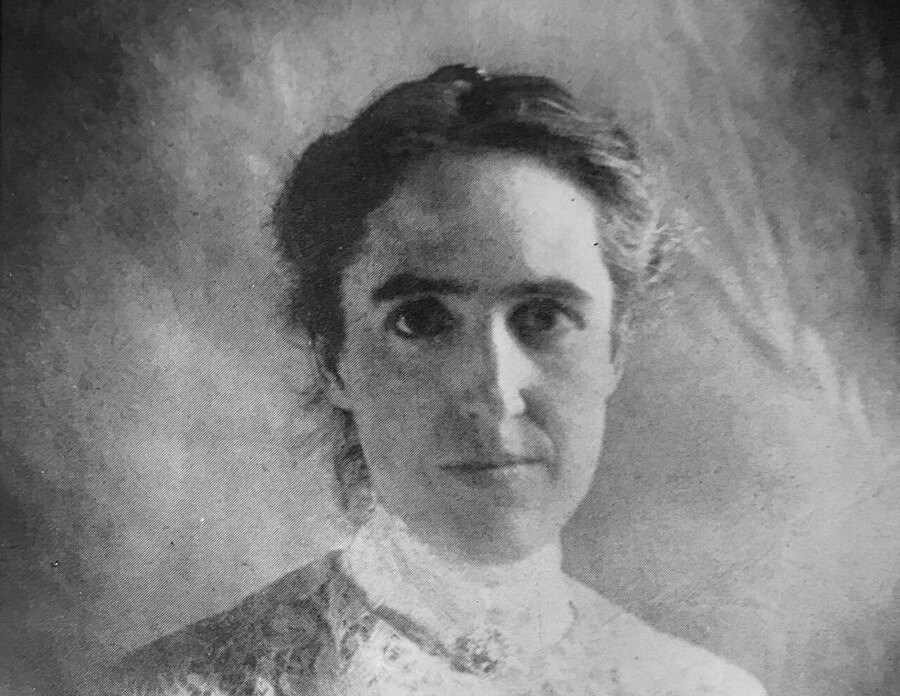 Next lessonThe people who changed the pictureFour astronomers of the 20th century, Henrietta Leavitt, Cecilia Payne, Jocelyn Bell and Vera Rubin, each saw something nobody expected, often with little credit at the time.
Words used here
- Gravity
- The pull that every mass has on every other mass.
- Orbit
- The path one body follows around another, held there by gravity.
- Orbital period
- The time taken to go once round an orbit.
- Ice giant
- A large planet made mostly of water, ammonia and methane under a hydrogen and helium atmosphere: Uranus and Neptune.
Where this comes from
- Wikipedia, Discovery of Neptune
- NASA Science, Neptune
- NASA NSSDC Neptune fact sheet
- Wikimedia Commons, Urbain Le Verrier, lithograph (public domain)
- Wikipedia, Urbain Le Verrier
- Wikipedia, John Couch Adams
- NASA NSSDC Uranus fact sheet
- Wikipedia, Neptune
- Wikipedia, Vulcan (hypothetical planet)
- Wikipedia, Planets beyond Neptune (Planet X and the discovery of Pluto)
- Batygin and Brown, Evidence for a distant giant planet in the Solar System (Astronomical Journal, 2016)
- Live Science, Planet Nine: is the search for this elusive world nearly over?

The words are written for this site. Sums in the text are worked from the figures in these sources.