Eighth planet · 30 au from the Sun
Neptune
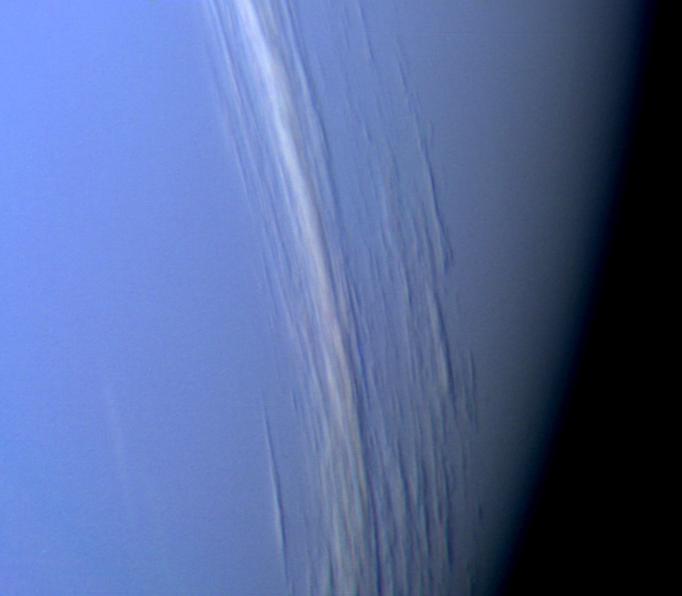
The farthest planet, thirty times as far from the Sun as we are, and the windiest. Fall in and you will come out above the clouds at 29° north, the same latitude where Voyager 2 photographed long white streaks throwing shadows on the cloud below.
Found with a pen
By the 1840s Uranus was drifting from where it should have been, as if something unseen was pulling on it. In France, Urbain Le Verrier worked out where that something had to be and wrote to Johann Galle at the Berlin Observatory. Galle looked on 23 September 1846 and found the planet the same night, within about a degree of the spot.
John Couch Adams in Cambridge had done much the same sums a little earlier, though nobody in England found it in time.
Wind on almost no sunlight
Neptune gets about a 900th of the sunlight we do, yet its winds are the fastest measured on any planet, up to about 2,000 km/h. That is quicker than sound travels through air on Earth.
Part of the answer is heat from inside. Neptune gives off more than twice as much energy as it takes in from the Sun, left over from when it formed. With so little friction near the top of the atmosphere, once the wind gets going not much slows it down.
Clouds with shadows
It is late afternoon at 29° north, and the Sun is a single hard point low in the west-south-west. The white streaks are methane ice, high above the main cloud deck. With the light coming in so low, each one lays a dark shadow across the deck beside it. Voyager 2 saw exactly this, two hours before its closest pass.
The blue is deeper than on Uranus, with less haze in the way. Somewhere above it is Triton, the largest moon, which goes round Neptune the wrong way, against the planet’s spin. That almost certainly means it was caught from somewhere further out rather than formed here.
A storm that went away
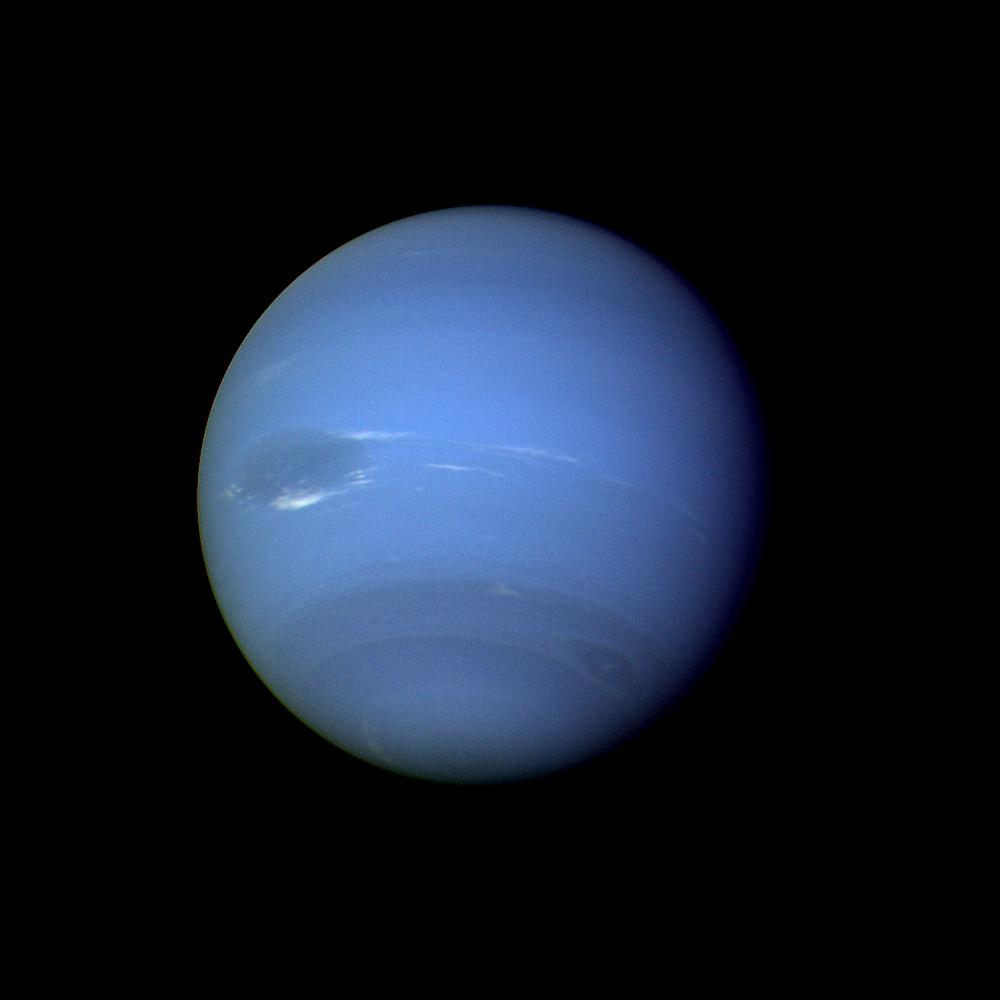
In August 1989 Voyager 2 found a dark oval in the southern half of the planet, about as wide as the Earth, with bright cloud riding along its edge. It was named the Great Dark Spot. When the Hubble Space Telescope looked in 1994, it had gone. Other dark spots have come and gone since.
Closest of all
On 25 August 1989 Voyager 2 passed about 4,950 km above Neptune’s north pole, the nearest it came to anything in its whole journey. Twelve years after launch it was still on time to within minutes. This was the last planet on its route, and nothing has been back to Neptune since.
In numbers
- Radius at the equator
- 24,764 km
- Radius at the poles
- 24,341 km
- Mass
- 102.4 × 10²⁴ kg
- Average density
- 1,638 kg/m³
- Distance from the Sun
- 30.1 au
- A year
- 165 years
- A day
- 16 h 7 min
- Axial tilt
- 28.32°
- Strongest winds
- about 2,000 km/h
- Known moons (NASA)
- 16
NASA NSSDC Neptune Fact Sheet and JPL orbital elements. A year on Neptune is so long that it only finished its first lap round the Sun since being found in July 2011.
The clouds here are generated. The Sun’s place in the sky is worked out from JPL Horizons for 29° north on the afternoon of 9 November 2026.