
Learn / White dwarfs, neutron stars and black holes
How it works
Cause and effect, with real numbers.
- First look
- How it works
- The physics, still to be written
- The frontier, still to be written
How it works
Cause and effect, with real numbers
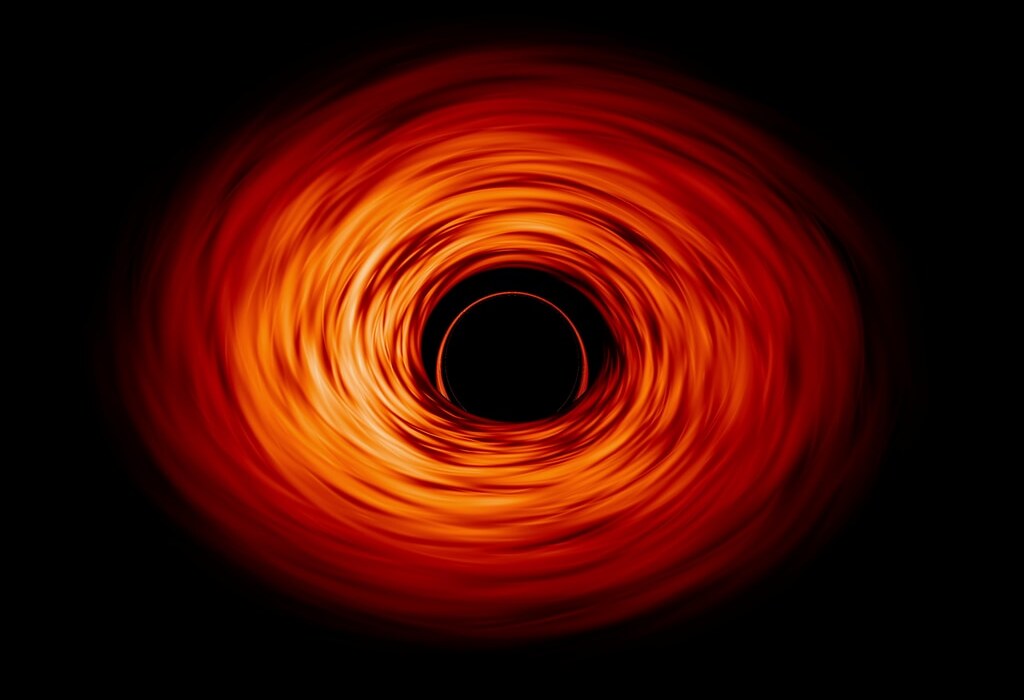
NASA’s two journeys. Both were worked out by Jeremy Schnittman and Brian Powell at NASA’s Goddard Space Flight Center and published on 6 May 2024. The black hole does not spin and has 4.3 million times the mass of the Sun, much like the one at the centre of the Milky Way.
| The plunge | The fly-by | |
|---|---|---|
| Start | About 640 million km out | The same |
| What happens | Nearly two orbits, then across the edge after about 3 hours | Two loops close to the edge, then away |
| The end | Pulled apart 12.8 seconds after crossing | Home after 6 hours, 36 minutes younger than those who waited |
Had the black hole been spinning fast, NASA adds, the traveller on the fly-by would have come home many years younger.
Why big is gentle. What stretches a falling body is the difference between the pull at its head and the pull at its feet. A black hole made from a dead star holds up to about 30 Suns and its edge is small, so that difference is enormous well outside the edge. A black hole of millions of Suns has an edge so wide that the pull hardly changes across the length of a person there. The NASA scientist who made the pictures put it plainly: given the choice, fall into a big one.
The two clocks. Clocks run slower where gravity is stronger. That is measured every day, on a small scale, by satellites round the Earth, and the lesson on gravity as bent space and time shows how. Near a black hole the effect is no longer small. A watcher far away sees the faller’s clock slow without limit, so they never see the crossing. The faller’s own clock keeps ordinary time all the way through.
What is at the middle. Einstein’s equations say everything that falls in is crushed to a point of no size at all, called the singularity. Equations that give an answer like that have usually been pushed past where they work. NASA’s own summary is that the singularity may be a real thing or only a sign that the mathematics is not finished. Nobody knows.
How far to trust this. No instrument has been near a black hole, so nothing here has been watched happening. It rests on general relativity, which has passed every test set for it so far, including the picture at the top of this lesson, where the size of the bright ring came out as the theory said it would.
Where this comes from
- NASA, New NASA black hole visualization takes viewers beyond the brink (6 May 2024)
- NASA Scientific Visualization Studio, Black hole accretion disk visualization (2019)
- NASA, Anatomy of a black hole
- NASA, Black holes
- ESO, Astronomers reveal first image of the black hole at the heart of our galaxy (12 May 2022)
The words are written for this site. Sums in the text are worked from the figures in these sources.