
Learn / White dwarfs, neutron stars and black holes
How it works
Cause and effect, with real numbers.
- First look
- How it works
- The physics, still to be written
- The frontier, still to be written
How it works
Cause and effect, with real numbers
Where the idea came from. In 1972 Jacob Bekenstein, a student at Princeton, argued that a black hole must have something like a temperature, or it would break one of the firmest laws of physics. Hawking thought this was wrong, since a thing with a temperature must glow and a black hole cannot. In 1973 he visited Moscow, where Yakov Zel’dovich and Alexei Starobinsky showed him why a spinning black hole ought to give off particles. He set out to do the sum properly and found that every black hole should glow, spinning or not. His paper came out in the journal Nature in 1974 under the title “Black hole explosions?”. The glow is called Hawking radiation.
How can anything come out? Nothing does come out from inside. The usual short explanation is this. Empty space is never quite empty: pairs of particles flicker into being and vanish again all the time. Right at the edge of a black hole, one of a pair can fall in while the other gets away. The one that gets away is the glow, and the black hole pays for it with a little of its mass. Physicists warn that this is a cartoon of the real sum, which is about how the black hole bends the waves that fill empty space. But it gives the right idea of where the energy comes from.
The temperatures. Hawking’s formula says the temperature goes down as the mass goes up. Double the mass and the temperature halves. These figures were worked out here from the formula. Temperatures are in kelvin, which counts up from the coldest possible.
| Black hole | Mass | Temperature |
|---|---|---|
| As heavy as the Sun | 1 Sun | 0.00000006 kelvin |
| The one at the centre of our galaxy | 4.3 million Suns | About two hundred million million times colder than space |
| The one in the galaxy M87 | 6.5 billion Suns | About 1,500 times colder again |
| One exactly as warm as space is today | Six-tenths of the Moon | 2.7 kelvin |
The last one would be about a tenth of a millimetre across. Nothing is known that could make a black hole so small today.
How long? The time a black hole takes to vanish goes as its mass multiplied by itself twice. Ten times the mass lasts a thousand times as long. For the Sun’s mass the figure is 2.1 followed by 67 noughts of years. For the largest black holes known, of about a hundred billion Suns, it is 2 followed by 100 noughts. Both are from Wikipedia’s article, the second from a calculation by Don Page in 1976. They leave out the long wait before space is cold enough for the shrinking to start.
The last second. With one second to go, a black hole has a mass of about 230 tonnes, the mass of a large aeroplane, packed into a space far smaller than an atom. All of it becomes energy: about 20 thousand million million million joules, or about 5 million megatonnes of TNT. That is about 100,000 times the largest bomb ever exploded. Worked out here from the formula, taking that bomb as 50 megatonnes. What happens at the very end nobody knows, because the sum stops working when the black hole is small enough.
The small ones. A black hole made at the birth of the universe with less than about 500 billion kilograms, the mass of a small mountain, would have gone by now. One with just that mass would be flashing out today. It would be about the size of a single proton. NASA’s Fermi telescope has been watching for such flashes in gamma rays since 2008 and by 2024 had found none.
Tests in the laboratory. In 2016 Jeff Steinhauer in Israel reported a matching effect in a cold fluid made to flow faster than sound moves through it, so that sound cannot escape from part of it. A faint hiss came from the edge, as Hawking’s sums said it should. This shows the mathematics works. It does not show that real black holes do the same.
The puzzle it left. If a black hole vanishes, what becomes of the record of everything that fell in? The glow, as Hawking worked it out, carries no trace of it. The rules of small things say that such a record can never be wiped out. This clash is called the information paradox. Hawking argued for years that the record is lost, and changed his mind in 2004. It is still not settled, and it is one of the best clues there is to a deeper theory.
Where this comes from
- Wikipedia, Hawking radiation
- S. W. Hawking, Black hole explosions?, Nature 248 (1974)
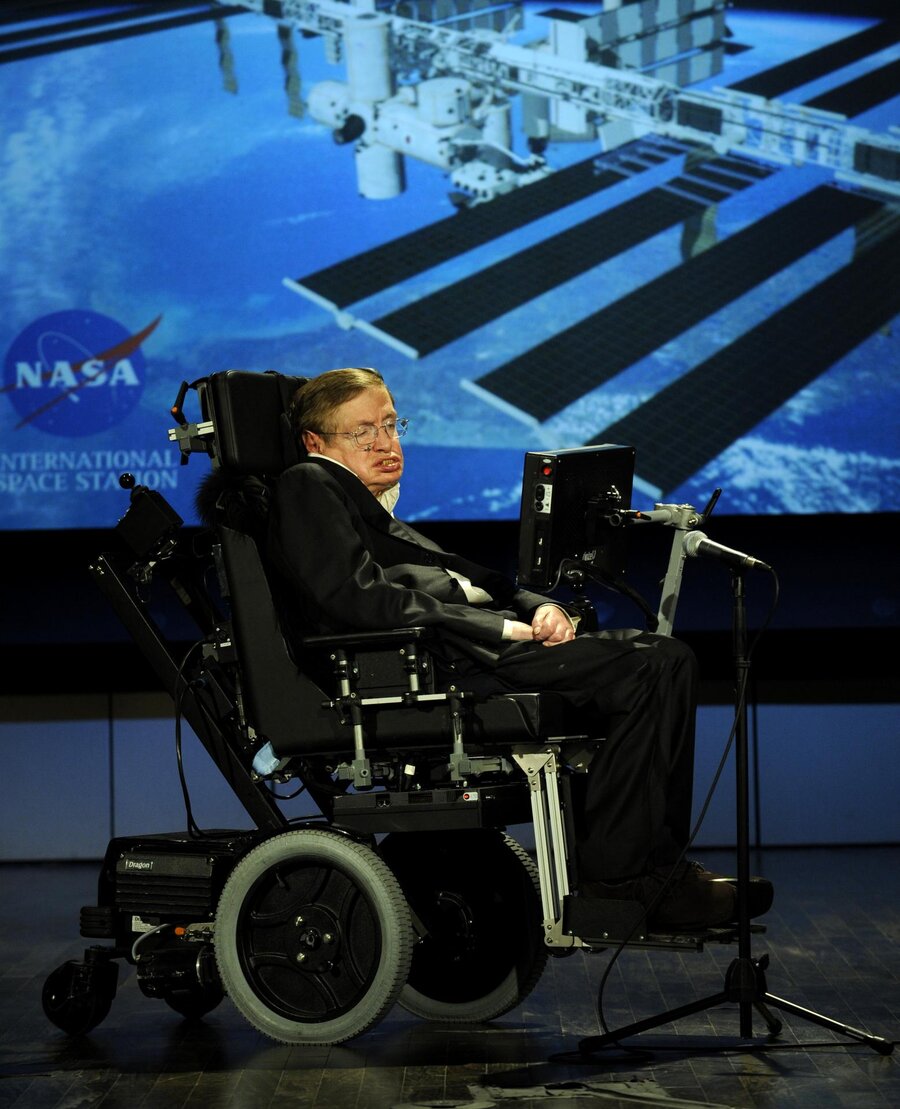
- NASA image library, Stephen Hawking at NASA's 50th anniversary lecture
- NASA image library, Fermi sees the gamma-ray sky
The words are written for this site. Sums in the text are worked from the figures in these sources.