
Learn / Stars
How it works
Cause and effect, with real numbers.
- First look
- How it works
- The physics, still to be written
- The frontier, still to be written
How it works
Cause and effect, with real numbers
The two limits. The upper limit is where ordinary hydrogen starts to burn steadily: about 80 times the mass of Jupiter, or about 0.08 of the mass of the Sun. Above it is a red dwarf. The lower limit is set by a rare, heavy kind of hydrogen called deuterium, which burns more easily. Anything above about 13 Jupiter masses can burn its deuterium for a while when young, and that is the usual line between a brown dwarf and a giant planet. It is a rule of thumb and not a sharp edge. Many astronomers would rather go by how a thing formed: a brown dwarf from a collapsing cloud, like a star, and a planet in the disc round a star.
How dense? Jupiter is 1.33 times as dense as water. Put 80 times the mass into the same space and you have about 106 times the density of water, where lead is 11.3. Worked out here, taking the brown dwarf to be exactly as wide as Jupiter.
The idea and the name. The Indian-born astronomer Shiv Kumar worked out in the 1960s that such objects should exist. He called them black dwarfs. Jill Tarter gave them the name brown dwarf in 1975, meaning a colour somewhere between red and black. They are not brown. To the eye most would probably look magenta or a deep dull red, because sodium and potassium in their air soak up green light.
1995. The first to be confirmed was Teide 1, in the cluster of stars called the Pleiades, found by Rafael Rebolo, María Rosa Zapatero-Osorio and Eduardo Martín. The test was lithium. A star destroys its lithium early on. Teide 1 still had its lithium, so its centre had never been hot enough. Gliese 229B was first seen from Palomar Observatory in California in October 1994 and photographed by the Hubble Space Telescope in November 1995. Its surface is at about 950 kelvin. In 2024 it turned out to be two brown dwarfs, of about 38 and 33 Jupiter masses, circling each other every 12 days only 16 times as far apart as the Earth and the Moon.
Sorted by temperature. Brown dwarfs are sorted into classes, each cooler than the last.
| Class | Surface temperature | What it is like |
|---|---|---|
| L | 1,300 to 2,100 kelvin | Glows dull red. Clouds of iron and rock dust |
| T | 600 to 1,300 kelvin | Methane in the air. Gliese 229B is the model for the class |
| Y | below 600 kelvin | Hardly glows at all. The coldest are no warmer than the Earth |
A brown dwarf does not stay in one class. As it cools it slides down the table, the heavier ones more slowly.
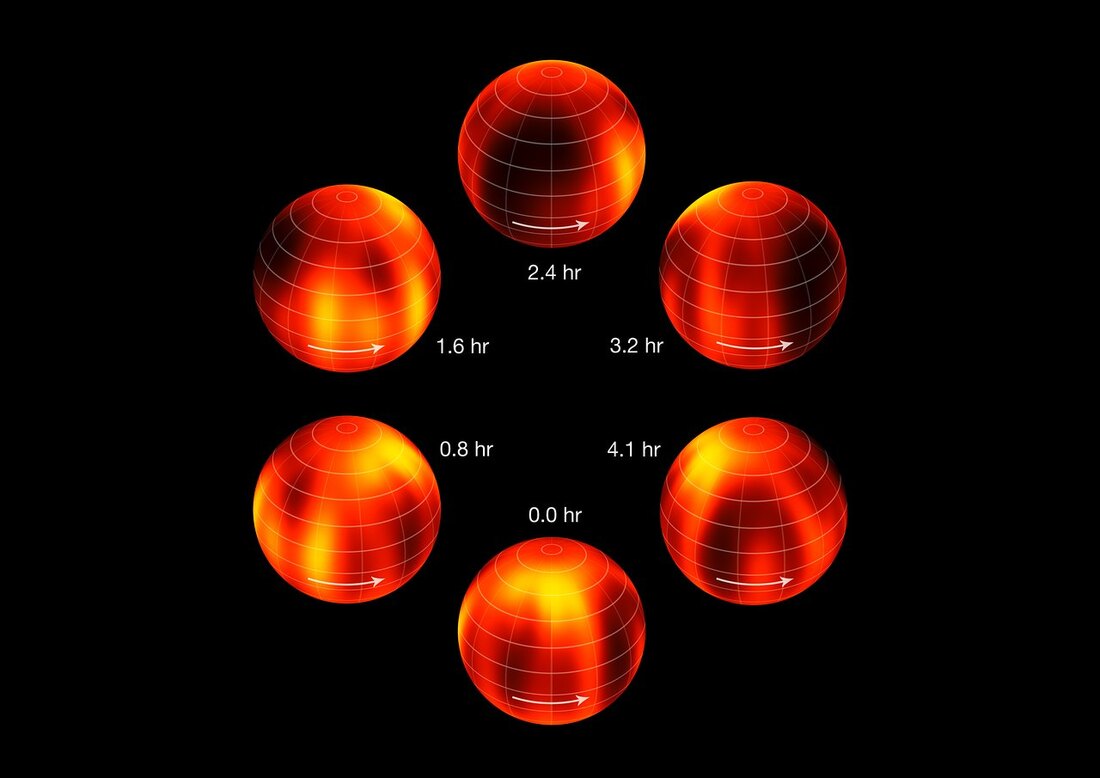
The nearest. Luhman 16 is a pair of brown dwarfs 6.5 light years away in the southern constellation Vela. Only the three stars of Alpha Centauri and Barnard’s Star are nearer. Kevin Luhman found the pair in 2013 in pictures taken by NASA’s WISE satellite, by looking for anything that had moved between one picture and the next. The two are about 35 and 29 times the mass of Jupiter, and circle each other every 27 years. The map was made by Ian Crossfield and others with the Very Large Telescope in Chile, by watching the brighter and darker patches turn into and out of view. The James Webb Space Telescope has since found water vapour, methane and clouds of fine rock grains at about 900 to 1,000 degrees Celsius.
The coldest. WISE 0855−0714 is 7.4 light years away, the fourth nearest system to the Sun, and was also found by Luhman, in 2014. Its temperature is about 276 to 285 kelvin. It has perhaps 3 to 10 times the mass of Jupiter, so by the rule of thumb it is no heavier than a large planet, drifting between the stars alone. Whether to call it a brown dwarf or a planet without a sun is a matter of taste.
The wind. The speed quoted is for a brown dwarf with the catalogue name 2MASS J1047+21, measured in 2020 at about 650 metres a second, give or take 310. That is about 2,300 km an hour. Worked out here.
Where this comes from
- Wikipedia, Brown dwarf
- Wikipedia, Gliese 229
- ESA/Hubble, Brown dwarf Gliese 229B
- Wikipedia, Luhman 16
- ESO, Surface map of Luhman 16B
- Wikipedia, WISE 0855-0714
The words are written for this site. Sums in the text are worked from the figures in these sources.