
Learn / What everything is made of
How it works
Cause and effect, with real numbers.
- First look
- How it works
- The physics, still to be written
- The frontier, still to be written
How it works
Cause and effect, with real numbers
The three pieces.
| Particle | Where | Electric charge | Mass |
|---|---|---|---|
| Proton | In the nucleus | Plus one | 1,836 times an electron |
| Neutron | In the nucleus | None | A shade more than a proton |
| Electron | Round the nucleus | Minus one | The lightest of the three |
An atom has as many electrons as protons, so its charges balance and it has none overall. The ratio of 1,836 is worked out here from the two measured masses.
How small. A typical atom is about 100 picometres across. A picometre is a millionth of a millionth of a metre. The nucleus is a few femtometres across, and a femtometre is a thousand times smaller again.
How it was found out. The word comes from the Greek “atomos”, which means “uncuttable”. Leucippus and his pupil Democritus used it in the fifth century BC, but theirs was a philosopher’s guess, not a measurement. The pieces were found much later. J. J. Thomson discovered the electron in 1897. Between 1908 and 1913 Ernest Rutherford and two colleagues, Hans Geiger and Ernest Marsden, fired fast particles at thin sheets of metal. Most went straight through, but a few bounced almost straight back, as if they had hit something small and very heavy. That was the nucleus. James Chadwick found the neutron in 1932.
Same element, different weights. Atoms of one element always have the same number of protons, but the number of neutrons can differ. These versions are called isotopes. Some are stable and some break up in time, giving out radiation. Of about 339 kinds of nucleus found in nature, 251 are stable. The heaviest element known, oganesson, has 118 protons and lasts only a moment.
The four forces.
| Force | Strength, with the strong force as 1 | Reach | What it does |
|---|---|---|---|
| Strong | 1 | About the width of a nucleus | Holds protons and neutrons together |
| Electric and magnetic | 1/137 | Without limit | Holds atoms together. Light is its messenger |
| Weak | About 1/100,000 | A thousand times less than the strong force | Turns one kind of particle into another, as in radioactive decay |
| Gravity | About 6 parts in a thousand million million million million million million | Without limit | Pulls all mass together |
The strengths are for particles very close together, and depend on how they are compared, so treat them as rough.
Deeper still. Protons and neutrons are not the smallest things. Each is made of three smaller particles called quarks, held together by the strong force. The force that holds a nucleus together is what is left over of that grip, reaching just beyond each proton and neutron to its neighbours. Electrons, as far as anyone can tell, are not made of anything smaller.
Two forces that are one. At very high energies, such as those of the first moments of the universe, the electric and magnetic force and the weak force behave as a single force. Physicists have long looked for a way to bring the strong force and gravity into the same scheme. Nobody has yet managed it, and nobody has found the particle that would carry gravity.
Not everything is atoms. All the atoms in all the stars, planets and gas clouds make up only about 5 per cent of what the universe holds. The rest is dark matter and dark energy, and what those are made of is unknown.
Where this comes from
- Wikipedia, Atom
- Wikipedia, Fundamental interaction
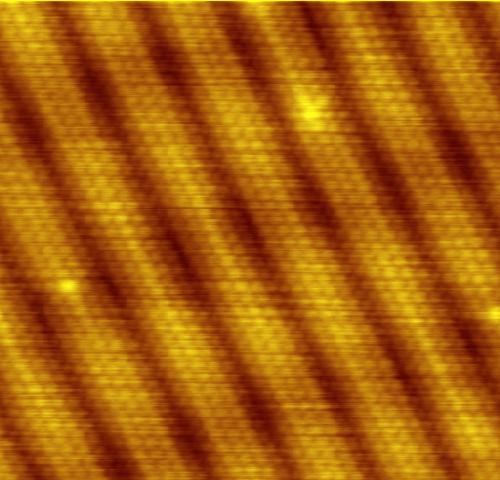
- Wikimedia Commons, Atomic resolution Au(100), by Erwin Rossen

The words are written for this site. Sums in the text are worked from the figures in these sources.