
Back to the Moon, and on to Mars
Nobody has stood on the Moon since 1972. The plans to go back aim for its south pole, where there is ice, and treat it as practice for Mars.
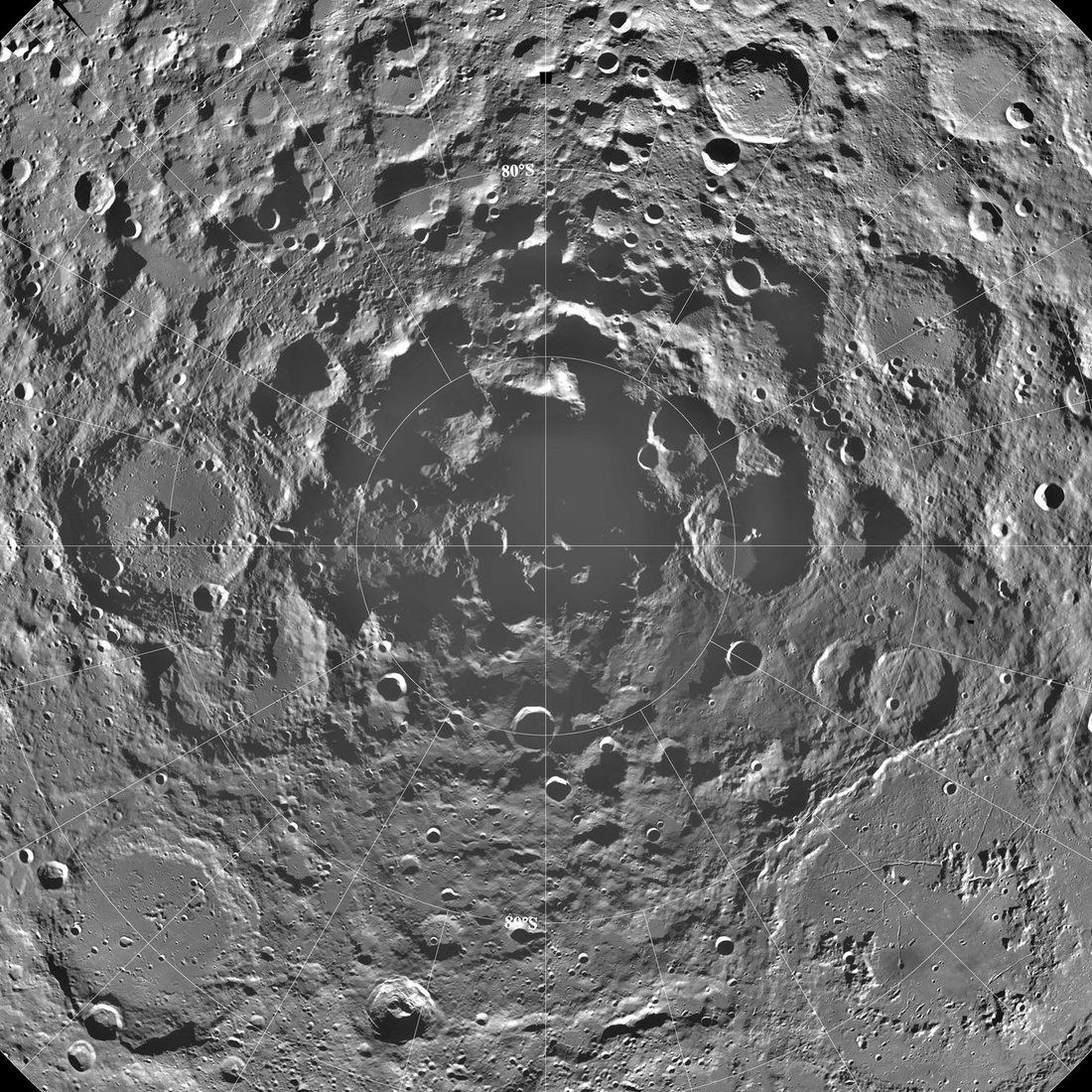
First look
The idea, in plain words
Twelve people walked on the Moon between July 1969 and December 1972. Then nobody went back. For more than fifty years every person who left the ground stayed within a few hundred kilometres of it, going round and round the Earth.
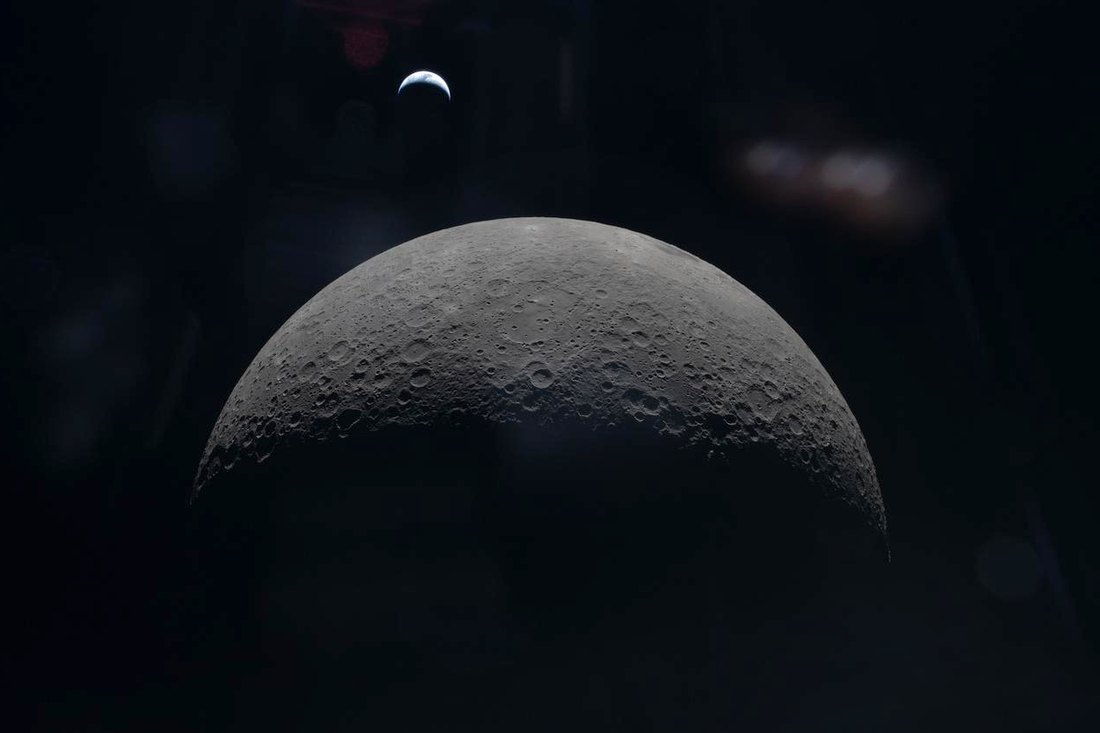
That changed in April 2026, when the four people of Artemis II flew round the far side of the Moon and came home. They did not land. Landing is the next step, and this time the plan is not just to visit but to stay.
Why go back at all? Apollo answered the first questions: what the Moon is made of, how old it is, and whether people could get there and home again. It did not answer whether people could live there. That needs water, air and fuel, and carrying them all from the Earth costs a fortune. Every kilogram has to be lifted out of the Earth’s gravity first.
Ice in the dark. The Moon’s axis is hardly tilted at all, so near its poles the Sun never climbs far above the horizon. The floors of some deep craters there have not seen sunlight for billions of years. They are among the coldest places known in the Solar System: some are colder than −230 °C.
In October 2009 a spacecraft called LCROSS fired a spent rocket stage into one of those craters, Cabeus, and flew through the cloud it threw up. The cloud held water. Other spacecraft have since found the signs of ice on the surface in the shadows round both poles.
Ice is the most useful thing that could be found there. Melted, it is water to drink. Split by electricity, it becomes oxygen to breathe and hydrogen, and those two together are rocket fuel. A base that can make its own fuel could also become a filling station for ships going further out.
The plan, as it stood in November 2026. NASA’s next crewed flight, Artemis III, is meant to stay close to home in 2027: astronauts will practise docking their Orion capsule with the landers that will one day take them down. The first landing is now planned for Artemis IV, in 2028, near the south pole. Two companies are building landers, SpaceX and Blue Origin. China is building its own rocket, capsule and lander, and aims to put two people on the Moon by 2030. All of these dates are plans, and plans in spaceflight often slip.
Then Mars. Mars is a very different journey. The Moon is about three days away. Mars is about seven months away, and a ship can only set off when the two planets line up, which happens about every 26 months. A crew could not turn round halfway. Once there they might have to wait more than a year for the planets to line up again for the trip home.
The air on Mars is thin, less than one hundredth as thick as the Earth’s, and almost all carbon dioxide. It cannot be breathed, but it can be used.
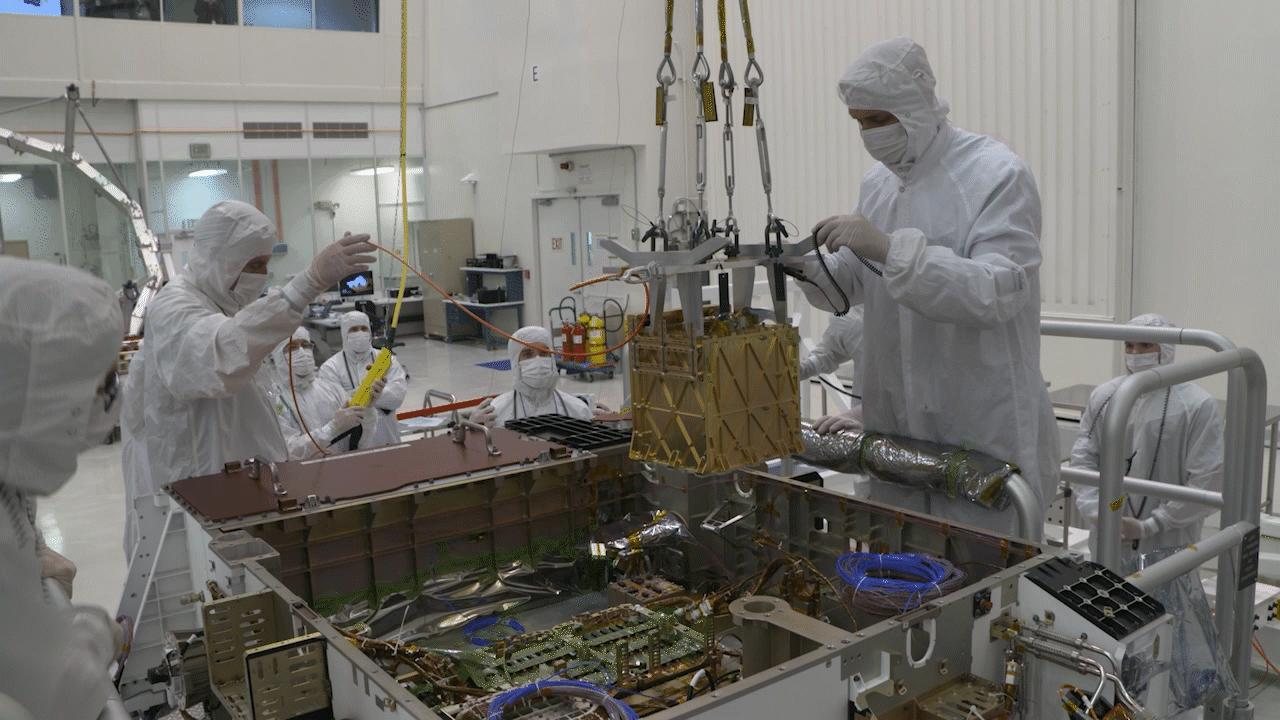
Between 2021 and 2023 MOXIE made oxygen on Mars sixteen times, 122 grams in all. That is about what a small dog breathes in ten hours. It is a tiny amount, but it was the first time anything useful had been made from another planet’s air. To fill the tanks of a rocket home, a crew would need a far bigger machine, and a way to turn the oxygen into a liquid and store it.
Two common mistakes. Going back to the Moon is not a repeat of Apollo. Apollo landed near the Moon’s equator, where it is easier to reach and well lit, and stayed a few days at most. The new plans aim for the poles because of the ice, and for stays that grow longer each time. And Mars is not just a longer trip to the Moon. Help from the Earth is months away, and even a radio message takes between about 3 and 22 minutes to arrive, so a crew there would have to solve their own problems.
How it works
Cause and effect, with real numbers
The plan, as it stood on 13 November 2026. Every date after today is a target, not a promise.
| Flight | What it is for |
|---|---|
| Artemis I, 16 November 2022 | No crew. The Orion capsule went round the Moon and came home |
| Artemis II, 1 to 10 April 2026 | Four people round the far side of the Moon and back, without landing |
| Artemis III, planned for 2027 | A crew stays in orbit round the Earth and practises docking Orion with test versions of the two landers |
| Artemis IV, planned for 2028 | The first landing since 1972, near the Moon’s south pole |
| Artemis V, planned for 2028 | The second landing, and the start of a base |
Until February 2026 Artemis III was to be the landing. NASA changed it to a test closer to home so that each new piece is tried before people depend on it. In March 2026 NASA also said it would pause the Gateway, a small station that was to circle the Moon, and put its hardware towards a base on the surface near the south pole instead.
The landers come from two companies. SpaceX’s is a version of its Starship. It is so big that it must be refilled with fuel in orbit round the Earth, by other Starships, before it can go to the Moon, and that refilling had not yet been done by November 2026. Blue Origin’s lander, Blue Moon, is smaller and is to be carried to the Moon by three smaller craft of its own. Both must land on the Moon without a crew before anyone rides in them.
China is following its own path. It is building a rocket, Long March 10, a capsule, Mengzhou, and a lander, Lanyue. In August 2025 a full-size Lanyue was tested on the ground, landing on a model of the Moon’s surface and taking off again. China aims to land two people by 2030.
Why fuel made on the Moon is worth so much. To leave a world for good, a spacecraft has to reach its escape velocity. From the Earth that is 11.2 km a second. From the Moon it is 2.38 km a second. The energy needed for each kilogram goes with the square of the speed, so lifting a kilogram clear of the Moon takes about 22 times less energy than lifting it clear of the Earth (a sum: 11.2 ÷ 2.38 = 4.7, and 4.7 × 4.7 = 22). There is no air on the Moon to push through either. Water, oxygen and fuel made there and sent onwards start with a huge head start.
How much water, and where. In October 2009 the LCROSS spacecraft steered its spent rocket stage into Cabeus, a crater near the south pole that never sees the Sun. LCROSS flew through the cloud of material thrown up and measured it before it hit the crater too. About 5.6 per cent of the material, by weight, was water. In 2018 a team reading data from an instrument on India’s Chandrayaan-1 spacecraft found the fingerprint of ice lying in the open, in shadowed places near both poles. How much ice there is in all, and how deep it goes, is still not known. Finding out is one of the main jobs for the robot landers going there first.
The shadows exist because the Moon hardly tilts. Its equator sits only about 1.5 degrees from the plane of its path round the Sun, compared with 23.4 degrees for the Earth. Near the poles the Sun always stays low, and deep crater floors stay dark for ever.
Turning water into air and fuel. Electricity splits water into hydrogen and oxygen. By weight, 9 kg of water gives 1 kg of hydrogen and 8 kg of oxygen, because an oxygen atom is 16 times heavier than a hydrogen atom and water has two hydrogens for each oxygen. That suits rockets well: an engine burning hydrogen uses several kilograms of oxygen for every kilogram of hydrogen. The same oxygen is what a crew breathes. The electricity has to come from somewhere. Near the pole there are ridges that are in sunlight most of the time, which is another reason to go there.
Living on the surface. Moon gravity is about a sixth of the Earth’s. The ground is covered in regolith, broken rock and dust that has never been worn smooth by wind or water. Its grains are sharp and cling to everything: the Apollo crews found it in their suits, their seals and their lungs. There is no air to stop the solar wind or fast particles from space, so a base would need shielding, perhaps by piling regolith on top. Away from the poles a night lasts about two weeks.
Getting to Mars. The planets move, so a ship aims for where Mars will be. The cheapest path is a transfer orbit, half an ellipse that touches the Earth’s orbit at one end and Mars’s at the other. The Earth must be in the right place for that path to meet Mars, and that happens about every 26 months, because that is how long the Earth takes to catch up with Mars again. Perseverance left on 30 July 2020 and landed on 18 February 2021, 203 days later.
A long way to call home. Mars is 54.6 million km from the Earth at the very closest and about 401 million km at the furthest. Radio travels at the speed of light, so a message takes between about 3 minutes and 22 minutes (a sum: 401,000,000 km ÷ 299,792 km a second = 1,338 seconds, or 22.3 minutes). A question and its answer take twice that. For the Moon the light-time is 1.3 seconds.
Radiation on the way. On its way to Mars in 2011 and 2012, the Curiosity rover carried a radiation counter inside its spacecraft. From what it measured, a round trip of about 360 days in space, not counting any time on Mars, would give a person about 0.66 sieverts. NASA now limits the dose over an astronaut’s whole career to 0.6 sieverts, the same for everyone whatever their age or sex. So the journey alone would use up more than a career’s limit, unless better shielding or a faster trip can be found, or the limit is set aside for such a mission.
Landing heavy things. The heaviest thing yet landed on Mars is Perseverance, at about 1,025 kg. Mars has enough air to heat a spacecraft coming in fast, but too little to slow a heavy one down with parachutes alone, so Perseverance was lowered the last part of the way on cables by a hovering rocket crane. A crewed ship with its supplies would weigh many tonnes, and nobody has yet landed anything near that size on Mars.
Air on Mars. The air on Mars is about 95 per cent carbon dioxide, at less than one hundredth of the pressure on the Earth. Between 2021 and 2023 MOXIE, on board Perseverance, pulled in that air, split the carbon dioxide and kept the oxygen. It ran 16 times and made 122 grams, at best 12 grams an hour and at least 98 per cent pure. The next step would be a machine big enough to fill the tanks of a rocket home, with a way to turn the oxygen to liquid and store it.
Two common mistakes. The Moon’s ice is not a frozen lake. Where it has been measured it is mixed into the soil, a few per cent by weight, and getting it out means digging, heating and cleaning. And a Mars mission cannot simply leave whenever it is ready. If it misses the window, it waits about two years for the next one.
In the 3D view
Real photographs of the Moon's south pole from above, of the Earth over the far side of the Moon from Artemis II, and of the oxygen maker going into the Perseverance rover before it flew to Mars.
Not built yet. This lesson will be able to fly you there.
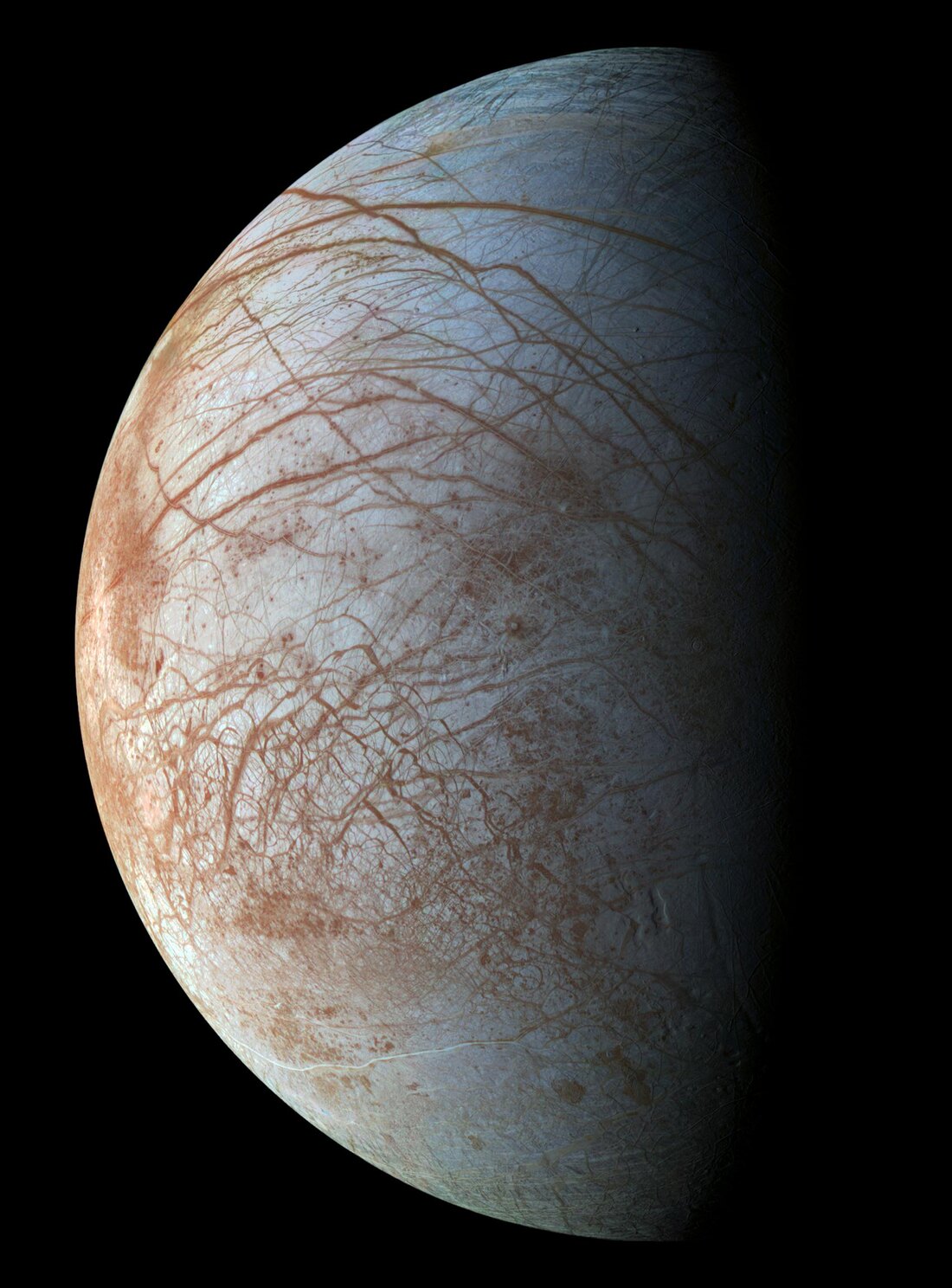 Next lessonLooking for life in the Solar SystemFour places near home might hold life or the remains of it: Mars, Europa, Enceladus and Titan. Spacecraft have been to all four, and more are on the way.
Words used here
- Transfer orbit
- The path a spacecraft coasts along to get from one orbit to another, most cheaply half of an oval that touches both.
- Light time
- How long light takes to cross a gap, used as a way of saying how big the gap is.
- Regolith
- The layer of loose dust and broken rock that covers the solid ground of an airless world.
- Escape velocity
- The speed needed to leave a body for good without any further push.
- Solar wind
- A stream of charged particles that blows outward from the Sun all the time.
- Orbit
- The path one body follows around another, held there by gravity.
Where this comes from
- NASA, Artemis
- Wikipedia, Artemis program
- SpacePolicyOnline, NASA is full steam ahead on Artemis III, IV and V (23 October 2026)
- Wikipedia, LCROSS
- NASA, NASA's oxygen-generating experiment MOXIE completes Mars mission (2023)
- NASA, Perseverance instruments: MOXIE
- NASA image library, Clementine mosaic of the Moon's south pole (PIA00001)
- NASA image library, Engineers lower MOXIE into Perseverance (PIA24176)
- Wikipedia, Artemis I
- Wikipedia, Artemis II
- The Register, NASA ditches the Lunar Gateway (24 March 2026)
- CGTN, China gears up for crewed Moon landing by 2030 (28 February 2026)
- Li and others, Direct evidence of surface exposed water ice in the lunar polar regions (PNAS, 2018)
- NASA NSSDC Moon fact sheet
- NASA NSSDC Mars fact sheet
- Zeitlin and others, Measurements of energetic particle radiation in transit to Mars on the Mars Science Laboratory (Science, 2013)
- NASA Office of the Chief Health and Medical Officer, Radiation protection technical brief
- Wikipedia, Perseverance (rover)
- NASA image library, Crescent Earth over the lunar horizon, Artemis II (art002e015231)
The words are written for this site. Sums in the text are worked from the figures in these sources.