Fourth planet · 1.52 au from the Sun
Mars
Half the width of Earth, cold, dry and very quiet. Keep scrolling and you will fall all the way to the ground.
Two small moons
Phobos is about 27 km long and shaped like a potato someone sat on. It goes round Mars in under eight hours, faster than Mars turns, so from the ground it rises in the west and sets in the east, more than twice a day.
It is also falling inwards, by around two metres a century. In some tens of millions of years it will break apart or hit the surface. Deimos, the other moon, is smaller and much farther out.
Moons drawn larger than life so you can see them. Their orbits are to scale.
Going down is the hard part
Mars has an atmosphere, but only just. At the surface the pressure is about 0.6 per cent of Earth’s. That is too much air to ignore and far too little to land on parachutes alone, which is why most missions to the surface have failed or nearly did.
The sky is the wrong colour
Fine dust hangs in the air all year, and it turns the daytime sky a pale butterscotch. Near the Sun it goes the other way: the dust scatters light so that sunsets are blue.
The Sun is two-thirds the width it is from Earth. The air is 95 per cent carbon dioxide and so thin that a fast Martian wind pushes on you about as hard as a breeze at home.
Big, but not how it looks in pictures
Olympus Mons is the tallest volcano we know of, about 22 km high and about 600 km across. Drawn to scale, it is a long, low swell. Its slopes climb at roughly five degrees, so if you stood on one you would not know you were on a mountain.
Valles Marineris, the great canyon, runs for about 4,000 km and goes down as far as 7 km. Fly the length of it and you cross a distance like London to Kabul.
It was wet here once
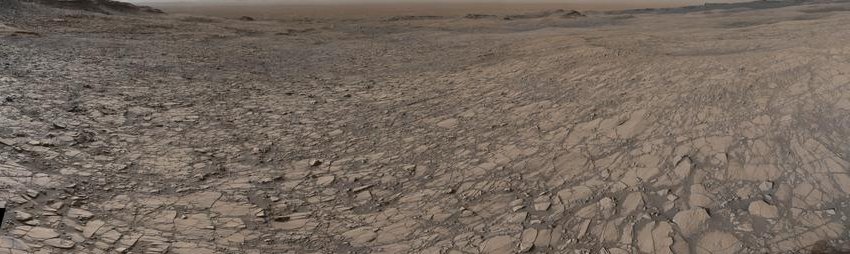
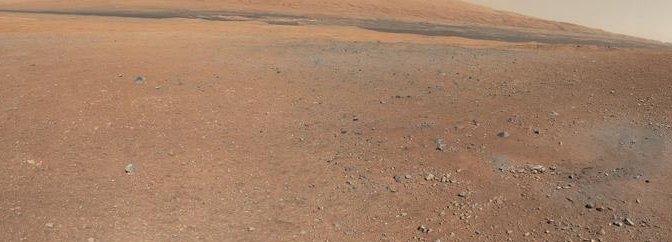
Curiosity has been driving across Gale Crater since 2012. The rock under its wheels is mudstone, laid down in the silt of a lake that existed some 3.5 billion years ago. Most of Mars’s water is now ice at the poles and underground.
In numbers
- Radius
- 3,390 km
- Mass
- 0.6417 × 10²⁴ kg
- Gravity at the surface
- 3.73 m/s²
- Distance from the Sun
- 1.524 au
- A year
- 687 days
- A day
- 24.7 hours
- Axial tilt
- 25.19°
- Average temperature
- −59 °C
- Moons
- 2
NASA NSSDC Mars Fact Sheet and JPL orbital elements. Missions to Mars so far include Viking, Pathfinder, Spirit, Opportunity, Curiosity, Perseverance, Tianwen-1 and Hope.
The ground and sky here are generated, modelled on Curiosity’s view in Gale Crater at dusk: Mount Sharp to the left, low flat-topped buttes in front, the crater rim on the far horizon.